
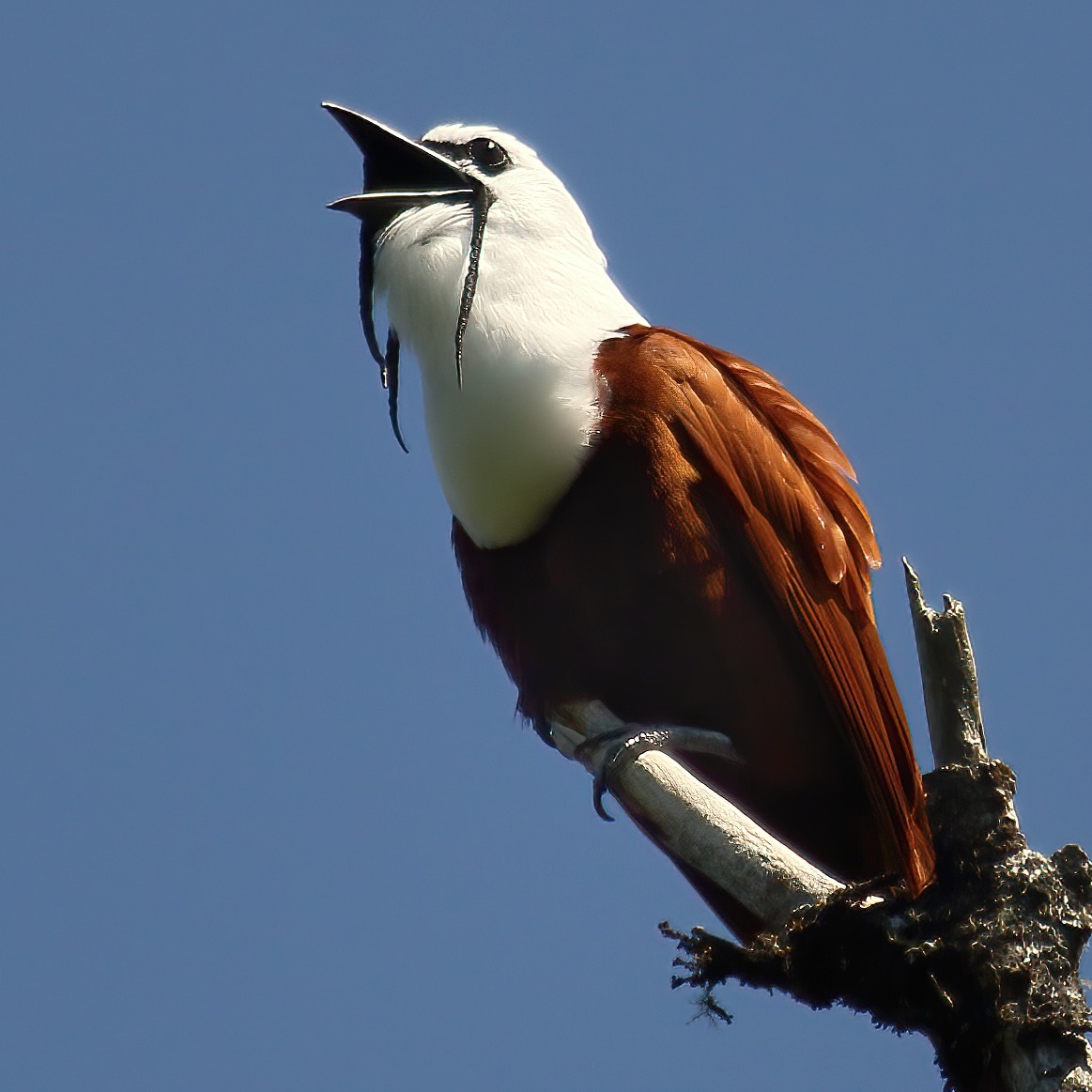
Procnias tricarunculatus
Three-wattled Bellbird
(J. Verreaux & E. Verreaux, 1853)
Added by
Anonymous Curator
Reviewed by
Under Review
Last modified by
Julia Trouin
TaxonomyBiological classification ranks placing this species within the tree of life, from Kingdom down to Genus.
Ecology & StatusHow this species lives: habitat preferences, diet, behavior, population status, and role in its ecosystem.
OriginWhether the species is native (evolved here), endemic (found only here), or introduced by human activity.
Native
Population TrendDirection of change in population size over time: increasing, stable, decreasing, or unknown.
Decreasing
Breeding SeasonTime of year when this species typically reproduces or flowers.
Dry Season
Trophic RolePosition in the food chain: producer, herbivore, carnivore, omnivore, decomposer, or parasite.
Frugivore
Recent SightingsWhether this species has been observed in the wild in Costa Rica within recent years.
Yes
Habitat SummaryOverview of the specific ecosystems and environments where this species is found in Costa Rica. Multi-lang
It is an endemic species of Central America (from Honduras to Panama) and a strict altitudinal migrant. During the breeding season, it inhabits the canopy of mature cloud forests and montane forests between 1,200 and 2,500 meters above sea level (such as in Monteverde, Costa Rica). After breeding, it undertakes complex migrations to lowlands and coastal areas (including mangroves and gallery forests) on both the Pacific and Caribbean slopes to seek food during the rainy season.BehaviourDaily activity patterns, movement, territory use, foraging style, and seasonal behavioral changes. Multi-lang
Males spend most of their day in the tops of the cloud canopy. To attract females, they perch on a dry, exposed branch of a very tall tree that acts as a stage (dispersed lek). When a female approaches, the male performs a short, noisy flight, crouches on the branch, opens his bill immensely, shakes his wattles, and emits a deafening squeak followed by a forceful metallic sound ('scraaaack... BONG!'). The force of the sound is so great that the bird is often thrown backward on the branch.Social ActivitySocial structure: whether the species is solitary, paired, or colonial; hierarchy and communication. Multi-lang
Despite gathering in dispersed singing areas to compete for females (leks), they are generally solitary birds, especially during migration and foraging. Females assume a completely solitary life to raise their chicks.Feeding GuildWhat the species eats, how it forages or hunts, and its role as a consumer in the food web. Multi-lang
Canopy frugivore / Seed disperser.Trophic Chain DetailsSpecific interactions in local food webs: prey species, predators, competitors, and scavengers. Multi-lang
Strict frugivore. Its diet is overwhelmingly based (over 90%) on fruits of the Lauraceae family (Ocotea, Persea, Nectandra), which are rich in lipids. By swallowing the drupes whole and then spitting out the seed far from the mother tree, the bellbird acts as one of the most important forest engineers and seed dispersers of the cloud forest. Adults do not have many predators due to their size, but their eggs and chicks are highly vulnerable to capuchin monkeys, coatis, and toucans.Reproductive BehaviourMating strategies, courtship displays, nesting or spawning behavior, and parental care. Multi-lang
They are not monogamous. A single successful male in the lek can mate with multiple females throughout the season. Once fertilized, the female departs and assumes absolutely all parental duties. She builds an incredibly flimsy and transparent cup nest using fine twigs and dry tendrils, usually placed in the frond of a tree fern or dense shrub in the understory (2-5 meters high). She lays a single, heavily mottled brown egg. The female incubates it alone for about 20 days. After hatching, she feeds the single chick a diet composed almost exclusively of regurgitated wild avocados, until it leaves the nest about 4 weeks later.Physical Measures
Length (cm)
25.0 - 30.0 cm
Weight (Grams)
140 g - 220 g
Lifespan
Sexual MaturityAge at which the individual becomes capable of reproducing for the first time.
24 - 48 Months
Gestation / IncubationDuration from fertilization to birth (mammals) or to hatching (egg-laying species).
19 - 21