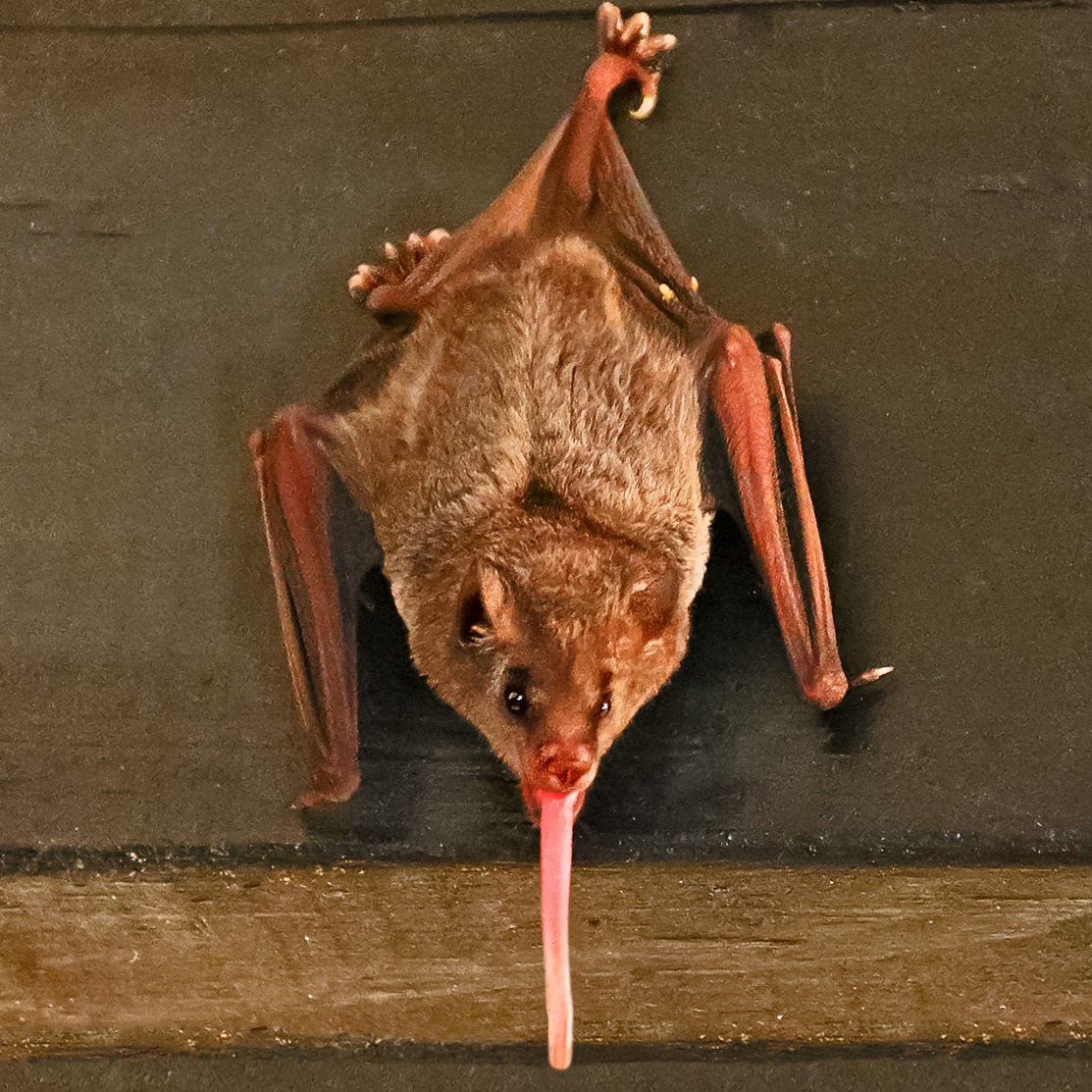
Glossophaga soricina
Pallas's Long-tongued Bat
(Pallas, 1766)
Added by
Anonymous Curator
Reviewed by
Under Review
Last modified by
Julia Trouin
TaxonomyBiological classification ranks placing this species within the tree of life, from Kingdom down to Genus.
Ecology & StatusHow this species lives: habitat preferences, diet, behavior, population status, and role in its ecosystem.
OriginWhether the species is native (evolved here), endemic (found only here), or introduced by human activity.
Native
Population TrendDirection of change in population size over time: increasing, stable, decreasing, or unknown.
Stable
Breeding SeasonTime of year when this species typically reproduces or flowers.
Year Round
Trophic RolePosition in the food chain: producer, herbivore, carnivore, omnivore, decomposer, or parasite.
Herbivore
Recent SightingsWhether this species has been observed in the wild in Costa Rica within recent years.
Yes
Habitat SummaryOverview of the specific ecosystems and environments where this species is found in Costa Rica. Multi-lang
It is a highly ubiquitous species tolerant of human modification. It inhabits primary and secondary rainforests, dry forests, savannas, and is very common in agricultural areas and urban gardens where there are night-blooming plants. To rest during the day, it forms colonies in dark places such as caves, tunnels, mines, hollow logs, and frequently in the roofs of abandoned or inhabited houses. In Costa Rica, it is found practically throughout the country, from both coasts to middle elevations.BehaviourDaily activity patterns, movement, territory use, foraging style, and seasonal behavioral changes. Multi-lang
They begin foraging immediately after sunset. They fly rapidly among plants, hovering in front of bell-shaped flowers to plunge their snout and tongue inside. By doing so, their head and chest get covered in pollen, which they then transport to the next flower. Because nectar lacks sufficient protein, this bat actively eats the pollen itself (grooming it from its fur) and hunts small insects in flight. Their spatial memory is exceptional, remembering the exact location of flowers that open each night.Social ActivitySocial structure: whether the species is solitary, paired, or colonial; hierarchy and communication. Multi-lang
Gregarious. Forms colonies ranging from small groups of 5-10 individuals to aggregations of hundreds or thousands in large caves, often sharing the roost with other bat species peacefully.Feeding GuildWhat the species eats, how it forages or hunts, and its role as a consumer in the food web. Multi-lang
Nectarivore / Pollinivore (with frugivorous and insectivorous tendencies).Trophic Chain DetailsSpecific interactions in local food webs: prey species, predators, competitors, and scavengers. Multi-lang
Primary consumer (Nectarivore) and secondary (Insectivore). Key pollinator of the nocturnal forest. It is hunted by owls, arboreal snakes, giant tarantulas, and large carnivorous bats.Reproductive BehaviourMating strategies, courtship displays, nesting or spawning behavior, and parental care. Multi-lang
Seasonal bimodal polyestry. Females have two pups a year (one per birth), synchronizing births with the peak flowering season. Gestation lasts about 105 to 115 days. Pups are born hairless and blind. During the first few weeks, the mother carries her pup attached to her chest during flight, but as it gains weight, she leaves it in the colony while foraging.Physical Measures
Length (cm)
4.5 - 6.0 cm
Weight (Grams)
8 g - 15 g
Lifespan
Sexual MaturityAge at which the individual becomes capable of reproducing for the first time.
8 - 12 Months
Gestation / IncubationDuration from fertilization to birth (mammals) or to hatching (egg-laying species).
105 - 115