
Costa Rica Species
Iriartea deltoidea
PlantaeHighest rank in taxonomy. Groups all life into domains: Animalia, Plantae, Fungi, etc.IUCN LCInternational Union for Conservation of Nature — the world authority on species extinction risk, using standardized criteria. — Least Concern — widespread and abundant; not at immediate risk of extinction.In ProgressCurrent stage of this record in the editorial review workflow. Recent Sighting

Iriartea deltoidea

Stilt Palm / Walking Palm

Ruiz & Pav., 1798

Detailed Texts Multi-lang
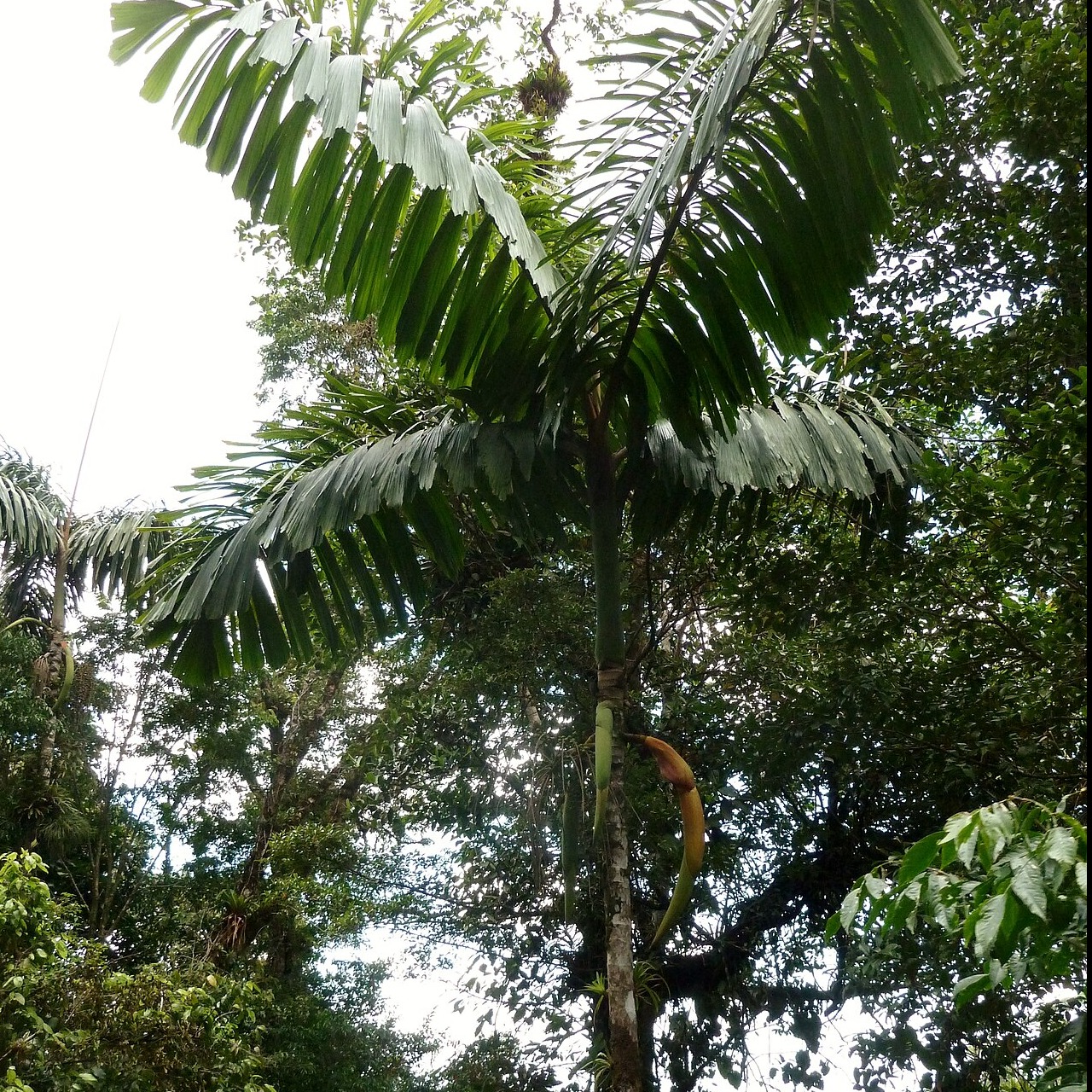
Iriartea deltoidea is one of the most majestic and structurally fascinating palms in the Neotropics. It is immediately distinguished by its impressive cone of stilt roots at the base, which can elevate the trunk more than a meter above the ground, forming a dense network of prickly roots. The trunk is solitary, smooth, grayish, and often features a characteristic bulge (belly) in the middle or upper part. It can reach heights of up to 25 or 30 meters (80-100 feet). Its leaves are pinnate, 3 to 5 meters long, with deltoid-shaped (triangular) leaflets and ragged apices, arranged in several planes, giving the frond a feathery and disordered appearance. The inflorescence is large, branched, and pendulous, initially protected by a horn-shaped bract. Its fruits are globose, greenish-brown when ripe, and contain a single hard seed. It is a dominant species that defines the architecture of very wet forests.

Added by

Anonymous Curator

Reviewed by

Under Review

Last modified by

Julia Trouin

TaxonomyBiological classification ranks placing this species within the tree of life, from Kingdom down to Genus.

PhylumRank below Kingdom. Groups organisms sharing a fundamental body plan (e.g., Chordata = vertebrates and some invertebrates).Tracheophyta
ClassRank below Phylum. Subdivides by structural traits (e.g., Mammalia, Aves, Reptilia, Insecta).Liliopsida
OrderRank below Class. Groups related families sharing common ancestry (e.g., Carnivora, Primates).Arecales
FamilyRank below Order. Groups closely related genera (e.g., Felidae = cats, Canidae = dogs).Arecaceae
GenusRank just above Species. The first word in the two-part binomial scientific name.Iriartea
Taxonomic AuthorityThe scientist who first formally described and published this species, followed by the year of publication.Ruiz & Pav., 1798
Record Completeness
84%
Coming soon

Ecology & StatusHow this species lives: habitat preferences, diet, behavior, population status, and role in its ecosystem.

OriginWhether the species is native (evolved here), endemic (found only here), or introduced by human activity.

Native

Population TrendDirection of change in population size over time: increasing, stable, decreasing, or unknown.

Stable

Trophic RolePosition in the food chain: producer, herbivore, carnivore, omnivore, decomposer, or parasite.

--

Growth HabitPhysical form and structure of the plant: tree, shrub, herb, vine, epiphyte, aquatic, etc.

--

Leaf TypeLeaf characteristics: deciduous (seasonal shed), evergreen, simple, compound, needle-like, etc.

--

Flowering SeasonTime of year when this species typically reproduces or flowers.

Year Round

Recent SightingsWhether this species has been observed in the wild in Costa Rica within recent years.

Yes

Habitat SummaryOverview of the specific ecosystems and environments where this species is found in Costa Rica. Multi-lang

It inhabits very wet tropical rainforests of lowlands and premontane slopes, from sea level up to 1,300 meters (4,200 feet) in altitude. It prefers deep, well-drained soils, although it is very common in broken topography terrain. It is one of the most abundant palms in the Neotropics, ranging from Nicaragua to Bolivia and the Amazon basin. In Costa Rica, it is a dominant canopy component in the Caribbean and Southern Pacific (Osa) lowlands.

Light & Water NeedsSunlight intensity and moisture levels this plant needs to grow and reproduce successfully. Multi-lang

Information not available in English. Help us expand this record!

BehaviourDaily activity patterns, movement, territory use, foraging style, and seasonal behavioral changes. Multi-lang

It is a structural canopy species. Its stilt roots create a complex microhabitat under the trunk where reptiles, amphibians, and invertebrates take refuge. It produces large amounts of biomass that nourish the forest floor. Its flowering and fruiting are massive events that attract a large community of animals, being a pillar in the jungle food web.

Toxicity / UsesToxic compounds present and their documented effects on humans or other organisms. Multi-lang

Information not available in English. Help us expand this record!

Physical Measures

Length (cm)

1500.0 - 3000.0 cm

Reproductive StructuresFlowers, fruits, and seeds — the reproductive organs and their seasonal appearance.

Flower Photos (Max 2)

No image

Fruit Photos (Max 2)

No image

Evolutionary AdaptationsInherited traits and behaviors that improve the species' survival and reproduction in its specific environment. Multi-lang

Stilt Root Cone: The stilt root system not only provides immense mechanical stability in often unstable rainforest soils but also allows the palm to rapidly elevate its trunk above temporary flood levels and leaf litter accumulation, facilitating gas exchange.
Belly or Trunk Bulge: It has been suggested that the trunk bulge acts as a reservoir for starch and water, allowing the palm to maintain vertical growth and the production of heavy inflorescences even during brief fluctuations in resource availability.

Main ThreatsDocumented pressures reducing the population: habitat loss, hunting, disease, climate change, and invasive species. Multi-lang

Timber overexploitation: Although not true wood, its trunk is extremely hard at the periphery and is used for building floors, walls, and crafts (known as 'palm wood'). Unregulated extraction can decimate local populations.

Interesting FactsSurprising or notable facts that highlight what makes this species unique or ecologically important. Multi-lang

The tree that 'walks': There is a popular myth that walking palms (like Iriartea and Socratea) can move toward light by growing new roots. While they don't physically move, the stilt root system is a marvel of biological engineering allowing them to thrive in terrains where other trees would fall.