
Costa Rica Species
Manta birostris
AnimaliaHighest rank in taxonomy. Groups all life into domains: Animalia, Plantae, Fungi, etc.IUCN ENInternational Union for Conservation of Nature — the world authority on species extinction risk, using standardized criteria. — Endangered — faces a very high risk of extinction if threats are not urgently addressed.In ProgressCurrent stage of this record in the editorial review workflow. Recent Sighting

Manta birostris

Giant Oceanic Manta Ray

(Walbaum, 1792)

Detailed Texts Multi-lang
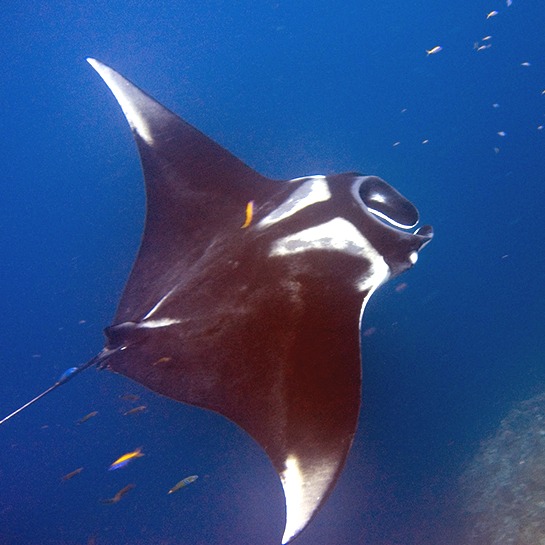
The giant oceanic manta ray is a harmless titan of the pelagic seas, a masterpiece of hydrodynamic evolution. Its monumental body, markedly flattened and rhomboidal in silhouette, extends into colossal triangular pectoral fins that can exceed a 7-meter wingspan, propelling it through the water with a graceful swimming motion that emulates the flight of a majestic bird. Its dorsal coloration is typically jet black or dark gray, adorned on the shoulders with unmistakable pale, wedge-shaped or chevron patches, while its immaculate white belly boasts a unique pattern of dark spots, unrepeatable in each individual, functioning as a biological fingerprint. The most iconic anatomical feature of its broad head are the cephalic lobes: muscular, horn-like extensions projecting on either side of its enormous terminal mouth. Unlike benthic stingrays, the giant manta completely lacks a venomous stinger on its slender, whip-like tail, relying exclusively on its immense size and burst speed for defense.

Added by

Anonymous Curator

Reviewed by

Under Review

Last modified by

Julia Trouin

TaxonomyBiological classification ranks placing this species within the tree of life, from Kingdom down to Genus.

PhylumRank below Kingdom. Groups organisms sharing a fundamental body plan (e.g., Chordata = vertebrates and some invertebrates).Chordata
ClassRank below Phylum. Subdivides by structural traits (e.g., Mammalia, Aves, Reptilia, Insecta).Elasmobranchii
OrderRank below Class. Groups related families sharing common ancestry (e.g., Carnivora, Primates).Myliobatiformes
FamilyRank below Order. Groups closely related genera (e.g., Felidae = cats, Canidae = dogs).Mobulidae
GenusRank just above Species. The first word in the two-part binomial scientific name.Manta
Taxonomic AuthorityThe scientist who first formally described and published this species, followed by the year of publication.(Walbaum, 1792)
Record Completeness
56%
Coming soon

Ecology & StatusHow this species lives: habitat preferences, diet, behavior, population status, and role in its ecosystem.

OriginWhether the species is native (evolved here), endemic (found only here), or introduced by human activity.

Native

Population TrendDirection of change in population size over time: increasing, stable, decreasing, or unknown.

Decreasing

Breeding SeasonTime of year when this species typically reproduces or flowers.

Summer

Trophic RolePosition in the food chain: producer, herbivore, carnivore, omnivore, decomposer, or parasite.

Carnivore

Recent SightingsWhether this species has been observed in the wild in Costa Rica within recent years.

Yes

Habitat SummaryOverview of the specific ecosystems and environments where this species is found in Costa Rica. Multi-lang

It is a solitary wanderer of the circumglobal pelagic waters, dominating the tropical, subtropical, and warm temperate oceanic belts. Although its life is mostly spent cruising the infinite blue of the open ocean at considerable distances from the coast, it makes periodically calculated migrations toward isolated seamounts, rocky pinnacles, and oceanic coral atolls, such as the remote waters of Cocos Island in Costa Rica. These neritic sanctuaries not only offer seasonal explosions of nutrients pushed by frigid upwelling currents, but they also serve as vital 'cleaning stations,' where mantas gather to allow cleaner wrasses to free them of parasites in one of the most beautiful symbiotic rituals of the ocean.

BehaviourDaily activity patterns, movement, territory use, foraging style, and seasonal behavioral changes. Multi-lang

The behavior of the giant manta alternates between epic transoceanic journeys of infinite solitude and complex, ritualistic congregations. During plankton hunting, they perform hypnotic feeding dances, executing 360-degree somersaults over their own axis to maximize filtration in krill-rich patches. Upon visiting shallow reef cleaning stations, their behavior becomes profoundly docile and cooperative. They decelerate drastically, hovering like slumbering deities over the coral, and open their mouths and gills wide, allowing tiny angelfish and wrasses to pluck dead tissue and parasitic copepods from even the deepest corners of their throats.

Social ActivitySocial structure: whether the species is solitary, paired, or colonial; hierarchy and communication. Multi-lang

Essentially solitary in the pelagic abyss, but they exhibit highly social, tolerant, and non-aggressive behavior when forming temporary massive congregations at food-rich coastal enclaves and seamounts (cleaning stations).

Feeding GuildWhat the species eats, how it forages or hunts, and its role as a consumer in the food web. Multi-lang

Pelagic continuous-ram filter-feeding planktivore.

Trophic Chain DetailsSpecific interactions in local food webs: prey species, predators, competitors, and scavengers. Multi-lang

Despite its imposing biomass, the giant manta exerts micro-scale trophic pressure, feeding almost exclusively at the very base of the marine food web: nektonic zooplankton, krill, copepods, and occasional massive coral spawn and pelagic eggs. Ecologically, they function as immense nutrient transfer pumps, defecating at the surface what they consume in the deep, thus fertilizing the open ocean. Without armor or venom, the manta is vulnerable to the most formidable oceanic mega-predators; great white sharks (Carcharodon carcharias), tiger sharks (Galeocerdo cuvier), and pods of false killer whales often leave massive semicircular bite marks torn from the tips of their pectoral fins.

Reproductive BehaviourMating strategies, courtship displays, nesting or spawning behavior, and parental care. Multi-lang

Manta courtship is a grueling biomechanical spectacle known as the 'mating train.' A mature, receptive female will release potent pheromones, attracting an escort of up to 20 to 30 colossal males that will relentlessly chase her at high speeds for days or hours, shadowing her every loop, turn, and evasive acceleration perfectly. Only the most agile, enduring, and obstinate male will manage to align himself beneath her belly. Copulation, which occurs while swimming in the water column, is painful and aggressive: the male firmly bites the female's left pectoral fin to anchor himself, inserting one of his mixopterygia for fertilization. After 12 to 13 long months of ovophagic aplacental viviparous gestation (where the fetus is nourished by a lipid-rich secretion known as 'uterine milk'), the female gives birth to a single colossal pup in the open ocean, which is born rolled up like a scroll and instantly unfurls its massive wings upon touching the water, born completely independent.

Physical Measures

Length (cm)

190.0 - 700.0 cm

Weight (Grams)

11.00 kg - 3000.00 kg

Offspring per cycleTypical number of young (live births, eggs, or seeds) produced by one adult in a single reproductive event or breeding season.1 - 2
Sexual DimorphismObservable physical differences between males and females of the same species (e.g., size, coloration, features).Yes

Lifespan

Sexual MaturityAge at which the individual becomes capable of reproducing for the first time.

10 - 15 Years

Gestation / IncubationDuration from fertilization to birth (mammals) or to hatching (egg-laying species).

12 - 13

Lifespan EstimatedExpected duration of life from birth to natural death under wild conditions.
Males30 - 40 Years
Females40 - 50 Years

Sexual DimorphismPhysical differences in size, coloration, or morphology between males and females of this species.

Males Multi-lang

Adult males are statistically smaller in wingspan and weight than the matriarchs of the species. Sexual dimorphism is visually confirmed in the ventral pelvic zone by the presence of two thick cartilaginous tubes, known as mixopterygia (claspers), extending visibly backward past the edge of their pelvic fins, which are used as organs of penetration and reproductive anchoring.

Females Multi-lang

Mature females are true biological dreadnoughts, reaching extreme wingspans that easily exceed 7 meters from tip to tip. They lack copulatory appendages (displaying a smooth belly at the caudal base). Evolutionarily, they develop a scarred back, the inevitable product of the brutal and permanent holding bites inflicted by males during the intense mating train.

Evolutionary AdaptationsInherited traits and behaviors that improve the species' survival and reproduction in its specific environment. Multi-lang

Extreme Filtration Mechanism (Gill Raker Apparatus): To sustain its colossal biological mass, the manta possesses retractable cephalic lobes that, when deployed like funnel-shaped scoops, channel avalanches of seawater straight into its colossal open mouth. The water flows out through its five pairs of ventral gills, where an intricate and highly specialized labyrinth of gill rakers acts as an ultra-filtration mesh, trapping metric tons of microscopic plankton and fish eggs without swallowing a single drop of saltwater.
The Brain of the Colossus: Intelligence and Self-Awareness: It possesses the largest brain (in relation to its body mass) of all cold-blooded fish documented on Earth. Its cognitive development is so advanced that recent behavioral research has shown giant mantas exhibit strong indications of self-awareness, being capable of recognizing their own reflection in underwater mirrors (an absolute rarity outside of higher mammals), and they demonstrate a profoundly empathetic and interactive curiosity toward respectful divers.

Main ThreatsDocumented pressures reducing the population: habitat loss, hunting, disease, climate change, and invasive species. Multi-lang

The Blood Harvest of Gill Rakers (The Gill Raker Trade): Listed as an Endangered (EN) species, the giant manta faces a silent, ruthless apocalypse. Its dense cartilaginous gill rakers have acquired an absurd and extraordinarily high commercial value under the false precepts of traditional Asian medicine. As a result, fishing fleets slaughter thousands of mantas annually using brutal gillnets, amputating exclusively their gill arches and discarding the rest of their monumental bodies into the sea as trash.
Microplastic Asphyxiation: By filtering thousands of liters of water per hour to feed on zooplankton, mantas directly ingest the overwhelming pollution of microplastics and industrial polymers suspended in the pelagic oceans. These lethal synthetic fragments block their digestive tracts, release endocrine-disrupting toxins into their bloodstream, and inhibit their ability to absorb nutrients.

Interesting FactsSurprising or notable facts that highlight what makes this species unique or ecologically important. Multi-lang

Colossal Acrobatics and Oceanic Breaching: Despite weighing over two tons, giant mantas are famous for detonating explosive vertical accelerations that launch them shooting out of the ocean, flying through the air before crashing down onto the surface with a deafening slam. Biologists theorize that this titanic impact serves to shake off stubborn remoras, for acoustic communication over miles of distance, or simply as pure, euphoric biomechanical play.
Abyssal Dives for Biological Heat: Using satellite telemetry, it has been discovered that the giant manta not only cruises the sunlit surface but executes brutal, nosediving descents into the bathypelagic zone (reaching 1,000 meters deep) where temperatures hover near 4°C, all to hunt dense swarms of winter krill. Its specialized capillary network acts as a counter-current heat exchanger to retain brain heat in the freezing darkness.