
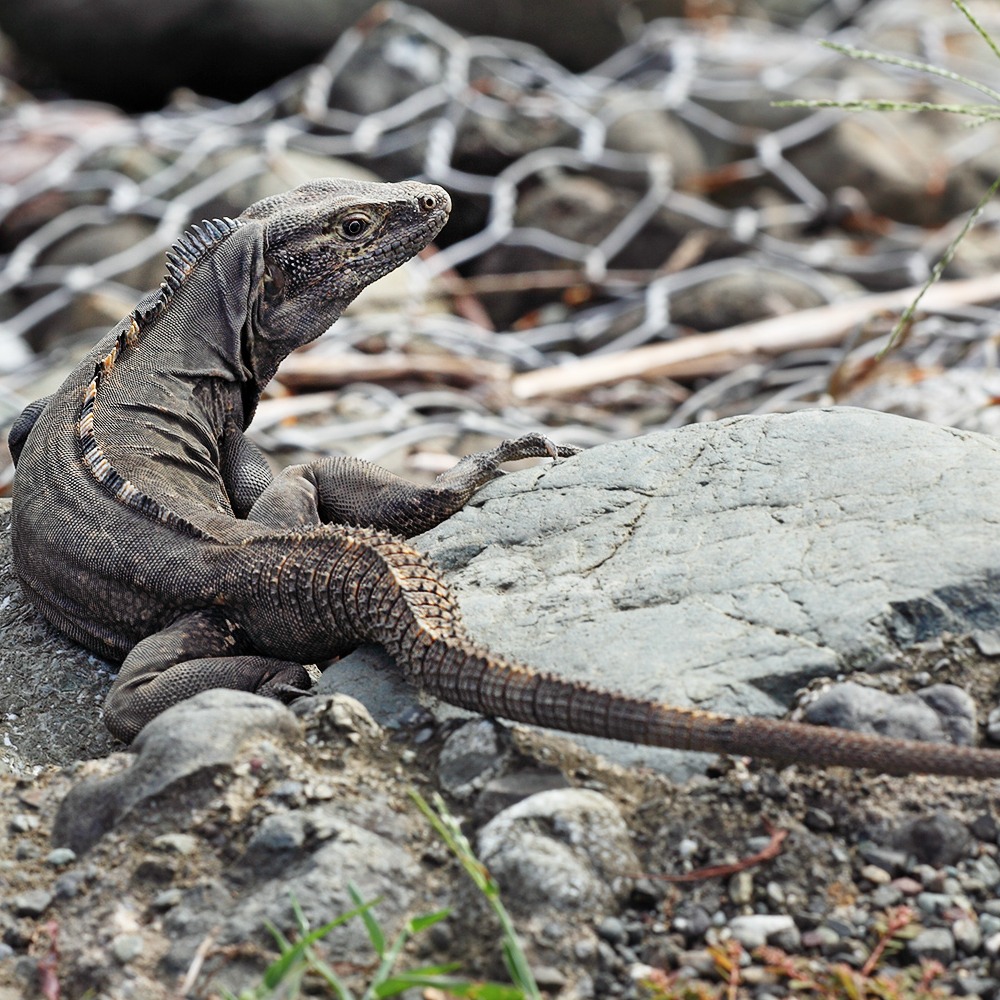
Ctenosaura quinquecarinata
Five-keeled Spiny-tailed Iguana
Gray, 1842
Added by
Anonymous Curator
Reviewed by
Under Review
Last modified by
Julia Trouin
TaxonomyBiological classification ranks placing this species within the tree of life, from Kingdom down to Genus.
Ecology & StatusHow this species lives: habitat preferences, diet, behavior, population status, and role in its ecosystem.
OriginWhether the species is native (evolved here), endemic (found only here), or introduced by human activity.
Native
Population TrendDirection of change in population size over time: increasing, stable, decreasing, or unknown.
Decreasing
Breeding SeasonTime of year when this species typically reproduces or flowers.
--
Trophic RolePosition in the food chain: producer, herbivore, carnivore, omnivore, decomposer, or parasite.
Herbivore
Recent SightingsWhether this species has been observed in the wild in Costa Rica within recent years.
Yes
Habitat SummaryOverview of the specific ecosystems and environments where this species is found in Costa Rica. Multi-lang
Inhabits mainly dry tropical forests, rocky slopes, and thorny scrub zones. It is a species dependent on natural refuges such as rock crevices or hollow logs to protect itself from predators and extreme heat.BehaviourDaily activity patterns, movement, territory use, foraging style, and seasonal behavioral changes. Multi-lang
Diurnal and highly thermophilic. They are frequently observed in small groups on rocky outcrops, showing signaling behaviors with the head and fast movements to defend their territory or access the best basking spots.Social ActivitySocial structure: whether the species is solitary, paired, or colonial; hierarchy and communication. Multi-lang
They exhibit a rudimentary social structure centered on a dominant male that guards an area. Females and juveniles usually coexist on the outskirts of the male's territory, establishing clear hierarchies.Feeding GuildWhat the species eats, how it forages or hunts, and its role as a consumer in the food web. Multi-lang
Active forager. Uses its visual acuity to locate fresh vegetation and, occasionally, can ingest small arthropods by accident or necessity during extreme droughts.Trophic Chain DetailsSpecific interactions in local food webs: prey species, predators, competitors, and scavengers. Multi-lang
Primary / Herbivore. It feeds on leaves, flowers, fruits, and tender shoots of local plants. Its digestive system is adapted to process fibrous plant material, which allows them to colonize environments where other species cannot survive.Reproductive BehaviourMating strategies, courtship displays, nesting or spawning behavior, and parental care. Multi-lang
Oviparous species. The female deposits a clutch of eggs in underground burrows. Egg development is dependent on soil temperature and humidity during the nesting season.Physical Measures
Length (cm)
20.0 - 30.0 cm
Weight (Grams)
150 g - 400 g
Lifespan
Sexual MaturityAge at which the individual becomes capable of reproducing for the first time.
2 - 3 Years
Gestation / IncubationDuration from fertilization to birth (mammals) or to hatching (egg-laying species).
2 - 3