
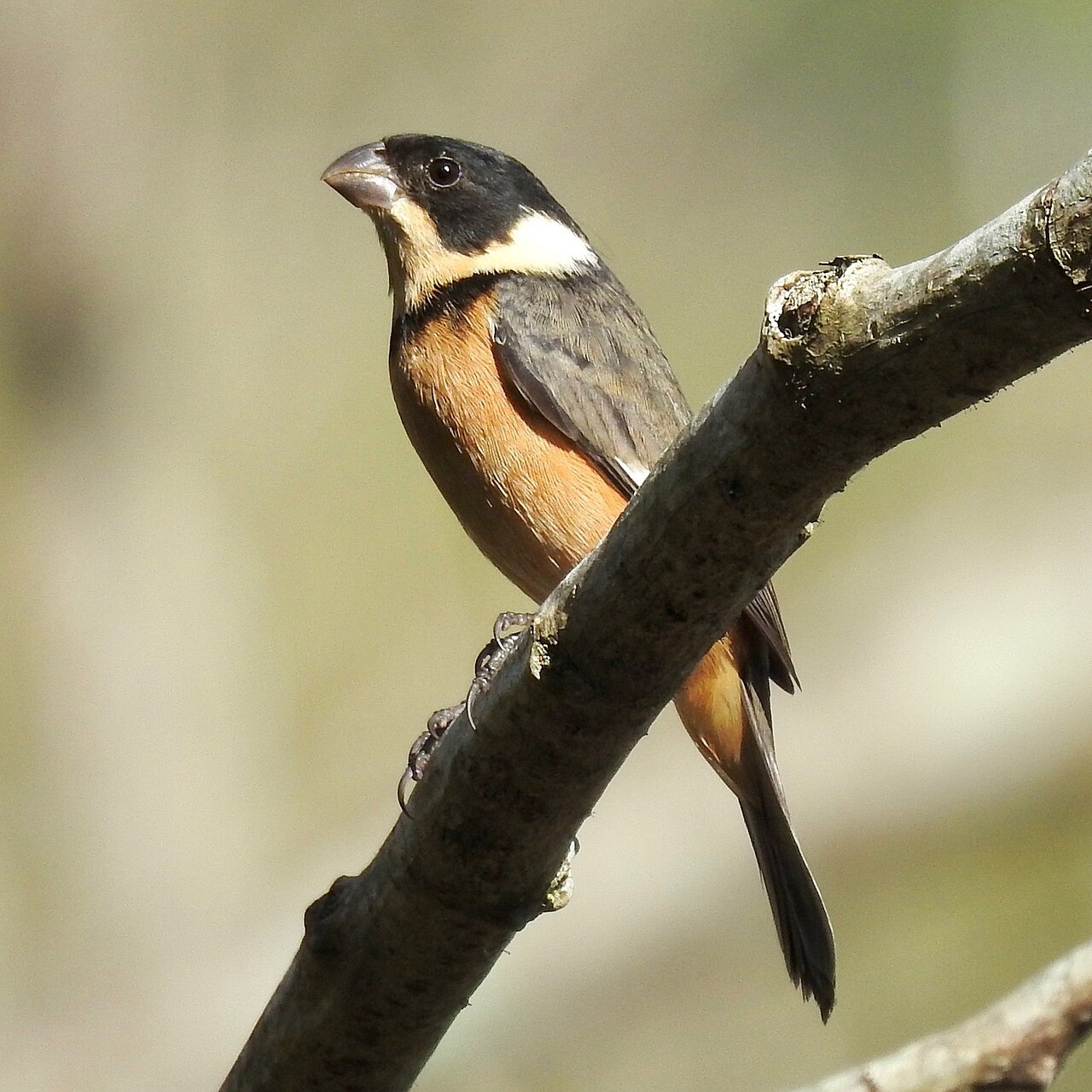
Sporophila torqueola
White-collared Seedeater
Bonaparte, 1850
Added by
Anonymous Curator
Reviewed by
Under Review
Last modified by
Julia Trouin
TaxonomyBiological classification ranks placing this species within the tree of life, from Kingdom down to Genus.
Ecology & StatusHow this species lives: habitat preferences, diet, behavior, population status, and role in its ecosystem.
OriginWhether the species is native (evolved here), endemic (found only here), or introduced by human activity.
Native
Population TrendDirection of change in population size over time: increasing, stable, decreasing, or unknown.
Stable
Breeding SeasonTime of year when this species typically reproduces or flowers.
--
Trophic RolePosition in the food chain: producer, herbivore, carnivore, omnivore, decomposer, or parasite.
Herbivore
Recent SightingsWhether this species has been observed in the wild in Costa Rica within recent years.
Yes
Habitat SummaryOverview of the specific ecosystems and environments where this species is found in Costa Rica. Multi-lang
It primarily inhabits open areas, pastures, agricultural fields, roadsides, shrubby savannas, and regenerating forest clearings in the Mesoamerican region, ranging from southern Texas and Mexico to Costa Rica and Panama. It is common in lowlands and middle elevations, adapting exceptionally well to anthropogenic environments such as sugar cane fields and cattle pastures. It prefers sunny areas with abundant growth of wild grasses.BehaviourDaily activity patterns, movement, territory use, foraging style, and seasonal behavioral changes. Multi-lang
It is a gregarious bird during the non-breeding season, forming large flocks that roam pastures in search of food. Its flight is undulating and over short distances. Males establish small territories during the breeding season, defending them through continuous and melodious songs delivered from the tops of bushes or wire fences.Social ActivitySocial structure: whether the species is solitary, paired, or colonial; hierarchy and communication. Multi-lang
It shows high gregariousness during the dry months of the year, forming monospecific or mixed associations with other seedeaters (genera Tiaris and Volatinia) to feed in areas of abundant pastures. During the nesting season, pairs isolate themselves and display moderate territoriality, although they may nest at relatively short distances from one another if food is extremely abundant.Feeding GuildWhat the species eats, how it forages or hunts, and its role as a consumer in the food web. Multi-lang
Specialized granivore. It feeds almost exclusively on small seeds from a wide variety of grasses and wild herbs (such as Panicum and Paspalum). During the breeding season, it opportunistically captures small insects to feed to the nestlings.Trophic Chain DetailsSpecific interactions in local food webs: prey species, predators, competitors, and scavengers. Multi-lang
It acts primarily as a specialized primary consumer through seed predation. By consuming vast quantities of grasses, it influences the population dynamics of these herbaceous plants. It occasionally consumes insects, acting as a secondary consumer. It is frequent prey for small falcons, open-country arboreal snakes, and medium-sized carnivorous mammals.Reproductive BehaviourMating strategies, courtship displays, nesting or spawning behavior, and parental care. Multi-lang
The nest is a delicate, compact, and thin open cup structure, built primarily by the female using fine rootlets, dry grass stems, and horsehair or other mammalian hair, often so thin that the eggs are visible from below. It is located between 0.5 and 2.5 meters off the ground in a dense shrub or tall weeds. She lays 2 to 3 grayish-white or pale bluish eggs speckled with brown. Incubation is done solely by the female for 12 to 13 days. Both parents feed the nestlings a mixture of crushed seeds and soft insects for 10 to 11 days until they fledge.Physical Measures
Length (cm)
10.5 - 12.5 cm
Weight (Grams)
8 g - 11 g
Lifespan
Sexual MaturityAge at which the individual becomes capable of reproducing for the first time.
1 Years
Gestation / IncubationDuration from fertilization to birth (mammals) or to hatching (egg-laying species).
12 - 13