
AnimaliaIUCN LCIn Progress Recent Sighting
Sporophila torqueola
White-collared Seedeater
Bonaparte, 1850
Detailed Texts Multi-lang
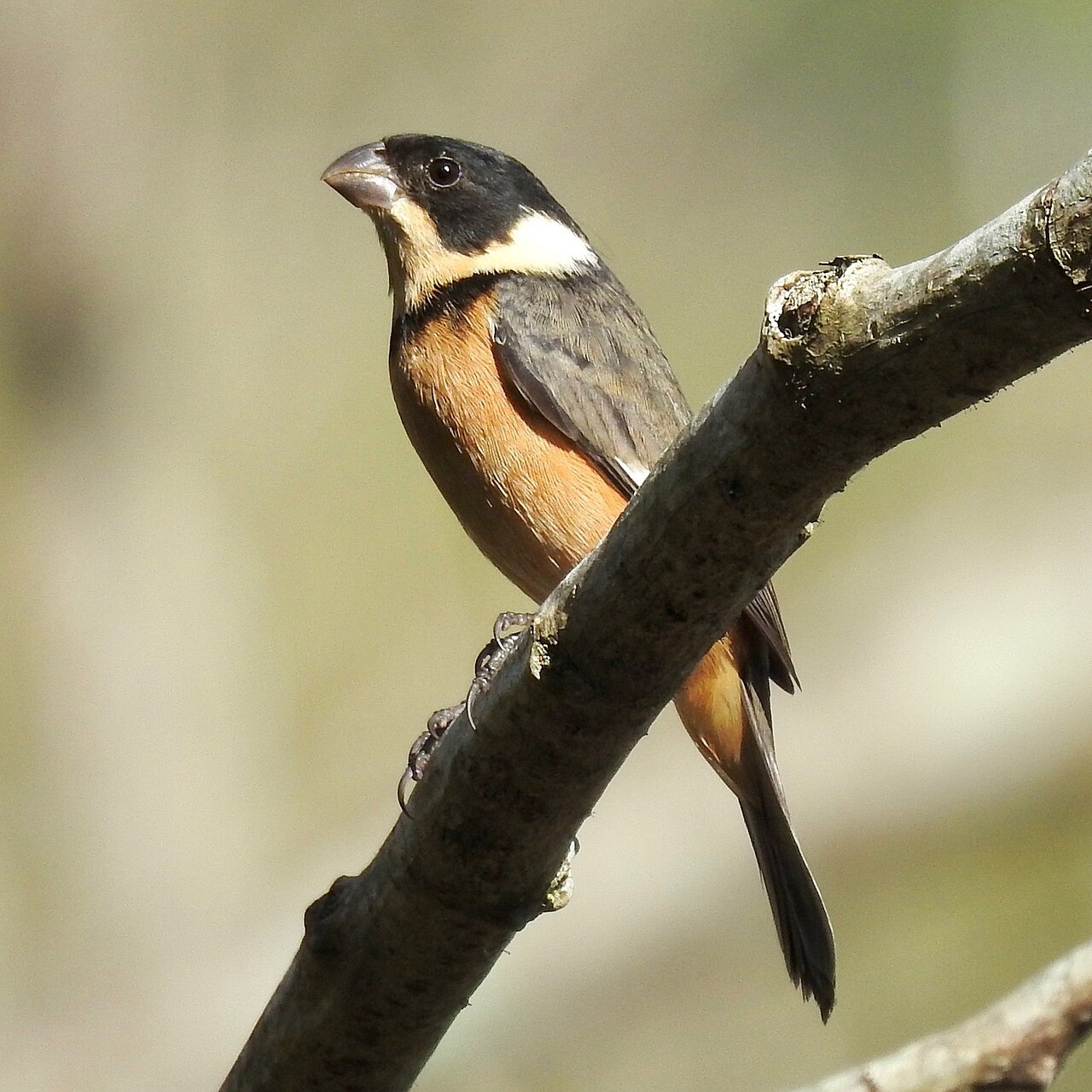
It is a small passerine with a markedly conical, short, and thick bill, specialized for cracking hard seeds. The adult male features a glossy black head with a characteristic white or cinnamon semi-collar extending from the sides of the neck toward the chest. The back varies from dark gray to blackish with conspicuous white wing patches visible in flight, while the underparts display soft buffy or cinnamon tones. The female exhibits a completely cryptic plumage of uniform olive-brown on the upperparts and a pale buff or yellowish tone on the belly, lacking any striking head markings. The eyes are dark and the legs are black.
Added by
Anonymous Curator
Reviewed by
Under Review
Last modified by
Julia Trouin
Taxonomy
PhylumChordata
ClassAves
OrderPasseriformes
FamilyThraupidae
GenusSporophila
Taxonomic AuthorityBonaparte, 1850
Ecology & Status
Origin
Native
Population Trend
Stable
Breeding Season
--
Trophic Role
Herbivore
Recent Sightings
Yes
Habitat Summary Multi-lang
It primarily inhabits open areas, pastures, agricultural fields, roadsides, shrubby savannas, and regenerating forest clearings in the Mesoamerican region, ranging from southern Texas and Mexico to Costa Rica and Panama. It is common in lowlands and middle elevations, adapting exceptionally well to anthropogenic environments such as sugar cane fields and cattle pastures. It prefers sunny areas with abundant growth of wild grasses.Behaviour Multi-lang
It is a gregarious bird during the non-breeding season, forming large flocks that roam pastures in search of food. Its flight is undulating and over short distances. Males establish small territories during the breeding season, defending them through continuous and melodious songs delivered from the tops of bushes or wire fences.Social Activity Multi-lang
It shows high gregariousness during the dry months of the year, forming monospecific or mixed associations with other seedeaters (genera Tiaris and Volatinia) to feed in areas of abundant pastures. During the nesting season, pairs isolate themselves and display moderate territoriality, although they may nest at relatively short distances from one another if food is extremely abundant.Feeding Guild Multi-lang
Specialized granivore. It feeds almost exclusively on small seeds from a wide variety of grasses and wild herbs (such as Panicum and Paspalum). During the breeding season, it opportunistically captures small insects to feed to the nestlings.Trophic Chain Details Multi-lang
It acts primarily as a specialized primary consumer through seed predation. By consuming vast quantities of grasses, it influences the population dynamics of these herbaceous plants. It occasionally consumes insects, acting as a secondary consumer. It is frequent prey for small falcons, open-country arboreal snakes, and medium-sized carnivorous mammals.Reproductive Behaviour Multi-lang
The nest is a delicate, compact, and thin open cup structure, built primarily by the female using fine rootlets, dry grass stems, and horsehair or other mammalian hair, often so thin that the eggs are visible from below. It is located between 0.5 and 2.5 meters off the ground in a dense shrub or tall weeds. She lays 2 to 3 grayish-white or pale bluish eggs speckled with brown. Incubation is done solely by the female for 12 to 13 days. Both parents feed the nestlings a mixture of crushed seeds and soft insects for 10 to 11 days until they fledge.Physical Measures
Length (cm)
10.5 - 12.5 cm
Weight (Grams)
8 g - 11 g
Offspring per cycle2 - 3
Sexual DimorphismYes
Lifespan
Sexual Maturity
1 Years
Gestation / Incubation
12 - 13
Lifespan Estimated
Males4 - 6 Years
Females4 - 6 Years
Sexual Dimorphism
Males Multi-lang
It presents a very distinctive and high-contrast breeding plumage. The head, crown, and cheeks are deep jet-black, strikingly interrupted by a pure white or cream semi-collar crossing the nape or sides of the neck. The breast and abdomen display variable tones between pale buff and cinnamon. It possesses a very prominent white wing speculum.
Females Multi-lang
Completely drab, dull, and cryptic, designed by evolution to blend in with the dry grasses and bushes where it nests. Its plumage is predominantly light olive-brown on the back, turning buffy or pale yellow on the underparts, with no trace of the male's black and white collar.
Evolutionary Adaptations Multi-lang
Specialized Bill Morphology: Its robust and culmen-curved bill functions as a high-precision mechanical pressure clamp, allowing the bird to crush and strip away the protective husk of grass seeds within fractions of a second.
Opportunistic Dietary Flexibility: It possesses the ability to temporarily shift its diet toward the intensive consumption of small flying insects during peak rainfall cycles, ensuring the protein intake required for breeding.
Main Threats Multi-lang
Intensive Use of Agrochemicals: The massive application of herbicides and synthetic pesticides in monocultures drastically reduces the availability of native grasses and poisons their primary food sources.
Illegal Cage-Bird Trade: Due to its melodious song and the attractiveness of the male, it is illegally captured using glue traps or mist nets to be commercialized as a pet in local markets.
Interesting Facts Multi-lang
Polyphonic Song and Learning: Young males are capable of mimicking fragments of songs from other bird species inhabiting their environment, enriching their repertoire to impress females during courtship.
Acrobatic Feeding: They habitually perch directly on the slender stems of grasses, using their body weight to bend the plant to the ground so they can comfortably extract mature seeds from the apex.