
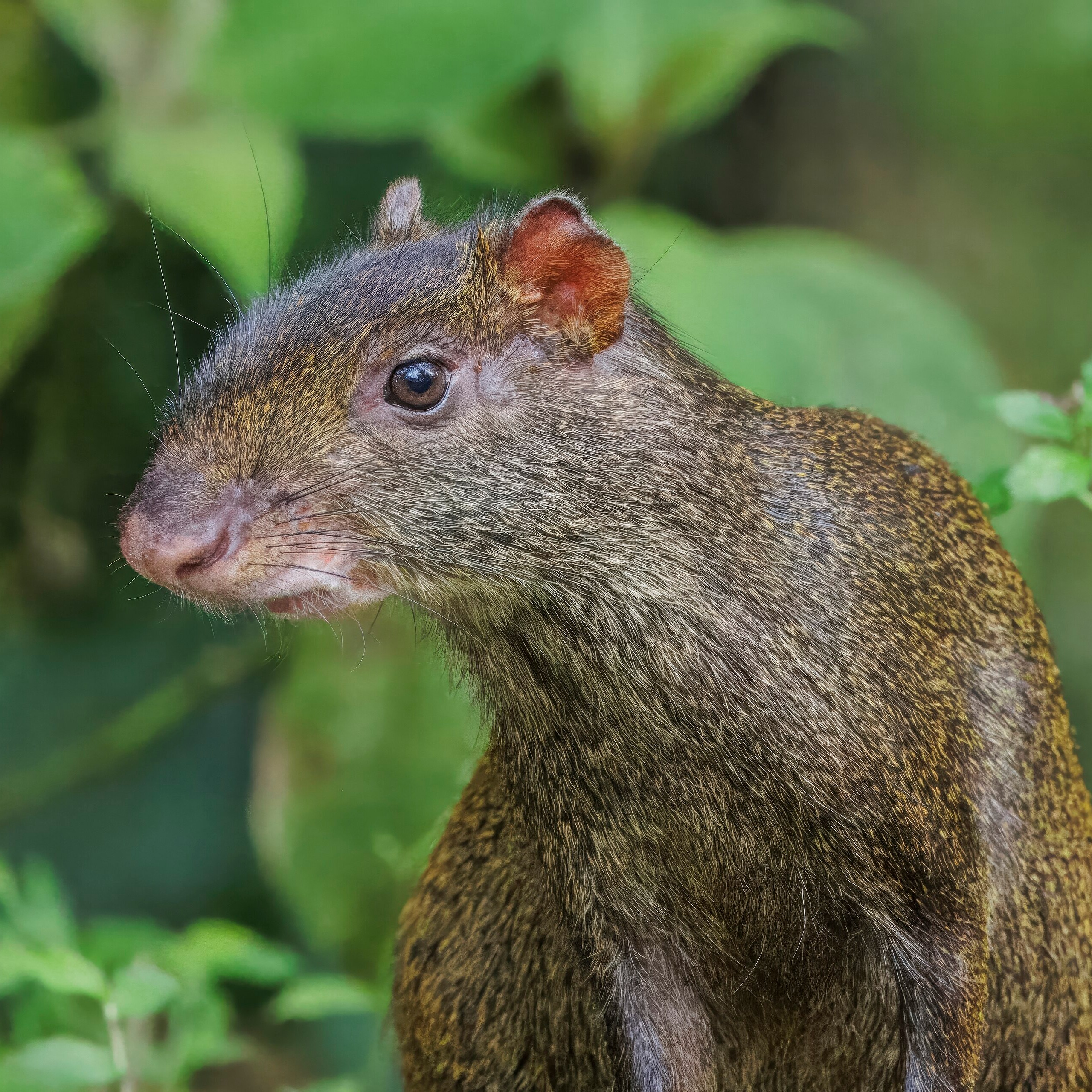
Dasyprocta punctata
Central American Agouti
Gray, 1842
Added by
Anonymous Curator
Reviewed by
Under Review
Last modified by
Julia Trouin
TaxonomyBiological classification ranks placing this species within the tree of life, from Kingdom down to Genus.
Ecology & StatusHow this species lives: habitat preferences, diet, behavior, population status, and role in its ecosystem.
OriginWhether the species is native (evolved here), endemic (found only here), or introduced by human activity.
Native
Population TrendDirection of change in population size over time: increasing, stable, decreasing, or unknown.
Decreasing
Breeding SeasonTime of year when this species typically reproduces or flowers.
Year Round
Trophic RolePosition in the food chain: producer, herbivore, carnivore, omnivore, decomposer, or parasite.
Herbivore
Recent SightingsWhether this species has been observed in the wild in Costa Rica within recent years.
Yes
Habitat SummaryOverview of the specific ecosystems and environments where this species is found in Costa Rica. Multi-lang
It primarily inhabits tropical moist and dry forests, secondary forests, riparian corridors, plantations, and agricultural areas adjacent to forested zones. It adapts well to disturbed environments as long as sufficient vegetation cover and food availability remain. It can also be found in mangroves, wooded savannas, and peri-urban gardens.BehaviourDaily activity patterns, movement, territory use, foraging style, and seasonal behavioral changes. Multi-lang
The agouti is a diurnal and predominantly solitary animal, although it can tolerate the proximity of conspecifics in areas of high resource concentration. It maintains small territories (0.5–5 ha) delimited by secretions from scent glands and urinary marking. It is a keystone species in tropical ecosystems due to its function as a primary seed disperser of large trees. Its activity peaks in the early morning hours and at dusk. When facing danger, it prefers rapid flight, though it may also remain motionless relying on its camouflage.Social ActivitySocial structure: whether the species is solitary, paired, or colonial; hierarchy and communication. Multi-lang
Primarily solitary. Individuals tolerate each other in areas of high resource availability but actively defend their territories against intruders through vocalization, dorsal hair erection, and chases. Communication occurs through contact and alarm vocalizations, chemical signals (anal and perianal glands), and visual signals (body posture). Pairs remain together temporarily during courtship and rearing.Feeding GuildWhat the species eats, how it forages or hunts, and its role as a consumer in the food web. Multi-lang
Specialized granivore-frugivore. It preferentially feeds on hard seeds and fallen ripe fruits, supplementing its diet with roots, bark, young shoots, and occasionally invertebrates or small fungi. During the dry season, when fruits are scarce, it intensively relies on its buried seed caches.Trophic Chain DetailsSpecific interactions in local food webs: prey species, predators, competitors, and scavengers. Multi-lang
Primary consumer that feeds on seeds, fruits, roots, and bark. It is regular prey of the jaguar (Panthera onca), puma (Puma concolor), ocelot (Leopardus pardalis), boa constrictor (Boa constrictor), harpy eagle (Harpia harpyja), and common black hawk (Buteogallus anthracinus). Its role as a secondary seed disperser positions it as a structurally important trophic link: by burying and forgetting seeds, it promotes the germination of key tree species that sustain many other forest organisms.Reproductive BehaviourMating strategies, courtship displays, nesting or spawning behavior, and parental care. Multi-lang
Reproduction can occur year-round, with peaks coinciding with greater fruit abundance. Courtship includes vocalizations, chases, and the male spraying urine on the female. After a gestation of 104–120 days, the female gives birth to 1–4 precocial young (usually 2), with open eyes, fur, and ability to move from the first day. Lactation lasts approximately 16 weeks. Young reach sexual maturity between 6 and 12 months of age.Physical Measures
Length (cm)
41.5 - 62.0 cm
Weight (Grams)
2.70 kg - 6.00 kg
Lifespan
Sexual MaturityAge at which the individual becomes capable of reproducing for the first time.
6 - 12 Months
Gestation / IncubationDuration from fertilization to birth (mammals) or to hatching (egg-laying species).
104 - 120