
Costa Rica Species
Notharchus macrorhynchos
AnimaliaHighest rank in taxonomy. Groups all life into domains: Animalia, Plantae, Fungi, etc.IUCN LCInternational Union for Conservation of Nature — the world authority on species extinction risk, using standardized criteria. — Least Concern — widespread and abundant; not at immediate risk of extinction.In ProgressCurrent stage of this record in the editorial review workflow. Recent Sighting

Notharchus macrorhynchos

White-necked Puffbird

(Gmelin, 1788)

Detailed Texts Multi-lang
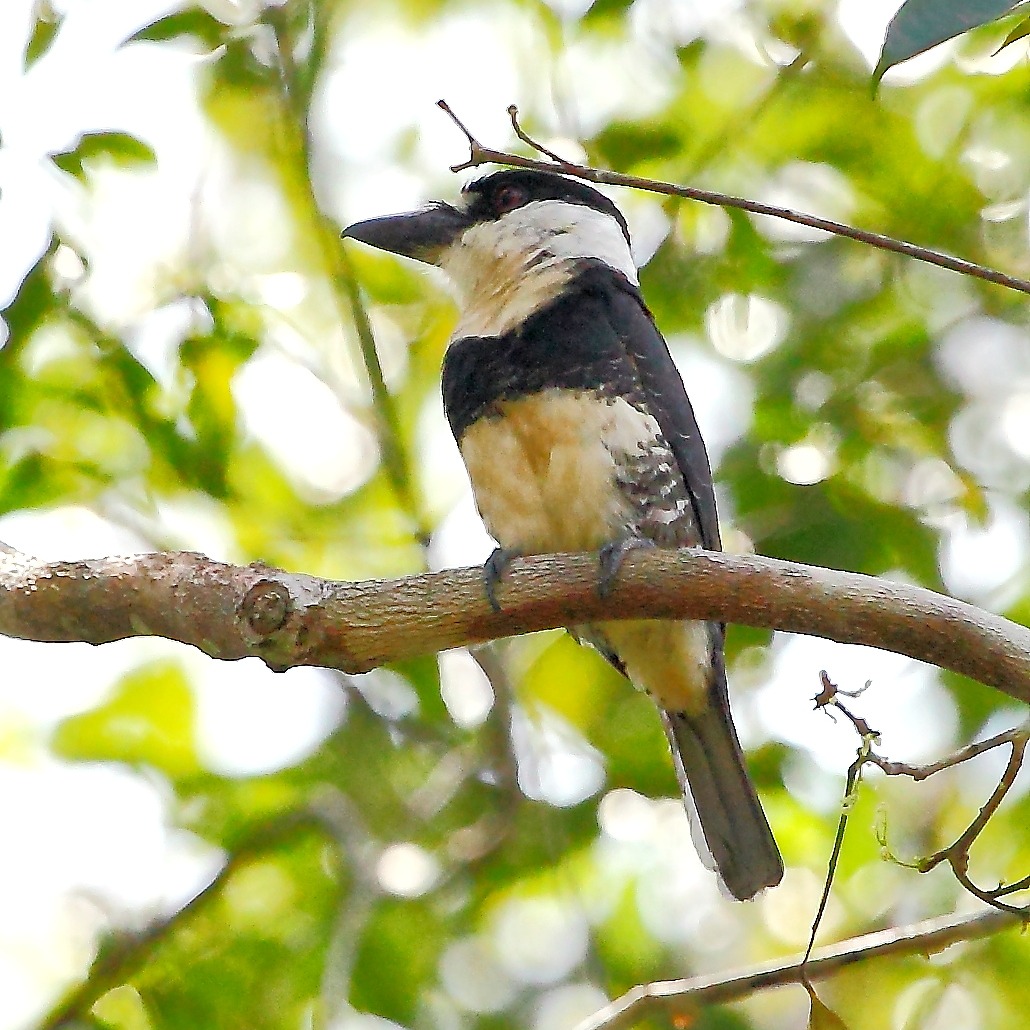
The White-necked Puffbird (Notharchus macrorhynchos) is a stout bird, large for its family, with a disproportionately voluminous head that gives it a big-headed or puffy appearance. Its back, wings, tail, and crown are a lustrous black. A broad white band on the forehead connects with a pure white throat and neck, forming a collar visible from a great distance. Just below the white neck, it sports a broad, imposing black chest band, followed by a white belly flanked with black scales or barring. Its bill is massive, very thick, and entirely black, equipped with a small but sharp hook at the tip. Its legs are very short and dark.

Added by

Anonymous Curator

Reviewed by

Under Review

Last modified by

Julia Trouin

TaxonomyBiological classification ranks placing this species within the tree of life, from Kingdom down to Genus.

PhylumRank below Kingdom. Groups organisms sharing a fundamental body plan (e.g., Chordata = vertebrates and some invertebrates).Chordata
ClassRank below Phylum. Subdivides by structural traits (e.g., Mammalia, Aves, Reptilia, Insecta).Aves
OrderRank below Class. Groups related families sharing common ancestry (e.g., Carnivora, Primates).Galbuliformes
FamilyRank below Order. Groups closely related genera (e.g., Felidae = cats, Canidae = dogs).Bucconidae
GenusRank just above Species. The first word in the two-part binomial scientific name.Notharchus
Taxonomic AuthorityThe scientist who first formally described and published this species, followed by the year of publication.(Gmelin, 1788)
Record Completeness
95%
Coming soon

Ecology & StatusHow this species lives: habitat preferences, diet, behavior, population status, and role in its ecosystem.

OriginWhether the species is native (evolved here), endemic (found only here), or introduced by human activity.

Native

Population TrendDirection of change in population size over time: increasing, stable, decreasing, or unknown.

Decreasing

Breeding SeasonTime of year when this species typically reproduces or flowers.

Dry Season

Trophic RolePosition in the food chain: producer, herbivore, carnivore, omnivore, decomposer, or parasite.

Insectivore

Recent SightingsWhether this species has been observed in the wild in Costa Rica within recent years.

Yes

Habitat SummaryOverview of the specific ecosystems and environments where this species is found in Costa Rica. Multi-lang

It is a resident of the forest heights. It prefers the canopy and edges of humid tropical rainforests, gallery forests, and semi-open areas with large remaining emergent trees, such as cacao plantations or pastures. It is often observed perched on the bare, exposed branch of the tallest tree in the area. In Costa Rica and the region, it is locally common in the lowlands of both the Caribbean and Pacific slopes.

BehaviourDaily activity patterns, movement, territory use, foraging style, and seasonal behavioral changes. Multi-lang

It is a classic sit-and-wait predator. Its strategy requires minimal energy expenditure: it perches on an exposed canopy branch with a hunched posture and retracted neck, appearing asleep. However, its eyes sharply scan the surroundings. Upon detecting large prey, it launches into a fast, direct, and heavy hunting flight, catches it mid-air or off leaves, and glides back to its original perch to kill and soften its food by violently beating it against the wood.

Social ActivitySocial structure: whether the species is solitary, paired, or colonial; hierarchy and communication. Multi-lang

It is typically a solitary bird or observed in pairs. They are very unvocal (which, combined with their immobility, makes them hard to detect) but occasionally emit a very high-pitched and weak descending trill, disproportionate to their large size.

Feeding GuildWhat the species eats, how it forages or hunts, and its role as a consumer in the food web. Multi-lang

Carnivore / Canopy predator (Sally-pounce).

Trophic Chain DetailsSpecific interactions in local food webs: prey species, predators, competitors, and scavengers. Multi-lang

Carnivore (Giant insect specialist). Its diet is dominated by large insects that other birds cannot handle: giant cicadas, rhinoceros beetles, stick insects (phasmids), large grasshoppers, and even centipedes, small lizards, and tree frogs. In turn, because of its habit of perching exposed high in the canopy, adults risk being hunted by fast falcons (like the Bat Falcon or Merlin), while climbing snakes attack their nests.

Reproductive BehaviourMating strategies, courtship displays, nesting or spawning behavior, and parental care. Multi-lang

They are monogamous birds with very specific nesting habits. The male and female work as a team using their strong bills to excavate a burrow directly inside a large, high arboreal black termite nest. They dig a short tunnel ending in a small chamber. They use no additional lining material. The female lays 2 to 3 pure white eggs. Both sexes share incubation, staying warm and secure inside the thermal structure of the termitarium. The chicks hatch altricial, blind and naked, and are fed by both parents with crushed large insects until they fledge a few weeks later.

Physical Measures

Length (cm)

24.0 - 26.0 cm

Weight (Grams)

80 g - 106 g

Offspring per cycleTypical number of young (live births, eggs, or seeds) produced by one adult in a single reproductive event or breeding season.2 - 3
Sexual DimorphismObservable physical differences between males and females of the same species (e.g., size, coloration, features).No

Lifespan

Sexual MaturityAge at which the individual becomes capable of reproducing for the first time.

12 - 24 Months

Gestation / IncubationDuration from fertilization to birth (mammals) or to hatching (egg-laying species).

15 - 20

Lifespan EstimatedExpected duration of life from birth to natural death under wild conditions.
Males5 - 10 Years
Females5 - 10 Years

Evolutionary AdaptationsInherited traits and behaviors that improve the species' survival and reproduction in its specific environment. Multi-lang

Immobility Strategy (Puffbird Posture): Its English name (puffbird) comes from its habit of fluffing its feathers, making it look larger and plump. This posture, combined with its absolute immobility for hours, breaks its silhouette, causing predators and insects to ignore it by mistaking it for a dead bromeliad or a stump on the branch.
Hooked Tongs Bill: Its bill is massive and heavy, ending in a sharp hook (tomial hook). This tool is designed not only to catch prey in flight but to crush the hard exoskeletons of giant beetles, cicadas, or quickly dispatch lizards by thrashing them against the branch.

Main ThreatsDocumented pressures reducing the population: habitat loss, hunting, disease, climate change, and invasive species. Multi-lang

Deforestation of Emergent Trees: This species invariably requires large, tall, mature trees (both live and dead) to perch and hunt. Selective logging in cattle areas eliminates these natural 'skyscrapers', forcing the bird to abandon the zone.
Loss of Termite Nests: They obligatorily depend on arboreal termite nests to excavate their nesting cavities. The cleaning of these termitaria on farms and plantations destroys their only reproductive means.

Interesting FactsSurprising or notable facts that highlight what makes this species unique or ecologically important. Multi-lang

The Lazy Bird: In many rural areas it is colloquially known as 'pájaro bobo' (silly bird) or lazy bird. This is because it trusts its immobility and camouflage so much that it allows humans to approach almost to the point of touching it before deciding to fly away.
Taxonomic Tangle: For centuries, Notharchus macrorhynchos was considered a single species ranging from Mexico to the Amazon. However, recent DNA studies demonstrated that the Central American bird is actually a distinct species (Notharchus hyperrhynchus), thus splitting this canopy king into two evolutionary realms.