
Costa Rica Species
PlantaeHighest rank in taxonomy. Groups all life into domains: Animalia, Plantae, Fungi, etc.IUCN LCInternational Union for Conservation of Nature — the world authority on species extinction risk, using standardized criteria. — Least Concern — widespread and abundant; not at immediate risk of extinction.ApprovedCurrent stage of this record in the editorial review workflow. Recent Sighting

Gongora maculata

Punch-and-Judy Orchid

Lindl., 1833

Detailed Texts Multi-lang
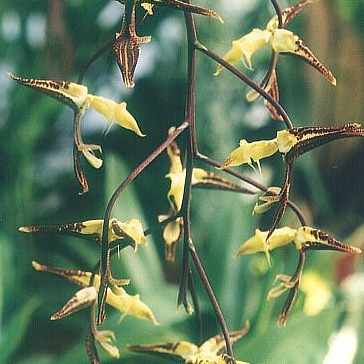
An extraordinary, robust epiphytic orchid with deeply ribbed, clustered pseudobulbs bearing two to three large, pliable, pleated leaves. It produces dramatic, pendulous, zigzagging inflorescences up to a meter long that dangle multiple complex, inverted flowers; these boast yellowish-tan to copper tepals intensely maculated with reddish-brown speckles and a highly modified, structurally intricate lip resembling a tiny bird or puppet.

Added by

Anonymous Curator

Reviewed by

Under Review

Other Names (Global)Regional and multilingual names used for this species across different countries and languages.

Orquídea pajaritoPunch-and-Judy OrchidGongora moteadaOrquídea vaquita

TaxonomyBiological classification ranks placing this species within the tree of life, from Kingdom down to Genus.

PhylumRank below Kingdom. Groups organisms sharing a fundamental body plan (e.g., Chordata = vertebrates and some invertebrates).Tracheophyta
ClassRank below Phylum. Subdivides by structural traits (e.g., Mammalia, Aves, Reptilia, Insecta).Magnoliopsida
OrderRank below Class. Groups related families sharing common ancestry (e.g., Carnivora, Primates).Asparagales
FamilyRank below Order. Groups closely related genera (e.g., Felidae = cats, Canidae = dogs).Orchidaceae
GenusRank just above Species. The first word in the two-part binomial scientific name.Gongora
Taxonomic AuthorityThe scientist who first formally described and published this species, followed by the year of publication.Lindl., 1833
Record Completeness
93%
Coming soon

Ecology & StatusHow this species lives: habitat preferences, diet, behavior, population status, and role in its ecosystem.

OriginWhether the species is native (evolved here), endemic (found only here), or introduced by human activity.

Native

Population TrendDirection of change in population size over time: increasing, stable, decreasing, or unknown.

Stable

Trophic RolePosition in the food chain: producer, herbivore, carnivore, omnivore, decomposer, or parasite.

Herbivore

Growth HabitPhysical form and structure of the plant: tree, shrub, herb, vine, epiphyte, aquatic, etc.

--

Leaf TypeLeaf characteristics: deciduous (seasonal shed), evergreen, simple, compound, needle-like, etc.

--

Flowering SeasonTime of year when this species typically reproduces or flowers.

Year Round

Recent SightingsWhether this species has been observed in the wild in Costa Rica within recent years.

Yes

Habitat SummaryOverview of the specific ecosystems and environments where this species is found in Costa Rica. Multi-lang

Inhabits primary and old-growth secondary wet lowland tropical rain forests and premontane moist canopy zones across Central America, Trinidad, and northern South America. It typically anchors to rough bark surfaces, horizontal crotches, and moss mats of mature forest trees, prioritizing heavily shaded environments with high ambient humidity and moderate to strong air movement, ranging from sea level up to 1,000 meters elevation.

Light & Water NeedsSunlight intensity and moisture levels this plant needs to grow and reproduce successfully. Multi-lang

Information not available in English. Help us expand this record!

BehaviourDaily activity patterns, movement, territory use, foraging style, and seasonal behavioral changes. Multi-lang

Grows as clustered epiphytic rosettes forming localized micro-communities on structural canopy branches. Its cascading flower chains release intense volatile scents strictly during the morning hours when euglossine bee flight activity peaks, optimizing pollination chances before ambient heat dissipates the fragrance compounds.

Toxicity / UsesToxic compounds present and their documented effects on humans or other organisms. Multi-lang

Information not available in English. Help us expand this record!

Physical Measures

Length (cm)

25.0 - 60.0 cm

Reproductive StructuresFlowers, fruits, and seeds — the reproductive organs and their seasonal appearance.

Flower Photos (Max 2)

No image

Fruit Photos (Max 2)

No image

Evolutionary AdaptationsInherited traits and behaviors that improve the species' survival and reproduction in its specific environment. Multi-lang

The flowers grow completely upside down (resupination process reversed), structurally modifying the floral architecture so that the waxy lip hangs downward to form a precise, gravity-assisted slide mechanism for its specialist euglossine bee pollinators.
Possesses robust, deeply pleated (plicate) leaf blades designed to maximize functional surface area for intercepting filtered light under deep forest canopy layers while channeling rainwater toward the pseudobulb cluster.

Main ThreatsDocumented pressures reducing the population: habitat loss, hunting, disease, climate change, and invasive species. Multi-lang

Susceptible to localized population collapses due to heavy commercial collection pressure, as its spectacular pendulous flower chains make it highly prized in global domestic and botanical orchid cultivation.
Extremely vulnerable to low-elevation forest fragmentation and microclimate drying, which cuts off the contiguous damp migratory pathways required by its obligate euglossine bee mutualists.

Interesting FactsSurprising or notable facts that highlight what makes this species unique or ecologically important. Multi-lang

The colloquial English name 'Punch-and-Judy Orchid' mirrors the strange, comical shape of the flowers swinging in the mountain wind, which early botanists noted looked like old-fashioned stringed marionettes or traditional European puppet theater characters.
The mechanism of pollination is extraordinarily specialized: bees are lured by powerful floral scents, lose their footing on the slippery, waxy surface of the lip, and slide down a specialized chute, catching the pollen packets (pollinia) perfectly on their backs on the way out.