
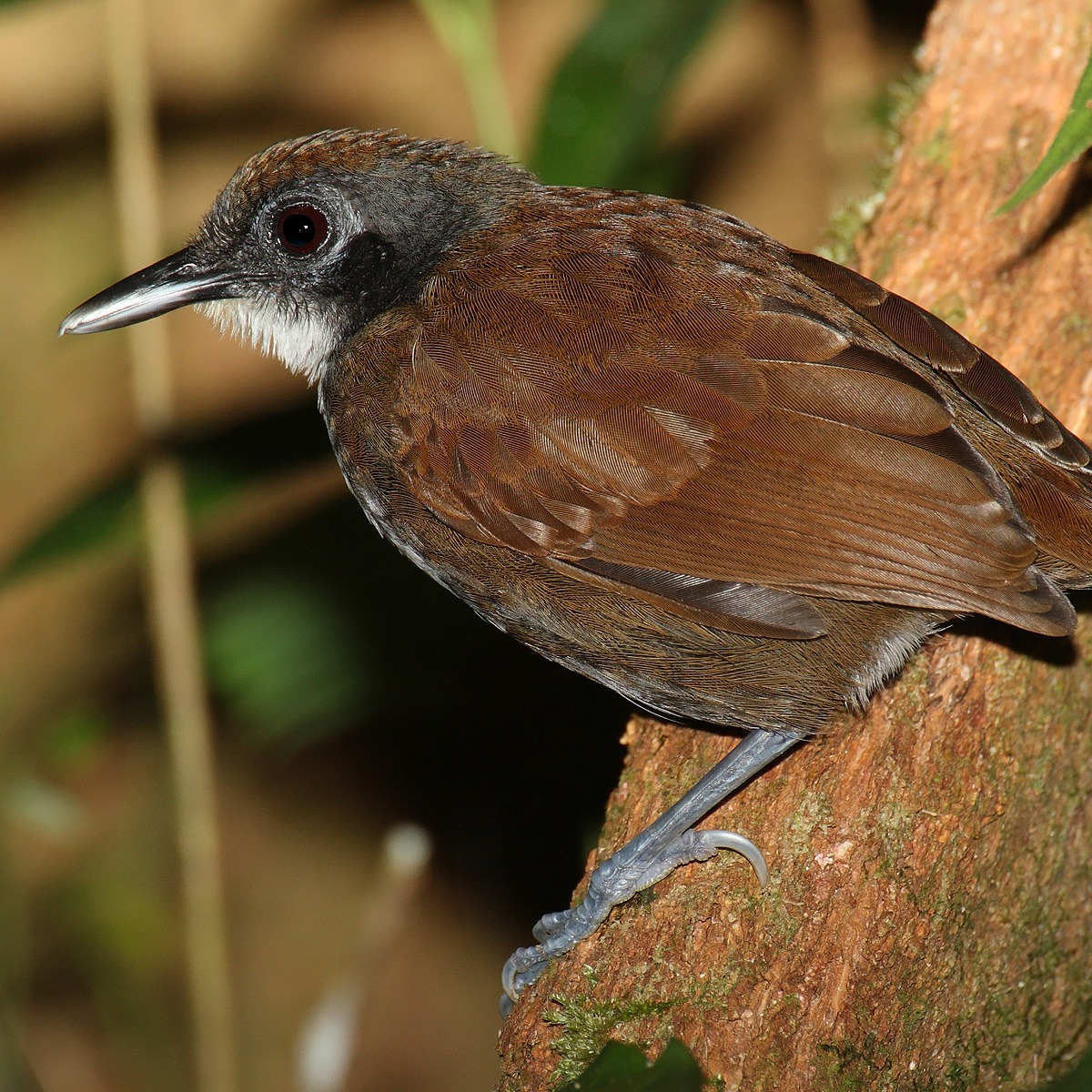
Gymnopithys leucaspis
Bicolored Antbird
(Sclater, 1855)
Added by
Anonymous Curator
Reviewed by
Under Review
Last modified by
Julia Trouin
TaxonomyBiological classification ranks placing this species within the tree of life, from Kingdom down to Genus.
Ecology & StatusHow this species lives: habitat preferences, diet, behavior, population status, and role in its ecosystem.
OriginWhether the species is native (evolved here), endemic (found only here), or introduced by human activity.
Native
Population TrendDirection of change in population size over time: increasing, stable, decreasing, or unknown.
Decreasing
Breeding SeasonTime of year when this species typically reproduces or flowers.
Wet Season
Trophic RolePosition in the food chain: producer, herbivore, carnivore, omnivore, decomposer, or parasite.
Insectivore
Recent SightingsWhether this species has been observed in the wild in Costa Rica within recent years.
Yes
Habitat SummaryOverview of the specific ecosystems and environments where this species is found in Costa Rica. Multi-lang
It is a resident strictly tied to the dark understory of primary humid tropical forests and advanced mature forests. It is highly intolerant of deforestation and direct sunlight, avoiding open edges, scrublands, and plantations. In Costa Rica and Central America, it is found primarily in the humid Caribbean lowlands and the South Pacific (such as the Osa Peninsula), from sea level up to about 1,000 meters in elevation.BehaviourDaily activity patterns, movement, territory use, foraging style, and seasonal behavioral changes. Multi-lang
It is a highly nervous and active bird whose daily cycle is tied to the location of the ants. When not with a swarm, they wander erratically searching for the colony's chemical trail. Upon finding the hunting front of the army ants, they cling vertically to low trunks (1 to 2 meters off the ground). They are very noisy; they emit loud alarm calls and harsh scolding ('churrrrr!') and a series of strident descending whistles to announce the discovery of the swarm to the rest of the forest.Social ActivitySocial structure: whether the species is solitary, paired, or colonial; hierarchy and communication. Multi-lang
They live strongly paired, but their social system around the ant swarm is complex. They temporarily tolerate other individuals of their species forming noisy groups above the horde, but they maintain a strict and aggressive dominance hierarchy to occupy the most productive positions for hunting.Feeding GuildWhat the species eats, how it forages or hunts, and its role as a consumer in the food web. Multi-lang
Insectivore / Obligate ant-follower (Sally-pounce).Trophic Chain DetailsSpecific interactions in local food webs: prey species, predators, competitors, and scavengers. Multi-lang
Strict carnivore (Ant-following insectivore). It does not consume ants; its diet consists of ground invertebrates flushed out by the swarm, primarily spiders, wood roaches, large grasshoppers, scorpions, and even small frogs or snakes. Due to their focus on the ground and intense vocalization, they can be ambushed by terrestrial snakes (like the fer-de-lance) or specialized forest hawks.Reproductive BehaviourMating strategies, courtship displays, nesting or spawning behavior, and parental care. Multi-lang
Monogamous birds. Unlike other birds, they do not build an elaborate nest from scratch. They hide their nest close to the ground (less than 1 meter high), using the hollow of a rotting stump, the base of a fallen dead palm frond, or a deep crevice in the bark. They precariously line it with a few dead leaves. The female lays 2 heavily spotted eggs. Both parents share the incubation (which lasts about 15 to 16 days) and the feeding of the chicks, returning stealthily from the ant swarm with whole prey for the young. The young leave the nest at 14 days.Physical Measures
Length (cm)
13.0 - 15.0 cm
Weight (Grams)
28 g - 34 g
Lifespan
Sexual MaturityAge at which the individual becomes capable of reproducing for the first time.
12 - 24 Months
Gestation / IncubationDuration from fertilization to birth (mammals) or to hatching (egg-laying species).
15 - 16