
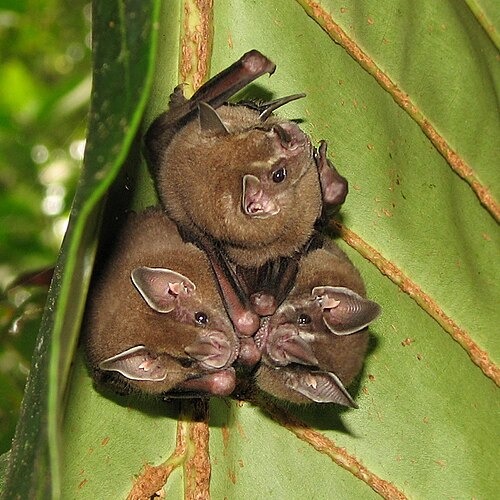
Artibeus jamaicensis
Jamaican Fruit Bat
Leach, 1821
Added by
Anonymous Curator
Reviewed by
Under Review
Last modified by
Julia Trouin
TaxonomyBiological classification ranks placing this species within the tree of life, from Kingdom down to Genus.
Ecology & StatusHow this species lives: habitat preferences, diet, behavior, population status, and role in its ecosystem.
OriginWhether the species is native (evolved here), endemic (found only here), or introduced by human activity.
Native
Population TrendDirection of change in population size over time: increasing, stable, decreasing, or unknown.
Stable
Breeding SeasonTime of year when this species typically reproduces or flowers.
Year Round
Trophic RolePosition in the food chain: producer, herbivore, carnivore, omnivore, decomposer, or parasite.
Herbivore
Recent SightingsWhether this species has been observed in the wild in Costa Rica within recent years.
Yes
Habitat SummaryOverview of the specific ecosystems and environments where this species is found in Costa Rica. Multi-lang
It is one of the most abundant and adaptable species in the Neotropics. It inhabits primary and secondary tropical rainforests, dry forests, cloud forests, and is extremely common in human-modified landscapes such as banana plantations, urban gardens, and parks. It uses a wide variety of roosts to sleep, including lit caves, tunnels, dense foliage, tree hollows, and frequently, the roofs of human buildings. In Costa Rica, it is ubiquitous in almost all territories up to 2,000 meters above sea level.BehaviourDaily activity patterns, movement, territory use, foraging style, and seasonal behavioral changes. Multi-lang
It is a nocturnal forager that flies quickly through the subcanopy and canopy searching for fruits. It does not eat in the same tree where it picks the fruit; typically, it takes the fruit in its mouth and flies to a nearby 'feeding roost,' where it hangs to process the food calmly. They are highly social animals that form large harems.Social ActivitySocial structure: whether the species is solitary, paired, or colonial; hierarchy and communication. Multi-lang
Highly gregarious. It is organized into harems consisting of a single dominant male and between 3 to 25 females, plus their young. Subordinate males form bachelor groups nearby.Feeding GuildWhat the species eats, how it forages or hunts, and its role as a consumer in the food web. Multi-lang
Frugivore (Occasionally nectarivore and insectivore).Trophic Chain DetailsSpecific interactions in local food webs: prey species, predators, competitors, and scavengers. Multi-lang
Primary consumer (Frugivore). Massive seed disperser. It is hunted by arboreal boas, owls, large opossums (Didelphis) that catch them in their roosts, and occasionally large spiders and centipedes in caves.Reproductive BehaviourMating strategies, courtship displays, nesting or spawning behavior, and parental care. Multi-lang
Females experience bimodal polyestry (two reproductive peaks a year, coinciding with maximum fruiting). Gestation lasts around 115 to 120 days, but delayed embryonic development occurs in some populations. A single pup is born per birth. Pups are born with open eyes and hairless. During the first days of life, the mother flies carrying the pup attached to her chest; later she leaves it at the roost while foraging.Physical Measures
Length (cm)
7.0 - 9.5 cm
Weight (Grams)
40 g - 65 g
Lifespan
Sexual MaturityAge at which the individual becomes capable of reproducing for the first time.
8 - 12 Months
Gestation / IncubationDuration from fertilization to birth (mammals) or to hatching (egg-laying species).
115 - 120