
Costa Rica Species
Psidium guajava
PlantaeHighest rank in taxonomy. Groups all life into domains: Animalia, Plantae, Fungi, etc.IUCN LCInternational Union for Conservation of Nature — the world authority on species extinction risk, using standardized criteria. — Least Concern — widespread and abundant; not at immediate risk of extinction.In ProgressCurrent stage of this record in the editorial review workflow. Recent Sighting

Psidium guajava

Guava / Apple Guava

L., 1753

Detailed Texts Multi-lang
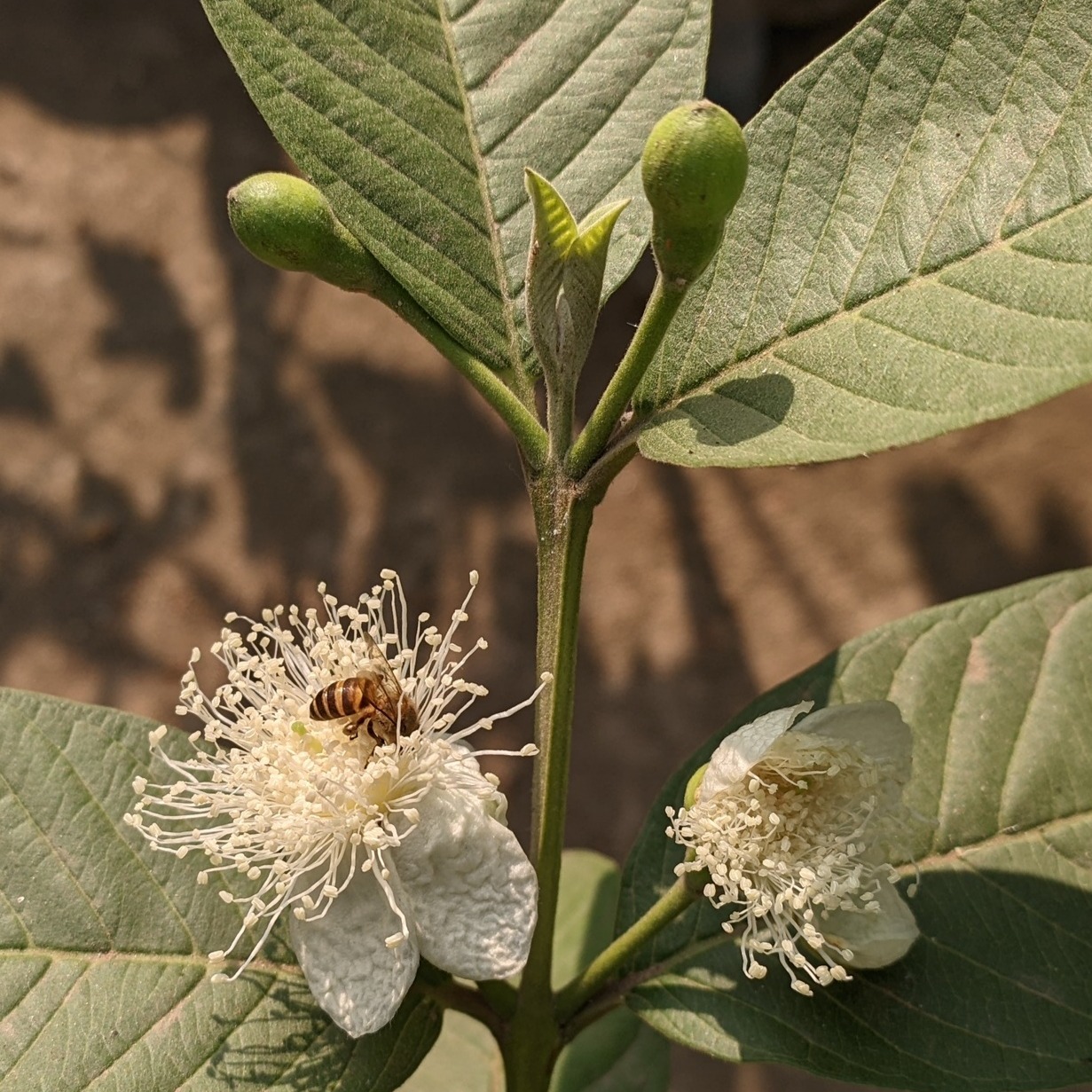
Psidium guajava is a small to medium-sized evergreen or semi-deciduous fruit tree, widely recognized for its hard wood and nutritious fruits. It reaches heights of 3 to 10 meters (10-33 feet), with a characteristic trunk featuring smooth, thin, copper-brown bark that peels off in papery scales, revealing a greenish inner layer. Its branches are quadrangular when young, with opposite, elliptical leaves that have very prominent veins on the underside. The flowers are white and fragrant, with numerous prominent stamens giving them a feathery appearance. The fruit is a globose or pyriform berry, with skin ranging from green to bright yellow when ripe. Its pulp can be white, pink, or red, filled with numerous small, hard seeds, and possesses a pungent, sweet aroma. It is a pioneer species that defines rural landscapes and forest edges throughout the Neotropics.

Added by

Anonymous Curator

Reviewed by

Under Review

Last modified by

Julia Trouin

TaxonomyBiological classification ranks placing this species within the tree of life, from Kingdom down to Genus.

PhylumRank below Kingdom. Groups organisms sharing a fundamental body plan (e.g., Chordata = vertebrates and some invertebrates).Tracheophyta
ClassRank below Phylum. Subdivides by structural traits (e.g., Mammalia, Aves, Reptilia, Insecta).Magnoliopsida
OrderRank below Class. Groups related families sharing common ancestry (e.g., Carnivora, Primates).Myrtales
FamilyRank below Order. Groups closely related genera (e.g., Felidae = cats, Canidae = dogs).Myrtaceae
GenusRank just above Species. The first word in the two-part binomial scientific name.Psidium
Taxonomic AuthorityThe scientist who first formally described and published this species, followed by the year of publication.L., 1753
Record Completeness
84%
Coming soon

Ecology & StatusHow this species lives: habitat preferences, diet, behavior, population status, and role in its ecosystem.

OriginWhether the species is native (evolved here), endemic (found only here), or introduced by human activity.

Native

Population TrendDirection of change in population size over time: increasing, stable, decreasing, or unknown.

Stable

Trophic RolePosition in the food chain: producer, herbivore, carnivore, omnivore, decomposer, or parasite.

--

Growth HabitPhysical form and structure of the plant: tree, shrub, herb, vine, epiphyte, aquatic, etc.

--

Leaf TypeLeaf characteristics: deciduous (seasonal shed), evergreen, simple, compound, needle-like, etc.

--

Flowering SeasonTime of year when this species typically reproduces or flowers.

Year Round

Recent SightingsWhether this species has been observed in the wild in Costa Rica within recent years.

Yes

Habitat SummaryOverview of the specific ecosystems and environments where this species is found in Costa Rica. Multi-lang

It is a highly adaptable species that thrives in a variety of tropical and subtropical climates, from sea level up to 1,500 meters (4,900 feet) in altitude. It prefers full sun and well-drained soils, although it tolerates temporary flooding and moderate droughts. It is commonly found in pastures, roadsides, secondary forests, and home gardens. In Costa Rica, it is distributed throughout the country, being particularly abundant in the rural areas of the Central Plateau and the Pacific and Caribbean plains.

Light & Water NeedsSunlight intensity and moisture levels this plant needs to grow and reproduce successfully. Multi-lang

Information not available in English. Help us expand this record!

BehaviourDaily activity patterns, movement, territory use, foraging style, and seasonal behavioral changes. Multi-lang

It is a fundamental species for seed dispersal in secondary forests. Its fruits are consumed by a vast diversity of fauna, from bats and birds to livestock and terrestrial mammals. When ingested, the hard seeds pass through the digestive tract without damage, facilitating long-distance dispersal (endozoochory). It is a pioneer plant that rapidly colonizes degraded lands, preparing the soil for the succession of mature forest species.

Toxicity / UsesToxic compounds present and their documented effects on humans or other organisms. Multi-lang

Information not available in English. Help us expand this record!

Physical Measures

Length (cm)

300.0 - 1000.0 cm

Reproductive StructuresFlowers, fruits, and seeds — the reproductive organs and their seasonal appearance.

Flower Photos (Max 2)

No image

Fruit Photos (Max 2)

No image

Evolutionary AdaptationsInherited traits and behaviors that improve the species' survival and reproduction in its specific environment. Multi-lang

Anti-epiphytic Exfoliating Bark: The ability to continuously shed its smooth bark is not just aesthetic; it is an adaptation to prevent parasitic or epiphytic plants (such as mosses or bromeliads) from establishing themselves on its trunk, keeping the surface clean and reducing pest load.
Aggressive Root System and Resprouting: It has a shallow but extensive root system that allows it to capture nutrients quickly. Furthermore, it has a high capacity to resprout from the base or roots if the main trunk is cut, making it very resistant to grazing and fire.

Main ThreatsDocumented pressures reducing the population: habitat loss, hunting, disease, climate change, and invasive species. Multi-lang

Fruit flies (Anastrepha spp.): The main biological threat is fruit fly larvae that infest the fruits, drastically reducing seed viability and food quality for wildlife and humans.

Interesting FactsSurprising or notable facts that highlight what makes this species unique or ecologically important. Multi-lang

Wood for Tools: Due to its fine grain and extreme hardness, guava wood is traditionally used in Costa Rica to manufacture handles for manual tools, such as axes and mallets, being highly prized for its impact resistance.