
Costa Rica Species
Celeus loricatus
AnimaliaHighest rank in taxonomy. Groups all life into domains: Animalia, Plantae, Fungi, etc.IUCN LCInternational Union for Conservation of Nature — the world authority on species extinction risk, using standardized criteria. — Least Concern — widespread and abundant; not at immediate risk of extinction.In ProgressCurrent stage of this record in the editorial review workflow. Recent Sighting

Celeus loricatus

Cinnamon Woodpecker

(Reichenbach, 1854)

Detailed Texts Multi-lang
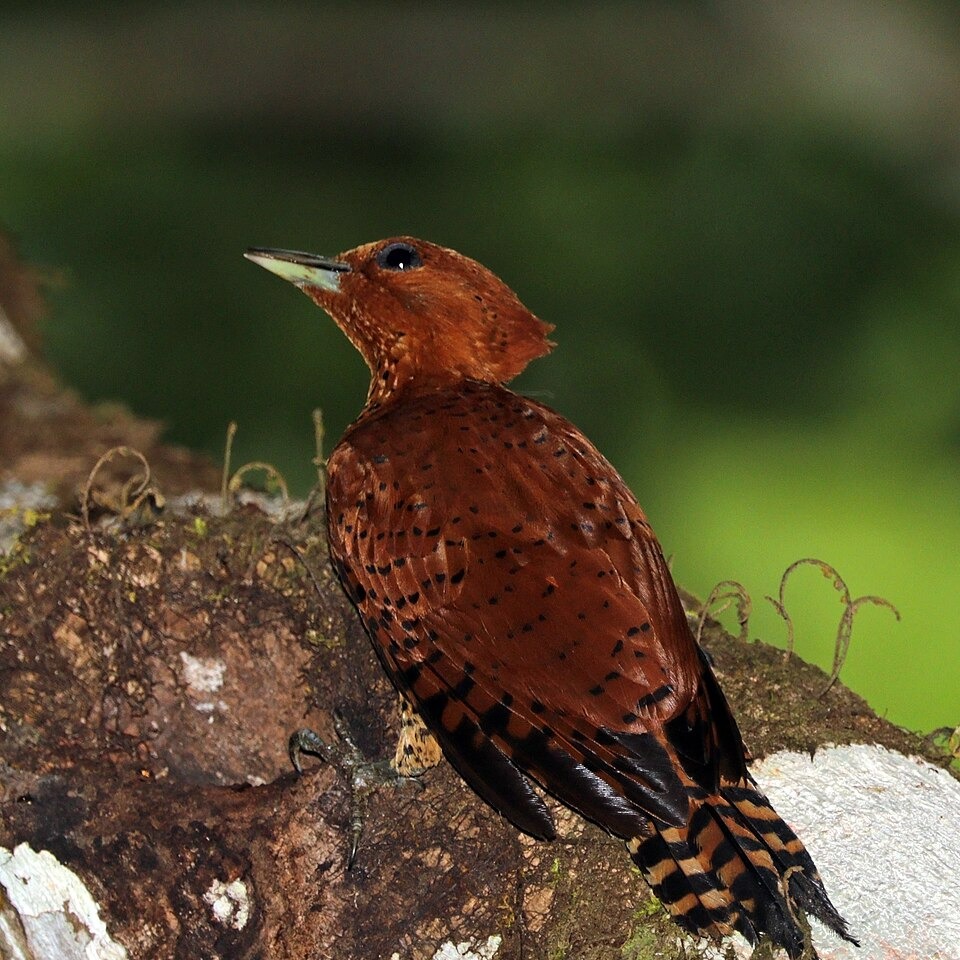
The Cinnamon Woodpecker (Celeus loricatus) is a medium-sized bird with an extraordinarily cryptic and attractive plumage. Its body is predominantly a rich cinnamon, rufous, or light chestnut color. It features a dense pattern of black scales, barring, and 'V' shaped marks on its back, wings, and belly. Its head sports a bushy and often 'messy' or unkempt-looking crest. The bill is pointed, of moderate length, and a pale yellowish or horn color, contrasting with the darker plumage. Males exhibit a distinctive red patch on the malar area (the cheek) and sometimes the throat, which is completely absent in females.

Added by

Anonymous Curator

Reviewed by

Under Review

Last modified by

Julia Trouin

TaxonomyBiological classification ranks placing this species within the tree of life, from Kingdom down to Genus.

PhylumRank below Kingdom. Groups organisms sharing a fundamental body plan (e.g., Chordata = vertebrates and some invertebrates).Chordata
ClassRank below Phylum. Subdivides by structural traits (e.g., Mammalia, Aves, Reptilia, Insecta).Aves
OrderRank below Class. Groups related families sharing common ancestry (e.g., Carnivora, Primates).Piciformes
FamilyRank below Order. Groups closely related genera (e.g., Felidae = cats, Canidae = dogs).Picidae
GenusRank just above Species. The first word in the two-part binomial scientific name.Celeus
Taxonomic AuthorityThe scientist who first formally described and published this species, followed by the year of publication.(Reichenbach, 1854)
Record Completeness
85%
Coming soon

Ecology & StatusHow this species lives: habitat preferences, diet, behavior, population status, and role in its ecosystem.

OriginWhether the species is native (evolved here), endemic (found only here), or introduced by human activity.

Native

Population TrendDirection of change in population size over time: increasing, stable, decreasing, or unknown.

Decreasing

Breeding SeasonTime of year when this species typically reproduces or flowers.

Dry Season

Trophic RolePosition in the food chain: producer, herbivore, carnivore, omnivore, decomposer, or parasite.

Insectivore

Recent SightingsWhether this species has been observed in the wild in Costa Rica within recent years.

Yes

Habitat SummaryOverview of the specific ecosystems and environments where this species is found in Costa Rica. Multi-lang

It is a strictly forest-dwelling species that prefers the canopy and mid-stories of humid tropical rainforests, gallery forests, and the edges of tall jungles. It rarely descends to the understory. In Costa Rica, it is confined almost exclusively to the humid lowlands and foothills of the Caribbean slope (such as Sarapiquí, Limón, and the northern zone), from sea level up to about 700 meters in elevation.

BehaviourDaily activity patterns, movement, territory use, foraging style, and seasonal behavioral changes. Multi-lang

It is a bird of agile but not frenetic movements, foraging in the canopy and subcanopy (generally above 10 meters high). It scrutinizes branches covered in moss, vines, and epiphytes. It is often observed pecking at arboreal carton nests of termites or ants, using its stiff tail as support. It usually travels in pairs and occasionally joins mixed-species canopy foraging flocks.

Social ActivitySocial structure: whether the species is solitary, paired, or colonial; hierarchy and communication. Multi-lang

Generally observed solitarily or in widely dispersed monogamous pairs through the canopy. They are peaceful birds that tolerate the presence of other species, joining mixed-species flocks without showing extreme territorial aggressiveness.

Feeding GuildWhat the species eats, how it forages or hunts, and its role as a consumer in the food web. Multi-lang

Insectivore / Bark gleaner and excavator.

Trophic Chain DetailsSpecific interactions in local food webs: prey species, predators, competitors, and scavengers. Multi-lang

Carnivore (Myrmecophagous and Insectivore). It feeds predominantly on arboreal ants and termites (larvae, eggs, and adults). It may supplement its diet with other small arthropods and rarely some fruit. Due to its size and habitat, adults can be preyed upon by forest falcons (e.g., Micrastur), while climbing snakes (Spilotes) are a threat to their nesting cavities.

Reproductive BehaviourMating strategies, courtship displays, nesting or spawning behavior, and parental care. Multi-lang

Monogamous birds. The pair collaborates in excavating a deep cylindrical cavity, generally in the dead trunk or branch of a softwood tree, at considerable heights (5 to 15 meters). They often prefer dead cecropia trunks or palm trees. They use no additional lining; the female lays 2 to 3 white eggs directly on the wood shavings at the bottom of the cavity. Both parents take turns incubating (about 13 to 15 days) and feed the altricial chicks by regurgitating masses of ants and termites until the young fledge about three weeks later.

Physical Measures

Length (cm)

20.0 - 23.0 cm

Weight (Grams)

55 g - 75 g

Offspring per cycleTypical number of young (live births, eggs, or seeds) produced by one adult in a single reproductive event or breeding season.2 - 3
Sexual DimorphismObservable physical differences between males and females of the same species (e.g., size, coloration, features).Yes

Lifespan

Sexual MaturityAge at which the individual becomes capable of reproducing for the first time.

12 - 18 Months

Gestation / IncubationDuration from fertilization to birth (mammals) or to hatching (egg-laying species).

13 - 15

Lifespan EstimatedExpected duration of life from birth to natural death under wild conditions.
Males5 - 8 Years
Females5 - 8 Years

Sexual DimorphismPhysical differences in size, coloration, or morphology between males and females of this species.

Males Multi-lang

The adult male is clearly distinguished by presenting a bright crimson red stripe or patch in the malar region (the cheeks or base of the bill) and, in some subspecies, slightly on the throat.

Females Multi-lang

The female is identical in size and in the rest of the scaled plumage, but completely lacks any red marks on the face, having the malar area and throat the same dark cinnamon or black-scaled color as the rest of the head.

Evolutionary AdaptationsInherited traits and behaviors that improve the species' survival and reproduction in its specific environment. Multi-lang

Carton-nest Breaker: Unlike woodpeckers that drill into hard wood looking for beetles, the Celeus genus has a bill adapted to break open and dismantle the arboreal carton nests of termites and ants. Its tongue is exceptionally long and sticky to extract hundreds of small insects at once.
Rotten Wood Camouflage: Its strongly black-scaled cinnamon plumage perfectly breaks up its silhouette high in the canopy. When it clings motionless to a damp trunk covered in moss and vines, it looks exactly like a piece of rotting wood or a dry bromeliad, evading aerial predators.

Main ThreatsDocumented pressures reducing the population: habitat loss, hunting, disease, climate change, and invasive species. Multi-lang

Deforestation of Humid Lowlands: Being highly dependent on intact humid jungles, the massive conversion of Caribbean forests into agricultural plantations (banana, pineapple) and cattle pastures irreparably destroys its habitat.
Loss of Dead Wood and Termite Nests: It requires decaying trees both for nesting (excavating soft cavities) and for foraging termites. Selective logging or 'cleaning' of the forest impacts its survival.

Interesting FactsSurprising or notable facts that highlight what makes this species unique or ecologically important. Multi-lang

The Silent Woodpecker: Unlike the loud Pale-billed Woodpecker (Campephilus) that drums forcefully to mark territory, the Cinnamon Woodpecker is a fairly discreet and quiet bird. It rarely drums loudly; instead, it emits soft whistles ('pweeeet!') and forages with delicate tapping to avoid alerting predators.
Specialized Diet (Myrmecophagy): Although it is a woodpecker, its diet and ecology closely resemble those of anteaters or woodcreepers. Much of its life consists of tracking pheromones and mud tunnels of arboreal termites, ignoring most beetles and fruits.