
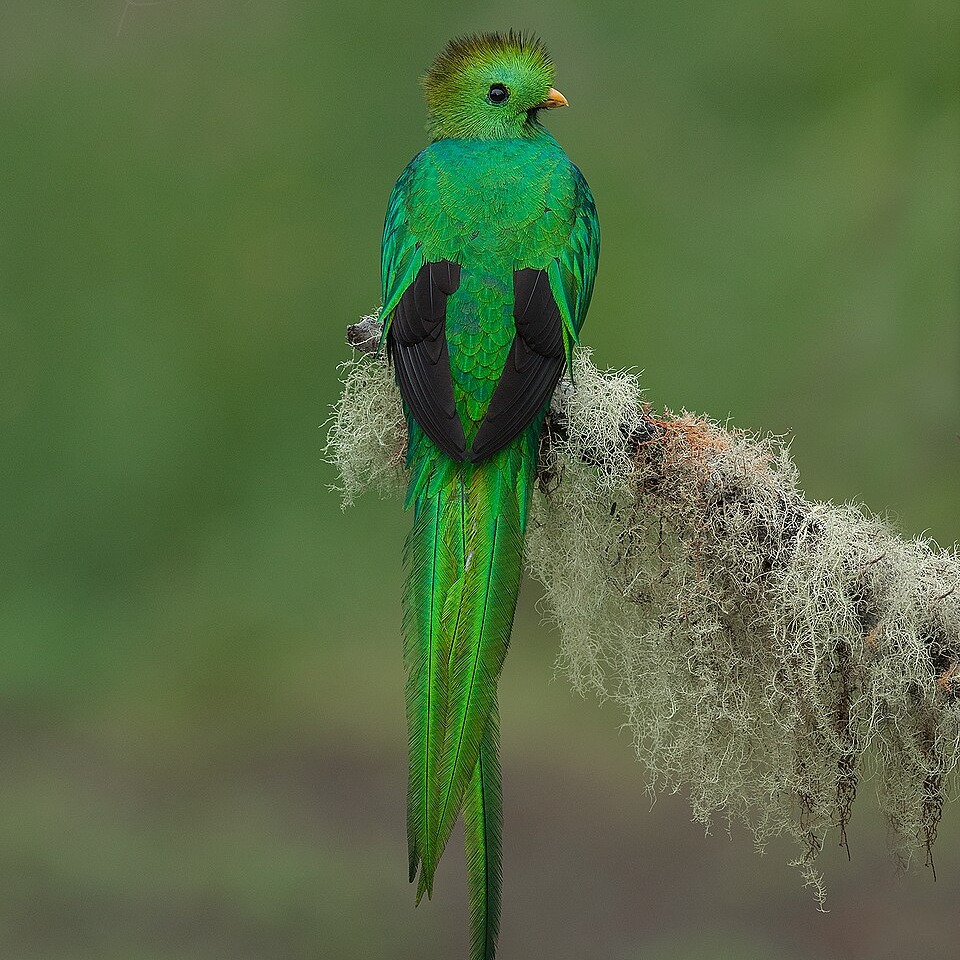
Pharomachrus mocinno
Resplendent Quetzal
(Lesson, 1832)
Added by
Anonymous Curator
Reviewed by
Under Review
Last modified by
Julia Trouin
TaxonomyBiological classification ranks placing this species within the tree of life, from Kingdom down to Genus.
Ecology & StatusHow this species lives: habitat preferences, diet, behavior, population status, and role in its ecosystem.
OriginWhether the species is native (evolved here), endemic (found only here), or introduced by human activity.
Native
Population TrendDirection of change in population size over time: increasing, stable, decreasing, or unknown.
Decreasing
Breeding SeasonTime of year when this species typically reproduces or flowers.
--
Trophic RolePosition in the food chain: producer, herbivore, carnivore, omnivore, decomposer, or parasite.
Frugivore
Recent SightingsWhether this species has been observed in the wild in Costa Rica within recent years.
Yes
Habitat SummaryOverview of the specific ecosystems and environments where this species is found in Costa Rica. Multi-lang
The resplendent quetzal inhabits exclusively cloud forests and humid montane forests between 1,200 and 3,200 meters in altitude, with the optimal range between 1,800 and 2,800 meters. It requires mature forests with high density of trees from the family Lauraceae — especially avocado relatives of the genus Persea and Ocotea — which are its primary food source. It also requires old trees with natural cavities or woodpecker nests for nesting. In Costa Rica it is concentrated primarily in the Talamanca Mountain Range, the Central Volcanic Mountain Range, the Cerros de la Muerte, and the area of La Amistad International Park. During the non-reproductive season it performs altitudinal movements toward lower zones — between 1,000 and 1,500 meters — following the fruiting phenology of the Lauraceae, in one of the most documented altitudinal migrations of any Central American bird. Its presence is an unambiguous indicator of well-conserved cloud forest.BehaviourDaily activity patterns, movement, territory use, foraging style, and seasonal behavioral changes. Multi-lang
The quetzal is primarily diurnal with activity peaks at dawn and dusk. It spends most of its time perched motionless on subcanopy and canopy branches, making it exceptionally difficult to detect despite its brilliant coloration. It makes short, direct flights between fruiting Lauraceae trees, frequently returning to the same productive trees day after day. Its territory ranges between 6 and 10 km² during the breeding season, which it actively defends through song. Outside the breeding season, individuals perform seasonal altitudinal movements of up to 1,000 meters in elevation difference, following the fruiting phenology of aguacatillo trees. These altitudinal migrations are not entirely predictable at the individual level and differ between years according to food availability. It sleeps in tree cavities or in dense canopy branches.Social ActivitySocial structure: whether the species is solitary, paired, or colonial; hierarchy and communication. Multi-lang
The quetzal is primarily solitary outside the breeding season. Adult individuals maintain exclusive territories during the nesting period — March to June in Costa Rica — actively defended through song and aerial pursuits. Outside the breeding season, individuals may tolerate each other in highly productive aguacatillo trees, where transitory concentrations of up to 15 individuals are observed without intense aggressive interaction. Communication is predominantly vocal: the male's territorial dawn song is the primary mechanism for maintaining individual space. Females also sing, though with less intensity and frequency than males. They do not form stable flocks or lasting family groups after juvenile independence.Feeding GuildWhat the species eats, how it forages or hunts, and its role as a consumer in the food web. Multi-lang
Specialized frugivore with seasonal insectivorous-carnivorous supplement. During the breeding season (March–June) the diet consists almost exclusively of Lauraceae fruits (Persea spp., Ocotea spp., Nectandra spp.) to meet the high energy demands of reproduction. Outside the breeding season and during chick feeding, it incorporates insects (especially wasps, chrysomelids, and other canopy beetles), larvae, tree snails, small frogs (especially glass frogs), and lizards. Chicks receive a mixed diet of small vertebrates and insects during the first weeks, gradually supplemented with Lauraceae fruits as they mature. It does not store food.Trophic Chain DetailsSpecific interactions in local food webs: prey species, predators, competitors, and scavengers. Multi-lang
Specialized frugivorous primary consumer and seed disperser of critical ecosystem importance. It consumes primarily Lauraceae fruits (Persea spp., Ocotea spp., Nectandra spp., Licaria spp.) representing 80% or more of its diet during the breeding season; it supplements with fruits of other families (Ericaceae, Myrtaceae, Clusiaceae), insects, larvae, small frogs, lizards, and snails. By regurgitating seeds at distances of up to 400 m from the mother tree, it is the primary regeneration vector of canopy Lauraceae in cloud forests. Its documented predators include the solitary eagle (Buteogallus solitarius), sharp-shinned hawk (Accipiter striatus), collared forest-falcon (Micrastur semitorquatus), puma (Puma concolor), and pine marten (Martes americana) in zones where they coexist. Snakes such as the fer-de-lance (Bothrops asper) can predate eggs and chicks in low-altitude nests.Reproductive BehaviourMating strategies, courtship displays, nesting or spawning behavior, and parental care. Multi-lang
The breeding season in Costa Rica extends primarily from March to June, coinciding with the highest availability of Lauraceae fruits. Males establish and proclaim their territories through intense singing from the tops of emergent trees before dawn. Courtship includes acrobatic flights in which the male ascends vertically above the canopy and dives with the long tail plumes waving, and aerial pursuits between male and female. Both sexes participate in nest excavation in dead trunks or rotting soft-wood branches — especially standing dead aguacatillo — using the bill as a tool. The cavity typically measures 15–25 cm in interior diameter. The clutch normally consists of 2 pale blue or bluish-green eggs. Both sexes incubate: the male during the day and the female at night, for 17 to 19 days. Chicks hatch altricial — blind and with scant down — and are fed by both parents with an initial diet of small vertebrates and insects, gradually supplemented with fruits. The nestling period lasts between 23 and 31 days. Juveniles reach complete plumage at 12–18 months and the full adult male plumage — including elongated tail plumes — between 3 and 5 years.Physical Measures
Length (cm)
36.0 - 40.0 cm
Weight (Grams)
180 g - 230 g
Lifespan
Sexual MaturityAge at which the individual becomes capable of reproducing for the first time.
3 - 5 Years
Gestation / IncubationDuration from fertilization to birth (mammals) or to hatching (egg-laying species).
17 - 19