
Costa Rica Species
Rhinella horribilis
AnimaliaHighest rank in taxonomy. Groups all life into domains: Animalia, Plantae, Fungi, etc.IUCN LCInternational Union for Conservation of Nature — the world authority on species extinction risk, using standardized criteria. — Least Concern — widespread and abundant; not at immediate risk of extinction.In ProgressCurrent stage of this record in the editorial review workflow. Recent Sighting

Rhinella horribilis

Mesoamerican Cane Toad

Wiegmann, 1833

Detailed Texts Multi-lang
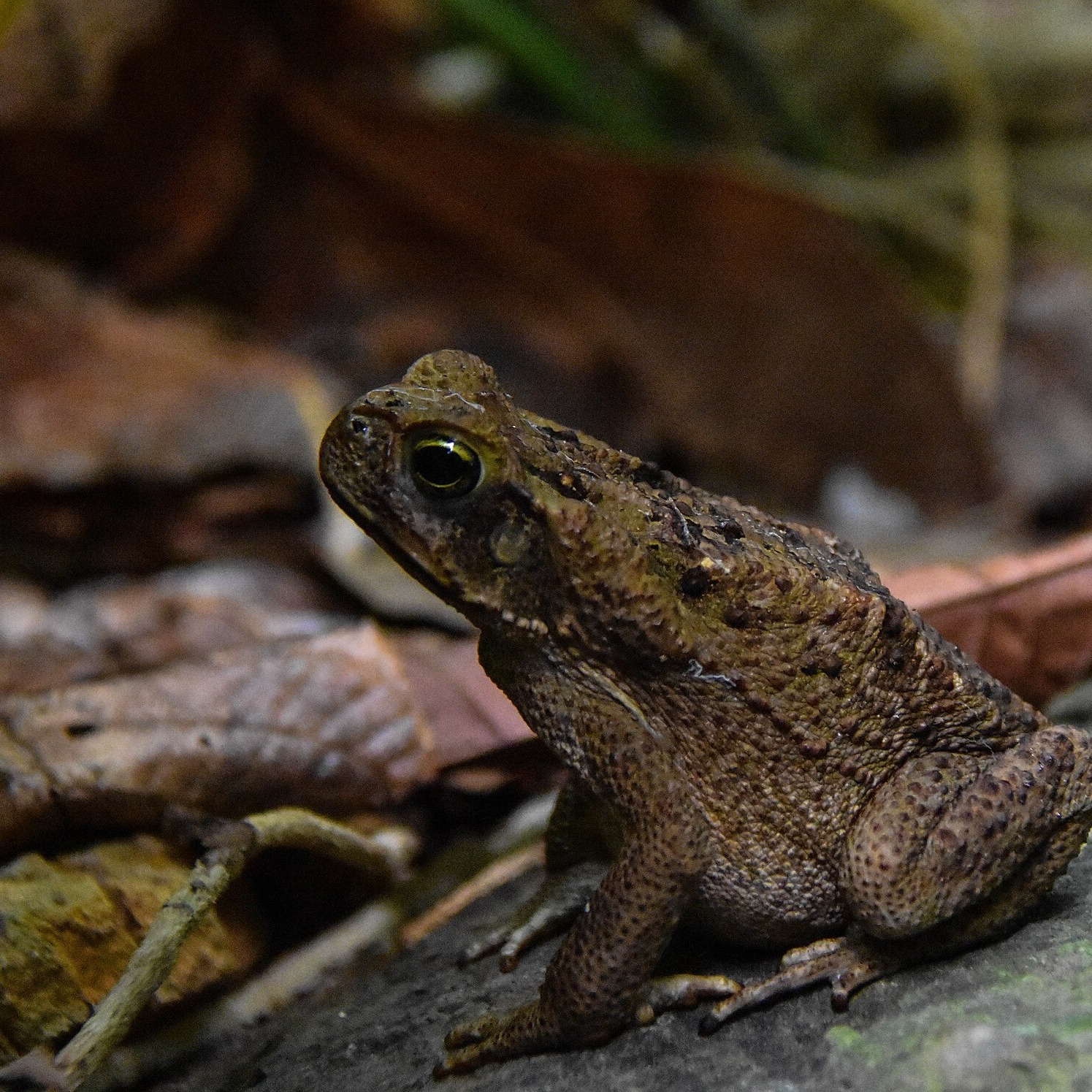
The Mesoamerican cane toad or giant toad (Rhinella horribilis) is the largest amphibian in Central America and one of the most massive toads in the world. Historically classified as Rhinella marina, recent genetic studies demonstrated that populations from southern Texas to northern South America (including Costa Rica) constitute a distinct species: R. horribilis. It possesses an extremely robust, squat body covered in keratinized warts. Its coloration ranges from dark grayish-brown to reddish or yellowish tones, with a dark-mottled belly. Its most distinctive and lethal feature is the enormous, swollen parotoid glands located just behind its eardrums and extending over the shoulders. These glands secrete bufotoxin, a highly toxic milky poison capable of killing large predators and even pets. It is a terrestrial, resilient, highly adaptable amphibian infamous for its voracious appetite.

Added by

Anonymous Curator

Reviewed by

Under Review

Last modified by

Julia Trouin

TaxonomyBiological classification ranks placing this species within the tree of life, from Kingdom down to Genus.

PhylumRank below Kingdom. Groups organisms sharing a fundamental body plan (e.g., Chordata = vertebrates and some invertebrates).Chordata
ClassRank below Phylum. Subdivides by structural traits (e.g., Mammalia, Aves, Reptilia, Insecta).Amphibia
OrderRank below Class. Groups related families sharing common ancestry (e.g., Carnivora, Primates).Anura
FamilyRank below Order. Groups closely related genera (e.g., Felidae = cats, Canidae = dogs).Bufonidae
GenusRank just above Species. The first word in the two-part binomial scientific name.Rhinella
Taxonomic AuthorityThe scientist who first formally described and published this species, followed by the year of publication.Wiegmann, 1833
Record Completeness
94%
Coming soon

Ecology & StatusHow this species lives: habitat preferences, diet, behavior, population status, and role in its ecosystem.

OriginWhether the species is native (evolved here), endemic (found only here), or introduced by human activity.

Native

Population TrendDirection of change in population size over time: increasing, stable, decreasing, or unknown.

Stable

Breeding SeasonTime of year when this species typically reproduces or flowers.

--

Trophic RolePosition in the food chain: producer, herbivore, carnivore, omnivore, decomposer, or parasite.

Omnivore

Recent SightingsWhether this species has been observed in the wild in Costa Rica within recent years.

Yes

Habitat SummaryOverview of the specific ecosystems and environments where this species is found in Costa Rica. Multi-lang

It is probably the amphibian with the greatest ecological breadth in the Neotropics. Although its original habitat consists of humid and dry tropical forests, savannas, and open riparian zones, its impressive adaptability allows it to colonize almost any human-altered ecosystem. It thrives in disturbed landscapes such as cattle pastures, sugarcane plantations, drainage canals, suburban gardens, and the very center of Costa Rican cities. It only requires small puddles of stagnant water, ditches, or gutters to reproduce, and it can even tolerate brackish water, which is unheard of for most amphibians.

BehaviourDaily activity patterns, movement, territory use, foraging style, and seasonal behavioral changes. Multi-lang

Strictly nocturnal and terrestrial habits. It spends the hot hours of the day buried under leaf litter, rocks, rotting wood, sewer pipes, or any debris that provides shade and moisture. At dusk, it emerges and walks (rather than hops) seeking open or artificially lit areas. It is very common to observe multiple giant toads sitting stoically under streetlights in Costa Rica, waiting patiently for insects to fall to the ground after hitting the light. If attacked by a predator, they do not flee quickly; instead, they inflate by filling their lungs with air to appear too large to be swallowed and tilt their head to expose their venomous glands.

Social ActivitySocial structure: whether the species is solitary, paired, or colonial; hierarchy and communication. Multi-lang

It is a passively tolerant, gregarious amphibian outside of the mating season. They often share the same moist hiding spots under rocks or porches and feed peacefully in high concentrations at shared food sources (for example, under the same streetlamp). They lack a complex hierarchical structure or family bonds. True social interaction is exclusively reproductive, during which aggregated males emit a competitive chorus, and females select a male through tactile inspection before allowing amplexus.

Feeding GuildWhat the species eats, how it forages or hunts, and its role as a consumer in the food web. Multi-lang

Generalist terrestrial carnivore/omnivore (Sit-and-wait and active foraging). It employs both tactics: passive ambush waiting for prey to cross its path, or active sniffing (it extensively uses its sense of smell to find carrion or stationary food, like dog food or rotting plant matter). It captures victims by rapidly extending its long, sticky tongue attached at the front of its mouth.

Trophic Chain DetailsSpecific interactions in local food webs: prey species, predators, competitors, and scavengers. Multi-lang

It is an omnivorous secondary or tertiary consumer in the Neotropical food web. It gulps down beetles, wasps, destructive ants, spiders, centipedes, and even baby mice, other frogs, lizards, and small snakes. Thus, they act as incredibly effective pest controllers. Their venomous defenses kill inexperienced mammals and crocodiles, but several native Costa Rican species have evolved immunity or clever strategies to evade the venom. The great-tailed grackle (Quiscalus mexicanus) pecks them and flips them over with its beak to eat their stomach and intestines from below, avoiding the poisonous glands on the back. Certain snakes and carnivorous ants also prey on newly metamorphosed toadlets, whose toxin levels are still low.

Reproductive BehaviourMating strategies, courtship displays, nesting or spawning behavior, and parental care. Multi-lang

They have an explosive reproductive potential that contributes to their biological success. When the rainy season begins (May in Mesoamerica), males approach stagnant puddles, ditches, or slow rivers and emit a deep, continuous trill resembling a distant tractor engine to attract females. After securing axillary amplexus, the female enters the water and extrudes double, transparent gelatinous strings (which can measure several meters long), wrapping them around submerged vegetation. A single large female can release an astonishing 8,000 to 30,000 toxic eggs in a single clutch. The eggs hatch rapidly, between 48 hours and a week later. The tiny black tadpoles group together in dense swarms at the water's edge to thermoregulate and complete their metamorphosis in barely a month, emerging as thumbnail-sized toadlets.

Physical Measures

Length (cm)

10.0 - 24.0 cm

Weight (Grams)

200 g - 1.50 kg

Offspring per cycleTypical number of young (live births, eggs, or seeds) produced by one adult in a single reproductive event or breeding season.8000 - 30000
Sexual DimorphismObservable physical differences between males and females of the same species (e.g., size, coloration, features).Yes

Lifespan

Sexual MaturityAge at which the individual becomes capable of reproducing for the first time.

1 - 2 Years

Gestation / IncubationDuration from fertilization to birth (mammals) or to hatching (egg-laying species).

2 - 7

Lifespan EstimatedExpected duration of life from birth to natural death under wild conditions.
Males10 - 15 Years
Females10 - 15 Years

Sexual DimorphismPhysical differences in size, coloration, or morphology between males and females of this species.

Males Multi-lang

Adult males are significantly smaller and less bulky than females. They have much rougher skin, with warts ending in small dark keratinized spines, giving them a sandpaper-like texture (which helps retain moisture and heat). During the mating season, the skin of their throat darkens and distends to form the vocal sac, and they develop nuptial pads (thick, dark, spiny cushions) on the first two fingers of their front feet, indispensable for firmly anchoring themselves to the slippery back of the female during aquatic amplexus.

Females Multi-lang

Adult females exhibit sexual gigantism; they grow much larger and weigh significantly more than males (some can exceed 20 cm in length and a kilogram and a half in weight under ideal conditions). Their skin is usually comparatively smoother, with less pointed warts, and their colors tend toward more contrasting patterns (light and dark mottling). Lacking a vocal sac, their throat is pale and firm. The enormous space in their balloon-shaped belly allows them to carry thousands of eggs ready for fertilization.

Evolutionary AdaptationsInherited traits and behaviors that improve the species' survival and reproduction in its specific environment. Multi-lang

Parotoid glands and bufotoxins: Its primary line of defense is a highly lethal cocktail of toxins secreted by large glands behind its head. When bitten or stressed, it exudes a thick white poison containing cardiotoxic compounds (bufadienolides) that cause immediate cardiac arrest in dogs, felines, crocodiles, and even predatory snakes. This makes it an almost invulnerable animal as an adult.
Water absorption and resilient skin: Unlike most amphibians that dehydrate rapidly, the giant toad has thick, keratinized skin that minimizes water loss. Furthermore, they possess a 'pelvic patch' (a highly vascularized area of skin on their abdomen) that allows them to rehydrate quickly simply by sitting on damp mud or dewy grass, enabling them to colonize dry or urban habitats.
Extreme dietary opportunism: They are indiscriminate generalists. Their broad diet range includes massive live prey (rodents, birds, other frogs), toxic insects that other animals avoid, plant matter, human household garbage, and pet food left in yards. Their dietary adaptability is key to their invasion and domination of altered ecosystems.

Main ThreatsDocumented pressures reducing the population: habitat loss, hunting, disease, climate change, and invasive species. Multi-lang

Vehicular collisions (Roadkill): Due to their habit of using open asphalt roads during rainy nights to warm up and migrate towards breeding ponds, thousands are crushed to death by vehicles annually, making this the leading cause of adult mortality.
Intentional human persecution: Because of their appearance, which is often considered 'ugly', their venomous reputation (which can indeed be fatal to domestic dogs), and the myth that they transmit warts, giant toads face continuous intentional killings by homeowners and farmers.

Interesting FactsSurprising or notable facts that highlight what makes this species unique or ecologically important. Multi-lang

Taxonomic split and the Australian catastrophe: For a long time, this toad was believed to be Rhinella marina. R. marina (the South American cane toad) was catastrophically introduced into Australia and Hawaii to control agricultural pests, becoming the worst invasive pest on the oceanic continent itself. 2016 DNA studies revealed that the natural Mesoamerican lineage reaching down to Costa Rica (R. horribilis) is actually a geographically and genetically separate species, meaning the famous invader of Australia does not come from Central America.
Lethal hallucinogenic latex: The bufotoxins exuded from their backs contain bufotenin, an active hallucinogenic steroid that alters the heart rate. In the wild, an inexperienced domestic dog that bites this toad will suffer convulsions, foaming at the mouth, and possibly death from cardiac arrest in less than 15 minutes if it doesn't receive emergency veterinary treatment.
Not true pests in Costa Rica: Although they are the global poster child for an 'invasive species' due to the ecological crisis in Australia, in Costa Rica and Central America the giant toad is a native species living in dynamic equilibrium. Local ecosystems have evolved with them over millennia, and certain specialized predators keep them under ecological control.