
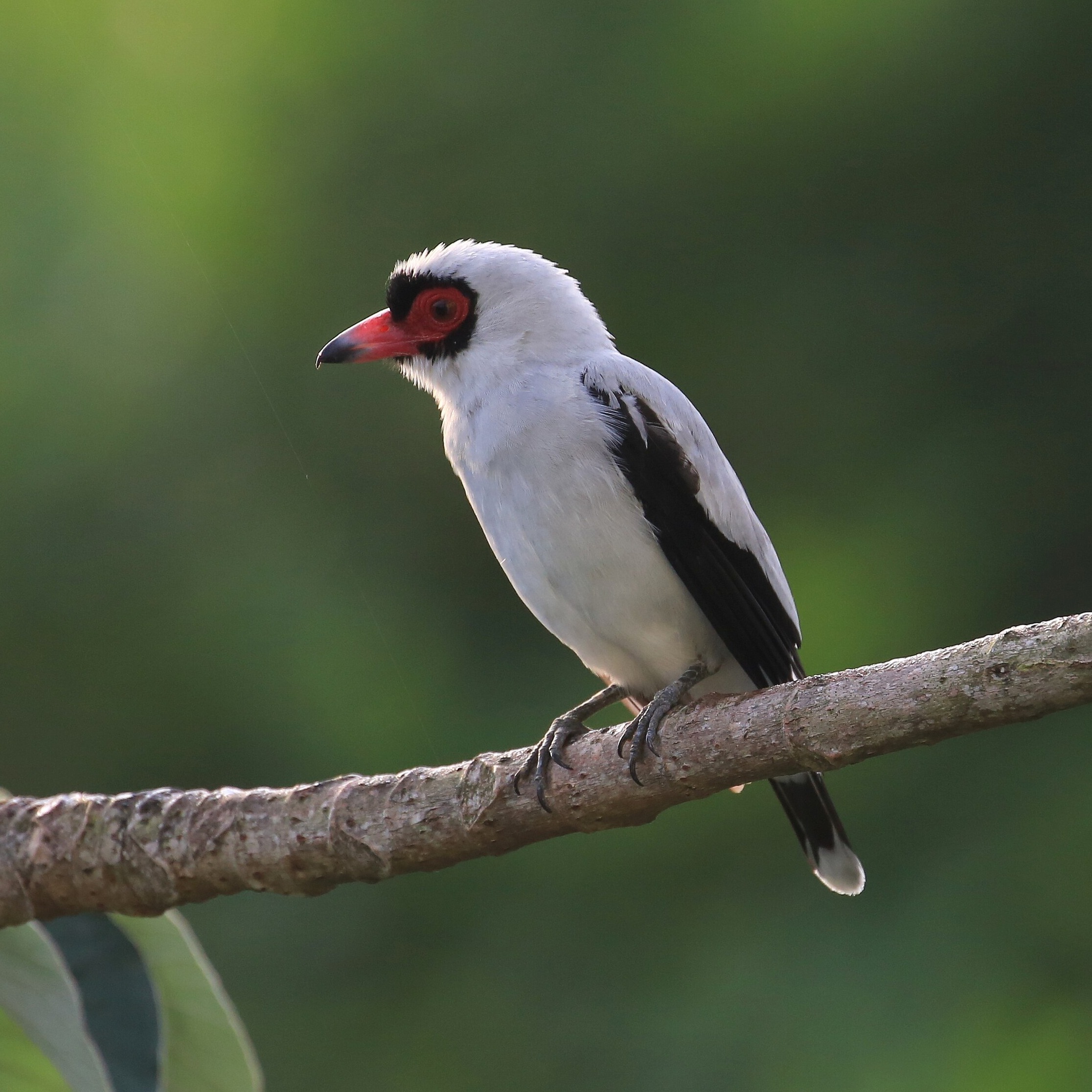
Tityra semifasciata
Masked Tityra
(Spix, 1825)
Added by
Anonymous Curator
Reviewed by
Under Review
Last modified by
Julia Trouin
TaxonomyBiological classification ranks placing this species within the tree of life, from Kingdom down to Genus.
Ecology & StatusHow this species lives: habitat preferences, diet, behavior, population status, and role in its ecosystem.
OriginWhether the species is native (evolved here), endemic (found only here), or introduced by human activity.
Native
Population TrendDirection of change in population size over time: increasing, stable, decreasing, or unknown.
Stable
Breeding SeasonTime of year when this species typically reproduces or flowers.
--
Trophic RolePosition in the food chain: producer, herbivore, carnivore, omnivore, decomposer, or parasite.
Insectivore
Recent SightingsWhether this species has been observed in the wild in Costa Rica within recent years.
Yes
Habitat SummaryOverview of the specific ecosystems and environments where this species is found in Costa Rica. Multi-lang
It inhabits widely in tropical and subtropical regions from northern Mexico to northwestern South America. In Central America and Costa Rica, it is common on both slopes (Pacific and Caribbean) at elevations ranging from sea level to 1,800 meters in altitude. It prefers the canopy and edges of humid primary forests, mature secondary forests, semi-open areas with scattered tall trees, forest plantations, and regenerating forest clearings, avoiding the dense and gloomy interior of the understory.BehaviourDaily activity patterns, movement, territory use, foraging style, and seasonal behavioral changes. Multi-lang
It is a diurnal bird that moves conspicuously and solitarily, or in stable pairs, along the high horizontal branches of the canopy. It inspects the surrounding foliage with deliberate head movements before launching into a short flight to pluck a fruit or capture prey. Although it defends the territory surrounding its nest with great ferocity against other tityras and cavity competitors, outside the breeding season it is relatively tolerant and can temporarily join dense fruiting trees along with other medium-sized bird species.Social ActivitySocial structure: whether the species is solitary, paired, or colonial; hierarchy and communication. Multi-lang
They are usually seen solitarily or in strongly associated monogamous pairs that remain together throughout the year. They maintain a regular territorial spacing in the upper canopy and do not form cohesive single-species flocks. Occasionally, they are seen engaging in short-lived aggressive interactions with neighboring tityras if nesting territorial boundaries are crossed.Feeding GuildWhat the species eats, how it forages or hunts, and its role as a consumer in the food web. Multi-lang
Omnivore with a strong frugivorous tendency (frugivore-insectivore). Its diet mainly consists of a wide variety of fleshy fruits and berries from the forest canopy (Lauraceae, Burseraceae, Moraceae). It actively supplements this plant base by capturing large arboreal insects such as grasshoppers, cicadas, fleshy caterpillars, and beetles, as well as small lizards of the genus Anolis skillfully snatched from trunks.Trophic Chain DetailsSpecific interactions in local food webs: prey species, predators, competitors, and scavengers. Multi-lang
It acts as a secondary consumer and an important canopy frugivore-insectivore. It is a crucial agent in seed dispersal for large trees such as Ficus, Virola, and various Lauraceae, swallowing the fruits whole and evacuating the viable seeds. It shares the canopy with toucans, Black-crowned Tityras, and cotingas. Its eggs and chicks in cavities are vulnerable to predation by arboreal snakes (Spilotes pullatus), forest falcons, and small climbing mammals such as capuchin monkeys.Reproductive BehaviourMating strategies, courtship displays, nesting or spawning behavior, and parental care. Multi-lang
It is a monogamous species where the female takes on nest construction inside a deep cavity, usually an abandoned woodpecker nest or the broken top of a dead palm tree at a high altitude (between 8 and 25 meters). The female sloppily fills the cavity with dry leaves, twigs, and pine needles. She lays 2 to 3 buff or light brown eggs with dark speckles and incubates alone for approximately 18 to 21 days, while the male stays nearby actively guarding against intruders. The chicks are born altricial (helpless and naked) and both parents cooperate intensely bringing berries and large insects during the 23 to 26 days it takes for them to fledge.Physical Measures
Length (cm)
20.0 - 22.0 cm
Weight (Grams)
45 g - 58 g
Lifespan
Sexual MaturityAge at which the individual becomes capable of reproducing for the first time.
1 - 2 Years
Gestation / IncubationDuration from fertilization to birth (mammals) or to hatching (egg-laying species).
18 - 21