
Costa Rica Species
Atta cephalotes
AnimaliaHighest rank in taxonomy. Groups all life into domains: Animalia, Plantae, Fungi, etc.IUCN NEInternational Union for Conservation of Nature — the world authority on species extinction risk, using standardized criteria. — Not Evaluated — not yet assessed against the IUCN Red List criteria.In ProgressCurrent stage of this record in the editorial review workflow. Recent Sighting

Atta cephalotes

Leafcutter Ant

Linnaeus, 1758

Detailed Texts Multi-lang
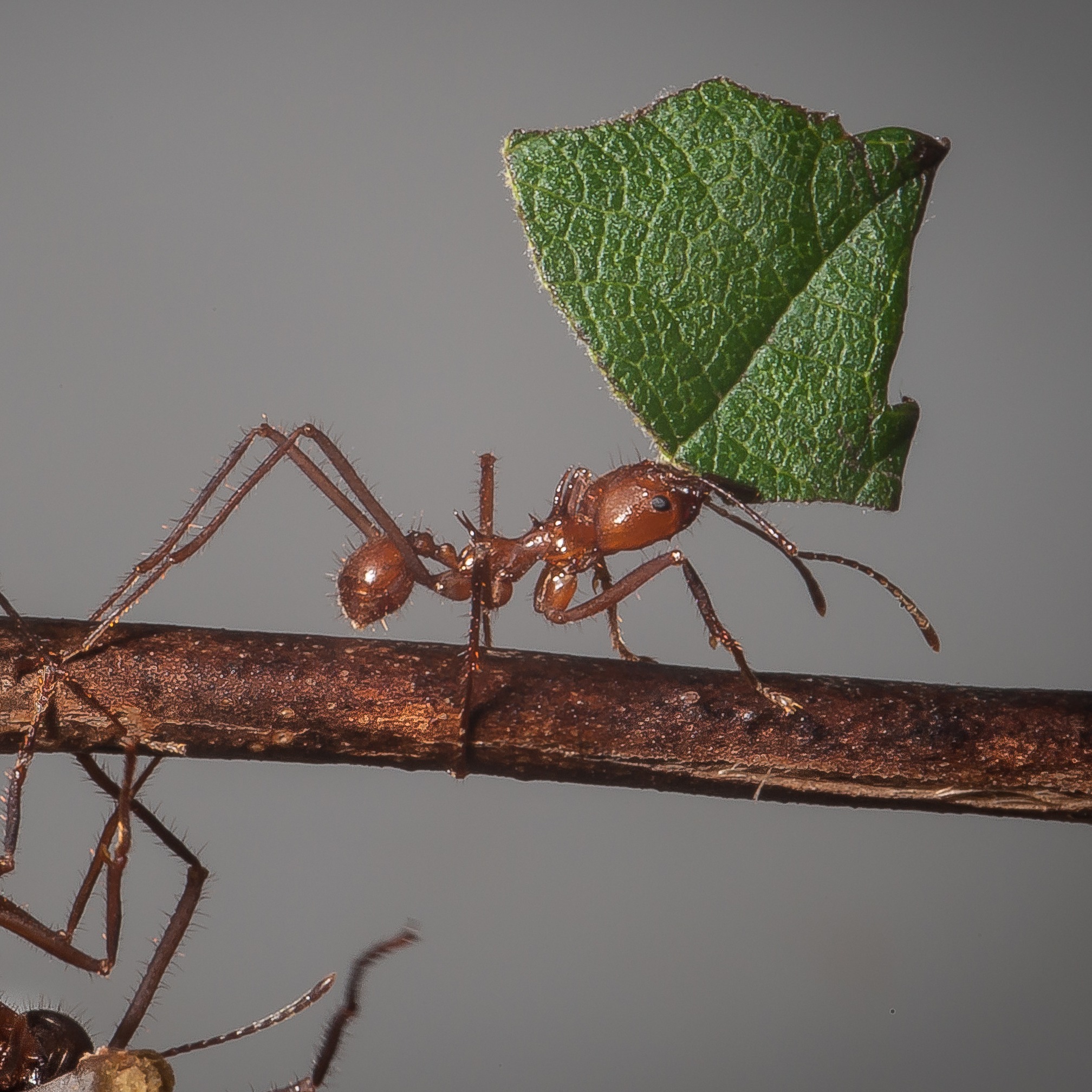
The leafcutter ant (Atta cephalotes) is one of the most well-known and ecologically dominant leaf-cutting ant species in the Neotropics. These ants are famous for forming endless, organized columns of workers carrying pieces of green leaves that look like tiny parasols. Their bodies are reddish-brown, and larger workers possess sharp spines on their thorax for defense. Far from eating the leaves, leafcutter ants are highly evolved farmers: they use the cut vegetation to cultivate a symbiotic fungus in immense underground chambers, which constitutes their sole food source. A single colony can house up to 8 million ants, structured in a highly specialized caste system based on worker size, ranging from tiny gardeners to massive soldiers with powerful mandibles. Their distribution extends from southern Mexico to South America.

Added by

Anonymous Curator

Reviewed by

Under Review

Last modified by

Julia Trouin

TaxonomyBiological classification ranks placing this species within the tree of life, from Kingdom down to Genus.

PhylumRank below Kingdom. Groups organisms sharing a fundamental body plan (e.g., Chordata = vertebrates and some invertebrates).Arthropoda
ClassRank below Phylum. Subdivides by structural traits (e.g., Mammalia, Aves, Reptilia, Insecta).Insecta
OrderRank below Class. Groups related families sharing common ancestry (e.g., Carnivora, Primates).Hymenoptera
FamilyRank below Order. Groups closely related genera (e.g., Felidae = cats, Canidae = dogs).Formicidae
GenusRank just above Species. The first word in the two-part binomial scientific name.Atta
Taxonomic AuthorityThe scientist who first formally described and published this species, followed by the year of publication.Linnaeus, 1758
Record Completeness
94%
Coming soon

Ecology & StatusHow this species lives: habitat preferences, diet, behavior, population status, and role in its ecosystem.

OriginWhether the species is native (evolved here), endemic (found only here), or introduced by human activity.

Native

Population TrendDirection of change in population size over time: increasing, stable, decreasing, or unknown.

Stable

Breeding SeasonTime of year when this species typically reproduces or flowers.

--

Trophic RolePosition in the food chain: producer, herbivore, carnivore, omnivore, decomposer, or parasite.

Herbivore

Recent SightingsWhether this species has been observed in the wild in Costa Rica within recent years.

Yes

Habitat SummaryOverview of the specific ecosystems and environments where this species is found in Costa Rica. Multi-lang

They show enormous habitat flexibility. Their massive underground nests can be found deep in primary and secondary rainforests, but they also thrive in agricultural areas, pastures, roadsides, and urban gardens. They prefer well-drained clay or loam soils where they can excavate deep galleries that reach up to 7 meters in depth and span a 30-meter radius. This adaptability to disturbed areas has caused their populations to increase where forests are cleared.

BehaviourDaily activity patterns, movement, territory use, foraging style, and seasonal behavioral changes. Multi-lang

Their foraging behavior is cyclical and highly adaptive. While they forage by day in shady forests, in hot areas and exposed pastures they become strictly nocturnal to avoid dehydrating in the sun. They form smooth, vegetation-free trails tens of meters long by chemically marking the path and physically removing rocks. They communicate via vibrational stridulation (rubbing their abdomen to call for help if a tunnel collapses) and pheromones. They have a gigantic ecological impact: by collecting so much organic matter underground and depositing their rich waste, they are the primary soil engineers of the tropics, aerating the earth and creating zones of hyper-fertility.

Social ActivitySocial structure: whether the species is solitary, paired, or colonial; hierarchy and communication. Multi-lang

Leafcutter ants form a eusocial superorganism, a giant colony where individuals are expendable for the good of the group. The queen does not dominate with conscious commands but through a pheromone language. They lack any individual reproductive structure (all workers are sterile sisters sharing 75% of their DNA). Their logistical and infrastructural cooperation is masterful: they evacuate tunnels during rains, dismember dead animals away from the fungal crop, and exhausted workers or those contaminated with parasites literally exile themselves to the garbage dump so as not to infect the fungus, dying of exhaustion. All work blindly together for the good of the queen's brood.

Feeding GuildWhat the species eats, how it forages or hunts, and its role as a consumer in the food web. Multi-lang

Obligate mycophagous (Strict fungivore). They feed exclusively on the gongylidia (tips full of carbohydrates, lipids, and proteins) produced by the mutualistic fungus Leucoagaricus gongylophorus cultivated intensively underground. To supply this giant farm, foragers cut soft, green parts (leaves from a great diversity of dicot forest species), but they opportunistically consume the exposed sap from the cut as they travel, giving them short-term energy to carry massive weights.

Trophic Chain DetailsSpecific interactions in local food webs: prey species, predators, competitors, and scavengers. Multi-lang

Functionally, they are the dominant herbivore controlling the vegetation, although strictly they are obligate fungivores (mycophagous). By removing biomass, they compete with howler monkeys and iguanas. Huge established colonies are so dangerous with their defensive soldiers that few predators dare to unearth the whole thing, except highly specialized and armored mammals like the giant anteater (Myrmecophaga tridactyla), armadillos (Dasypodidae), and tamanduas (Tamandua mexicana). During the spectacular nuptial flights in the rainy season, millions of defenseless, fat virgin queens and males take to the air; at this moment, every bird, lizard, and monkey in the rainforest takes advantage of the massive protein bonanza, eating over 99% of the reproductives.

Reproductive BehaviourMating strategies, courtship displays, nesting or spawning behavior, and parental care. Multi-lang

The colony takes about 3 to 5 years to reach a mature size to invest resources in reproduction. At that point, it raises thousands of alates (winged, fertile ants). With the first heavy warm rains of the season, the colony coordinates a massive 'nuptial flight'. Millions of winged individuals take off from multiple nests in the area to ensure genetic mixing. High in the sky in buzzing swarms, the queens mate in mid-air with 3 to 8 different males to store about 300 million sperm cells in their spermatheca, which they will keep alive for up to 20 years. The males, after ejaculating their genetic content, die quickly and fall to the forest floor. The newly mated young queen flies to the ground, tears off her wings, anxiously digs a solitary tunnel, and starts a new society by planting the fungus she brought with her.

Physical Measures

Length (cm)

0.2 - 3.0 cm

Weight (Grams)

0.001 g - 0.5 g

Offspring per cycleTypical number of young (live births, eggs, or seeds) produced by one adult in a single reproductive event or breeding season.1000 - 30000
Sexual DimorphismObservable physical differences between males and females of the same species (e.g., size, coloration, features).Yes

Lifespan

Sexual MaturityAge at which the individual becomes capable of reproducing for the first time.

40 - 60 Days

Gestation / IncubationDuration from fertilization to birth (mammals) or to hatching (egg-laying species).

20 - 30

Lifespan EstimatedExpected duration of life from birth to natural death under wild conditions.
Males1 - 2 Months
Females3 - 240 Months

Sexual DimorphismPhysical differences in size, coloration, or morphology between males and females of this species.

Males Multi-lang

Males (drones) are anatomically very different from leaf workers and queens. They are intermediate in size, have very slender bodies, large glistening wings, and noticeably reduced mandibles (since they never dig, fight, or eat vegetation). They have tiny brains but astoundingly oversized compound eyes to swiftly spot and capture a female in the night air during the dizzying cloud of the nuptial flight. Their lifespan is barely a few weeks leading up to the flight, perishing moments after the sexual act.

Females Multi-lang

Females encompass the greatest dimorphism of the species, manifested in the different sterile castes (worker minims from 2mm to majors of 20mm), and the overwhelmingly massive fertile Queen ant. The Queen can measure up to 3 centimeters and fatten up to hundreds of times the weight of the workers to sustain an ovary factory. At birth, they have wings for the nuptial flight and enormous flight muscles. After tearing off her wings upon landing to covertly nest her empire, the powerful mother Queen will never see the sunlight again, enclosed several meters underground dedicated solely to laying up to 30,000 eggs daily for one or two decades.

Evolutionary AdaptationsInherited traits and behaviors that improve the species' survival and reproduction in its specific environment. Multi-lang

Agricultural symbiosis: Leafcutter ants cannot digest cellulose. The cut leaves are used as a substrate to cultivate a basidiomycete fungus (Leucoagaricus gongylophorus). The ant cleans and chews the leaf for the fungus, and in return, the fungus produces 'gongylidia', small structures rich in proteins and sugars that feed the entire colony, in one of the most complex mutualistic relationships in the animal kingdom.
Extreme polymorphism (Caste System): Workers are born in different physical sizes for specific tasks. The 'minims' (tiny, 2 mm) tend the fungus garden and brood; the 'medias' or foragers are the ones that cut and carry the leaves; and the 'majors' or soldiers (up to 2 cm), with enormous mandibles powered by potent cranial muscles, defend the foraging lines and can pierce human skin.
Defensive hitchhiking against phorid flies: To protect the workers carrying leaves in their mandibles (who cannot defend themselves), 'minim' ants climb onto the leaf piece and ride along like hitchhikers. From there, they attack and chase away the lethal parasitic phorid flies (which attempt to land and inject an egg into the neck of the foraging ant).
Climatic nest architecture: They build incredible dirt domes on the surface above the nest with multiple openings and chimney-like tunnels. They use the heat generated by the fermentation of the fungus to create a thermal draft effect that extracts carbon dioxide and draws fresh air down into the fungal gardens, maintaining perfect temperature and humidity.

Main ThreatsDocumented pressures reducing the population: habitat loss, hunting, disease, climate change, and invasive species. Multi-lang

Human eradication as an agricultural pest: They are considered one of the most destructive agricultural pests in the Neotropics. A single large colony can completely defoliate an entire citrus tree in one night. As a result, they are subject to systematic mass extermination in agricultural zones through direct fumigation and the injection of toxic insecticides or baits into the nest.
Parasitoid Phorid Flies: Their greatest natural enemy are tiny flies (family Phoridae). These flies hover over the foraging columns and attempt to lay their eggs on the back of the neck of soldiers and medium workers. If successful, the fly larva hatches, moves inside the ant's head, devours the brain, and ultimately decapitates the ant from within to pupate.

Interesting FactsSurprising or notable facts that highlight what makes this species unique or ecologically important. Multi-lang

They are the Neotropical equivalent of large herds of African herbivores. A single established colony collects and processes as much vegetation per day as the consumption of an entire adult cow (up to several dozen kilos). Their leaf consumption is so high that it is estimated they process 12% to 17% of all foliar biomass in the Neotropical rainforest.
The queen founds the empire by carrying seeds of the garden in her mouth. During her nuptial flight, the virgin queen stores a tiny pellet of the fungus from her natal nest in her infrabuccal pocket. After mating and digging her first solitary chamber, she spits out this initial 'inoculum' and fertilizes it with her own fecal matter. She tears off her own wings and feeds on her atrophying flight muscles to survive until her first tiny cohort of miniature workers (minims) hatch to take over the farming.
They possess a sophisticated health and hygiene department. Gardener ants constantly weed the garden of deadly fungal weeds (like the pathogen Escovopsis), using not just physical but chemical means: the ant carries antibiotic-producing bacteria (Pseudonocardia) on its exoskeleton, which they rub onto the garden to kill invading fungi. They also have dedicated refuse dumps (middens) located far from the central fungus, managed by elderly ants.