
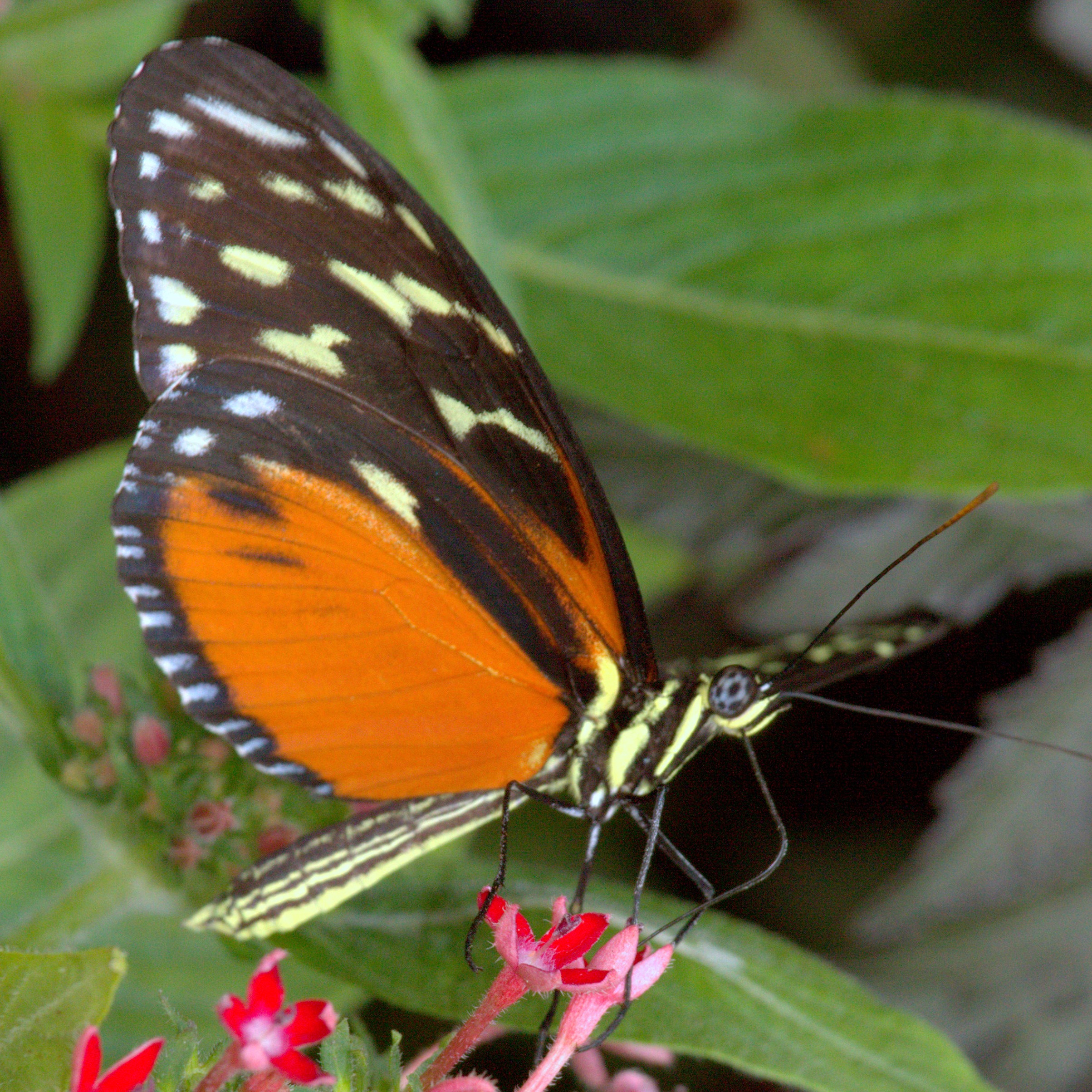
Heliconius hecale
Tiger Longwing
Fabricius, 1775
Added by
Anonymous Curator
Reviewed by
Under Review
Last modified by
Julia Trouin
TaxonomyBiological classification ranks placing this species within the tree of life, from Kingdom down to Genus.
Ecology & StatusHow this species lives: habitat preferences, diet, behavior, population status, and role in its ecosystem.
OriginWhether the species is native (evolved here), endemic (found only here), or introduced by human activity.
Native
Population TrendDirection of change in population size over time: increasing, stable, decreasing, or unknown.
Stable
Breeding SeasonTime of year when this species typically reproduces or flowers.
Year Round
Trophic RolePosition in the food chain: producer, herbivore, carnivore, omnivore, decomposer, or parasite.
Herbivore
Recent SightingsWhether this species has been observed in the wild in Costa Rica within recent years.
Yes
Habitat SummaryOverview of the specific ecosystems and environments where this species is found in Costa Rica. Multi-lang
It is widely distributed throughout tropical humid and gallery forests from Mexico to the Amazon. It prefers forest edges, clearings, and areas where its host plants, the passion flowers (Passiflora spp.), are abundant, generally at altitudes ranging from sea level to 1,500 meters.BehaviourDaily activity patterns, movement, territory use, foraging style, and seasonal behavioral changes. Multi-lang
It is a highly active diurnal butterfly. Its behavior is notable for being gregarious at night, when they gather in groups to sleep on the same branches, increasing safety through shared vigilance. During the day, they patrol constant routes in search of flowers rich in nectar and pollen. They are less erratic than other butterflies, exhibiting a slow but steady and determined gliding flight.Social ActivitySocial structure: whether the species is solitary, paired, or colonial; hierarchy and communication. Multi-lang
Socially complex; they congregate at night in communal roosts where individuals of different ages and possibly close relatives take shelter together. This behavior is key to reducing nocturnal predation.Feeding GuildWhat the species eats, how it forages or hunts, and its role as a consumer in the food web. Multi-lang
Specialized Frugivore/Nectarivore. Adults consume floral nectar rich in amino acids and pollen from plants of the genus Psiguria and Gurania, which is unique among Nymphalidae.Trophic Chain DetailsSpecific interactions in local food webs: prey species, predators, competitors, and scavengers. Multi-lang
It is a fundamental link as a pollinator of understory plants and climbing plants. In turn, it is preyed upon by a wide range of predators, including spiders, ants, insectivorous birds, and small wasps that parasitize its eggs. Its ability to process pollen makes it one of the few butterflies that obtains complex nitrogenous nutrition, influencing nutrient availability in local ecosystems.Reproductive BehaviourMating strategies, courtship displays, nesting or spawning behavior, and parental care. Multi-lang
Females lay their eggs individually on the tender shoots of Passiflora. Larvae are gregarious at birth and feed on the host plant leaves, sequestering toxins. Larval development lasts about 15 to 20 days, followed by a pupal phase of 10 to 14 days. There is no parental care after laying, but the use of specific host plants ensures the survival of the offspring.Physical Measures
Length (cm)
6.0 - 8.0 cm
Weight (Grams)
0.5 g - 1.2 g
Lifespan
Sexual MaturityAge at which the individual becomes capable of reproducing for the first time.
1 - 2 Months
Gestation / IncubationDuration from fertilization to birth (mammals) or to hatching (egg-laying species).
15 - 20