
Costa Rica Species
Callicore pitheas
AnimaliaHighest rank in taxonomy. Groups all life into domains: Animalia, Plantae, Fungi, etc.IUCN NEInternational Union for Conservation of Nature — the world authority on species extinction risk, using standardized criteria. — Not Evaluated — not yet assessed against the IUCN Red List criteria.In ProgressCurrent stage of this record in the editorial review workflow. Recent Sighting

Callicore pitheas

Two-eyed Eighty-eight

(Latreille, [1813])

Detailed Texts Multi-lang
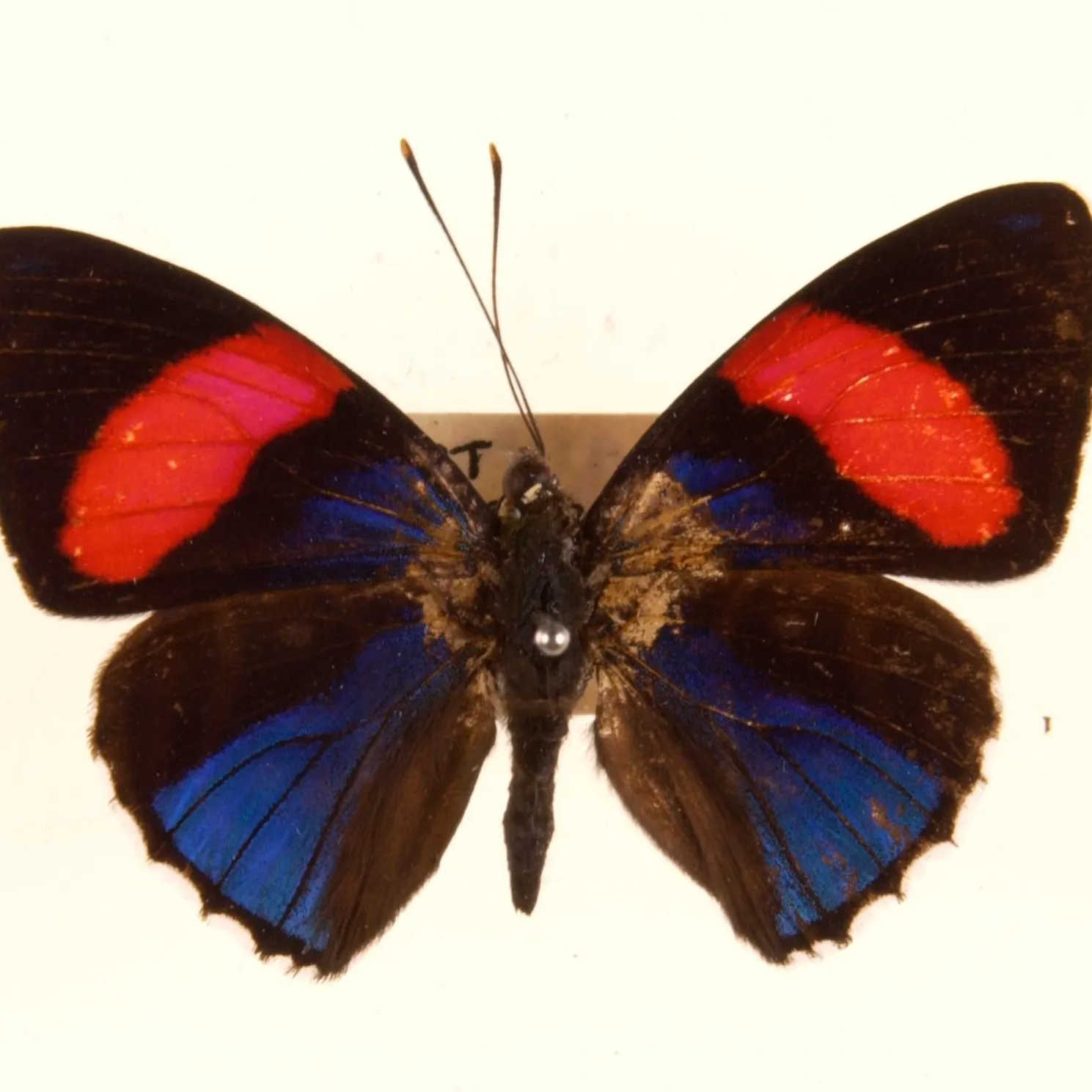
A strikingly beautiful medium-sized butterfly. The upper side of the wings is jet-black with a brilliant, glowing red or orange-red band across the forewings and an iridescent blue sheen near the base of the hindwings. The underside of the hindwings is cream-white, boldly outlined in thick black concentric circles and curves that form a pattern resembling the number '88' or '08'.

Added by

Anonymous Curator

Reviewed by

Under Review

Last modified by

Julia Trouin

TaxonomyBiological classification ranks placing this species within the tree of life, from Kingdom down to Genus.

PhylumRank below Kingdom. Groups organisms sharing a fundamental body plan (e.g., Chordata = vertebrates and some invertebrates).Arthropoda
ClassRank below Phylum. Subdivides by structural traits (e.g., Mammalia, Aves, Reptilia, Insecta).Insecta
OrderRank below Class. Groups related families sharing common ancestry (e.g., Carnivora, Primates).Lepidoptera
FamilyRank below Order. Groups closely related genera (e.g., Felidae = cats, Canidae = dogs).Nymphalidae
GenusRank just above Species. The first word in the two-part binomial scientific name.Callicore
Taxonomic AuthorityThe scientist who first formally described and published this species, followed by the year of publication.(Latreille, [1813])
Record Completeness
95%
Coming soon

Ecology & StatusHow this species lives: habitat preferences, diet, behavior, population status, and role in its ecosystem.

OriginWhether the species is native (evolved here), endemic (found only here), or introduced by human activity.

Native

Population TrendDirection of change in population size over time: increasing, stable, decreasing, or unknown.

Stable

Breeding SeasonTime of year when this species typically reproduces or flowers.

Year Round

Trophic RolePosition in the food chain: producer, herbivore, carnivore, omnivore, decomposer, or parasite.

Herbivore

Recent SightingsWhether this species has been observed in the wild in Costa Rica within recent years.

Yes

Habitat SummaryOverview of the specific ecosystems and environments where this species is found in Costa Rica. Multi-lang

Inhabits wet and transitional tropical rainforests, forest edges, riparian corridors, and secondary scrub from sea level up to premontane zones. It is frequently encountered along muddy paths and riverbanks.

BehaviourDaily activity patterns, movement, territory use, foraging style, and seasonal behavioral changes. Multi-lang

Diurnal. Adults fly dynamically in the morning and mid-day sun. They frequently descend from forest layers to the ground to probe organic liquids, often walking with their wings continually opening and snapping closed to flash their contrasting colors.

Social ActivitySocial structure: whether the species is solitary, paired, or colonial; hierarchy and communication. Multi-lang

Mainly solitary, but displays distinct gregarious groupings during mud-puddling on sand banks or near clean riverbeds, where dozens of individuals or mixed Callicore species can gather closely.

Feeding GuildWhat the species eats, how it forages or hunts, and its role as a consumer in the food web. Multi-lang

Herbivore (Folivore as larvae, Saprophage/Frugivore as adults).

Trophic Chain DetailsSpecific interactions in local food webs: prey species, predators, competitors, and scavengers. Multi-lang

Larvae eat woody vines and trees from the family Sapindaceae (such as Allophylus and Serjania). Adults target salts, nitrogen, and sugars from decaying fruits, carnivore dung, and sweat. Met with predation by birds, forest lizards, and arachnids.

Reproductive BehaviourMating strategies, courtship displays, nesting or spawning behavior, and parental care. Multi-lang

Males select specific streamside territories or sun flecks to encounter arriving mates. The females deposit tiny, round, single eggs on the fresh terminal leaves of host vines, often near water sources to guarantee high ambient humidity.

Physical Measures

Length (cm)

4.2 - 5.5 cm

Weight (Grams)

0.1 g - 0.3 g

Offspring per cycleTypical number of young (live births, eggs, or seeds) produced by one adult in a single reproductive event or breeding season.15 - 50
Sexual DimorphismObservable physical differences between males and females of the same species (e.g., size, coloration, features).No

Lifespan

Sexual MaturityAge at which the individual becomes capable of reproducing for the first time.

1 - 2 Days

Gestation / IncubationDuration from fertilization to birth (mammals) or to hatching (egg-laying species).

4 - 6

Lifespan EstimatedExpected duration of life from birth to natural death under wild conditions.
Males2 - 4 Weeks
Females2 - 4 Weeks

Evolutionary AdaptationsInherited traits and behaviors that improve the species' survival and reproduction in its specific environment. Multi-lang

The complex '88' graphic configuration on the underside serves as an effective form of disruptive coloration, breaking up the silhouette when resting and misdirecting the strikes of visual predators like birds.
Adults possess highly erratic, fast, and agile flight mechanisms that allow them to plunge rapidly into low vegetation or canopy gaps to escape danger.

Main ThreatsDocumented pressures reducing the population: habitat loss, hunting, disease, climate change, and invasive species. Multi-lang

Habitat disruption through logging and slash-and-burn agriculture, which removes crucial larval host plants in the family Sapindaceae.

Interesting FactsSurprising or notable facts that highlight what makes this species unique or ecologically important. Multi-lang

Like many members of the Callicore genus, these butterflies are well known for 'puddling' behavior, where groups of males aggregate on damp soil or river gravel to pump mineral-rich moisture into their bodies.