
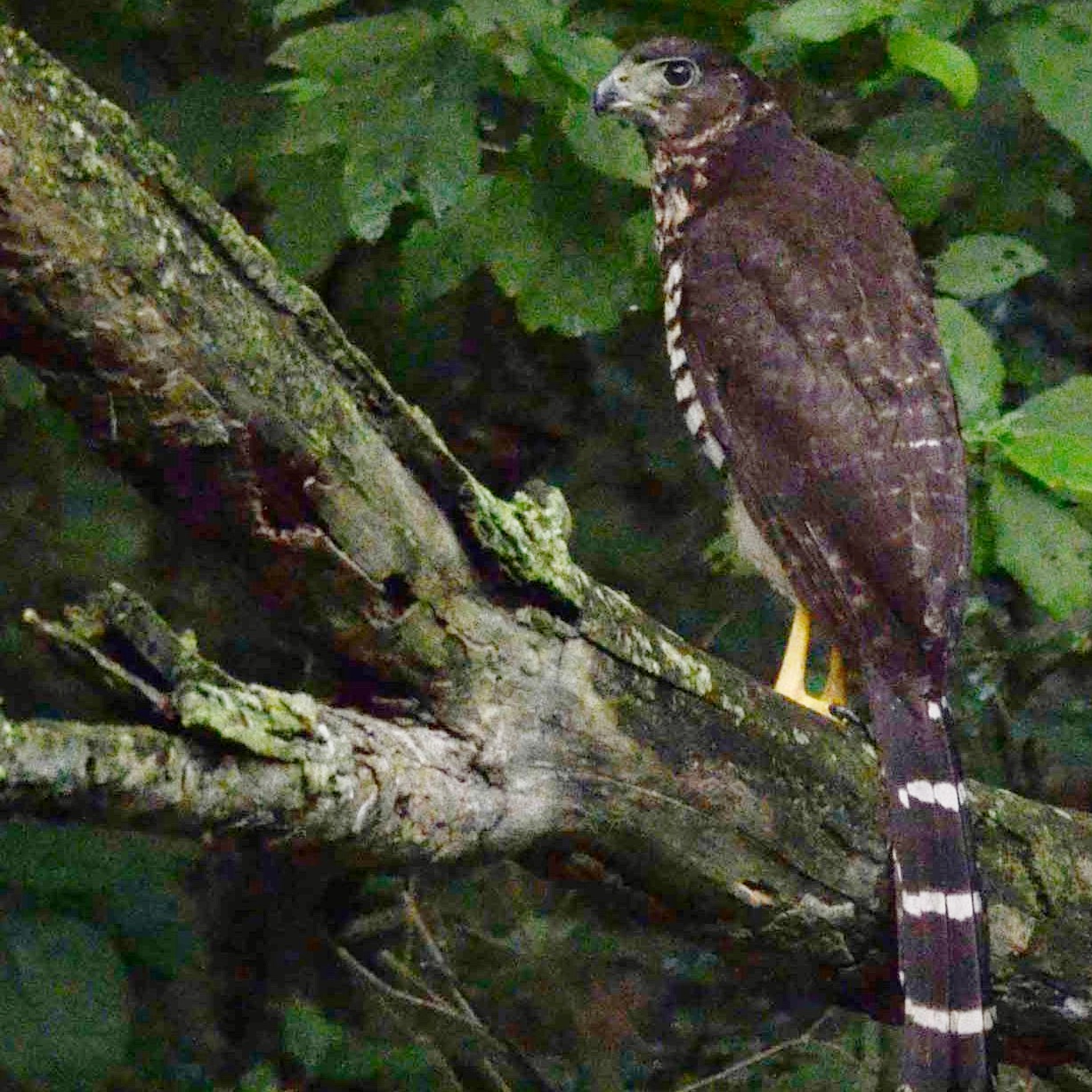
Micrastur semitorquatus
Collared Forest-Falcon
(Vieillot, 1817)
Added by
Anonymous Curator
Reviewed by
Under Review
Last modified by
Julia Trouin
TaxonomyBiological classification ranks placing this species within the tree of life, from Kingdom down to Genus.
Ecology & StatusHow this species lives: habitat preferences, diet, behavior, population status, and role in its ecosystem.
OriginWhether the species is native (evolved here), endemic (found only here), or introduced by human activity.
Native
Population TrendDirection of change in population size over time: increasing, stable, decreasing, or unknown.
Decreasing
Breeding SeasonTime of year when this species typically reproduces or flowers.
Dry Season
Trophic RolePosition in the food chain: producer, herbivore, carnivore, omnivore, decomposer, or parasite.
Carnivore
Recent SightingsWhether this species has been observed in the wild in Costa Rica within recent years.
Yes
Habitat SummaryOverview of the specific ecosystems and environments where this species is found in Costa Rica. Multi-lang
It is an endemic species of dense tropical forests. It prefers the understory and mid-story of primary forests, lowland wet forests, mature dry forests, and well-preserved gallery forests. It is rarely observed flying above the canopy or in open spaces. In Costa Rica, it can be found on both slopes from sea level to 1,500 meters, being a ghostly but loudly heard presence at dawn and dusk in areas like the Osa Peninsula or the dry forest of Guanacaste.BehaviourDaily activity patterns, movement, territory use, foraging style, and seasonal behavioral changes. Multi-lang
It is an extraordinarily stealthy raptor. It moves through the jungle flying from branch to branch via short, explosive flights, stopping silently to listen. If it detects prey, it pursues it at high speed through the dense tangle of branches without crashing, using its long tail to make tight turns (like a racing rudder). They have crepuscular tendencies, being much more active hunting early in the morning or entering the darkness of dusk.Social ActivitySocial structure: whether the species is solitary, paired, or colonial; hierarchy and communication. Multi-lang
Strictly solitary outside the nesting season and extremely territorial against other members of their species. They respond vigorously to the calls of intruders.Feeding GuildWhat the species eats, how it forages or hunts, and its role as a consumer in the food web. Multi-lang
Carnivore (Ambush / Forest pursuit hunter).Trophic Chain DetailsSpecific interactions in local food webs: prey species, predators, competitors, and scavengers. Multi-lang
Apex predator of the forest mid-story. Its diet is carnivorous and highly opportunistic: it hunts guans (Penelope purpurascens), toucans, doves, parrots, rodents, bats, lizards, and snakes. Due to its size, agility, and ferocity, healthy adults have almost no natural predators, although large felines or the Harpy Eagle could pose an occasional threat.Reproductive BehaviourMating strategies, courtship displays, nesting or spawning behavior, and parental care. Multi-lang
Unlike many falcons, they do not build a stick nest. They are obligate secondary nesters: they must seek deep, natural cavities in large dead trees, or take over abandoned enclosed nests of other raptors. The female lays 2 (rarely 3) reddish, heavily spotted eggs. Incubation falls almost entirely on the female and lasts about 35 to 45 days, during which time the male must hunt to feed her and, later, the chicks.Physical Measures
Length (cm)
46.0 - 58.0 cm
Weight (Grams)
450 g - 950 g
Lifespan
Sexual MaturityAge at which the individual becomes capable of reproducing for the first time.
24 - 36 Months
Gestation / IncubationDuration from fertilization to birth (mammals) or to hatching (egg-laying species).
35 - 45