Costa Rica Species
Vriesea splendens
PlantaeHighest rank in taxonomy. Groups all life into domains: Animalia, Plantae, Fungi, etc.IUCN NEInternational Union for Conservation of Nature — the world authority on species extinction risk, using standardized criteria. — Not Evaluated — not yet assessed against the IUCN Red List criteria.In ProgressCurrent stage of this record in the editorial review workflow. Recent Sighting

Vriesea splendens

Flaming Sword

(Brongn.) Lem.

Detailed Texts Multi-lang
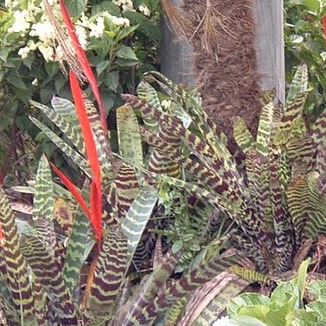
A striking epiphytic bromeliad known for its rosette of smooth, broad, dark green leaves dramatically patterned with horizontal purplish-brown stripes. From the center emerges a spectacular, tall, sword-shaped bright red spike of bracts, from which small yellow flowers bloom.

Added by

Anonymous Curator

Reviewed by

Under Review

Last modified by

Julia Trouin

TaxonomyBiological classification ranks placing this species within the tree of life, from Kingdom down to Genus.

PhylumRank below Kingdom. Groups organisms sharing a fundamental body plan (e.g., Chordata = vertebrates and some invertebrates).Tracheophyta
ClassRank below Phylum. Subdivides by structural traits (e.g., Mammalia, Aves, Reptilia, Insecta).Liliopsida
OrderRank below Class. Groups related families sharing common ancestry (e.g., Carnivora, Primates).Poales
FamilyRank below Order. Groups closely related genera (e.g., Felidae = cats, Canidae = dogs).Bromeliaceae
GenusRank just above Species. The first word in the two-part binomial scientific name.Vriesea
Taxonomic AuthorityThe scientist who first formally described and published this species, followed by the year of publication.(Brongn.) Lem.
Record Completeness
85%
Coming soon

Ecology & StatusHow this species lives: habitat preferences, diet, behavior, population status, and role in its ecosystem.

OriginWhether the species is native (evolved here), endemic (found only here), or introduced by human activity.

Native

Population TrendDirection of change in population size over time: increasing, stable, decreasing, or unknown.

Stable

Trophic RolePosition in the food chain: producer, herbivore, carnivore, omnivore, decomposer, or parasite.

Herbivore

Growth HabitPhysical form and structure of the plant: tree, shrub, herb, vine, epiphyte, aquatic, etc.

--

Leaf TypeLeaf characteristics: deciduous (seasonal shed), evergreen, simple, compound, needle-like, etc.

--

Flowering SeasonTime of year when this species typically reproduces or flowers.

Year Round

Recent SightingsWhether this species has been observed in the wild in Costa Rica within recent years.

Yes

Habitat SummaryOverview of the specific ecosystems and environments where this species is found in Costa Rica. Multi-lang

Native to the tropical regions of northern South America, particularly Venezuela, Trinidad, and the Guianas. It thrives natively as an epiphyte in humid mountain rainforests, anchoring itself to trees in shaded or partially bright understory environments.

Light & Water NeedsSunlight intensity and moisture levels this plant needs to grow and reproduce successfully. Multi-lang

Information not available in English. Help us expand this record!

BehaviourDaily activity patterns, movement, territory use, foraging style, and seasonal behavioral changes. Multi-lang

Utilizes tree branches solely for structural support. Its deep central tank accumulates rainwater, organic matter, and fallen leaves, serving as a functional breeding site and vital water source for rainforest tree frogs, arboreal insects, and varied canopy micro-fauna.

Toxicity / UsesToxic compounds present and their documented effects on humans or other organisms. Multi-lang

Information not available in English. Help us expand this record!

Physical Measures

Length (cm)

30.0 - 60.0 cm

Reproductive StructuresFlowers, fruits, and seeds — the reproductive organs and their seasonal appearance.

Flower Photos (Max 2)

No image

Fruit Photos (Max 2)

No image

Evolutionary AdaptationsInherited traits and behaviors that improve the species' survival and reproduction in its specific environment. Multi-lang

The rosette form creates a specialized water-tight central reservoir that acts as a tank to catch rainwater and falling organic debris, allowing the plant to sustain itself during dry spells independently of ground soil.
Features highly developed, specialized trichomes (leaf scales) designed to rapidly absorb moisture and dissolved nutrients directly through the leaf surface from the atmosphere.

Main ThreatsDocumented pressures reducing the population: habitat loss, hunting, disease, climate change, and invasive species. Multi-lang

Severe habitat loss driven by tropical deforestation, logging activities, and land conversion for agriculture, which dramatically reduces the numbers of older, mature host trees.
Poaching and illegal collection of wild-growing, brightly patterned specimens for botanical collections and international consumer ornamental trade markets.

Interesting FactsSurprising or notable facts that highlight what makes this species unique or ecologically important. Multi-lang

The brilliant sword-shaped structure is actually a composite of tightly packed leaf bracts; the true flowers are small, yellow, and emerge from the sides of these bracts, lasting only a short time compared to the long-lasting red spike.