
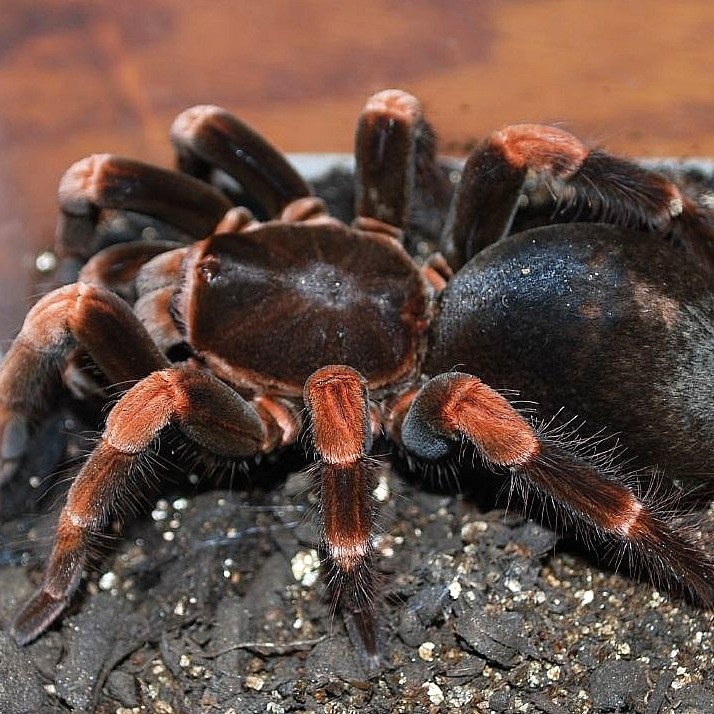
Megaphobema mesomelas
Costa Rican Red Leg Tarantula
O. Pickard-Cambridge, 1892
Added by
Ernest Minnema
Reviewed by
Under Review
Last modified by
Julia Trouin
Other Names (Global)Regional and multilingual names used for this species across different countries and languages.
 Costa Rican Red Knee TarantulaCosta Rican Giant RedlegBlack Velvet TarantulaFormerly known as Brachypelma mesomelas
TaxonomyBiological classification ranks placing this species within the tree of life, from Kingdom down to Genus.
Ecology & StatusHow this species lives: habitat preferences, diet, behavior, population status, and role in its ecosystem.
OriginWhether the species is native (evolved here), endemic (found only here), or introduced by human activity.
Endemic
Population TrendDirection of change in population size over time: increasing, stable, decreasing, or unknown.
Unknown
Breeding SeasonTime of year when this species typically reproduces or flowers.
Wet Season
Trophic RolePosition in the food chain: producer, herbivore, carnivore, omnivore, decomposer, or parasite.
Carnivore
Recent SightingsWhether this species has been observed in the wild in Costa Rica within recent years.
No
Habitat SummaryOverview of the specific ecosystems and environments where this species is found in Costa Rica. Multi-lang
This species is known from cloud forest and wet forest regions including Monteverde, Tapantí, Braulio Carrillo, San Carlos, Sarapiquí, Escazú highlands, and the Central Volcanic Range. It inhabits burrows in soil banks, vertical embankments, natural cavities, or abandoned animal holes, often near streams or in moist forest floor environments. Megaphobema mesomelas occurs primarily in humid premontane and montane forests, usually between approximately 500 and 2000 m elevation. Burrows are commonly constructed in soft soil banks, under roots, in ravines, or along stream margins.BehaviourDaily activity patterns, movement, territory use, foraging style, and seasonal behavioral changes. Multi-lang
Females are usually found inside their burrows, while males (once adult) are usually encountered roaming the forest floor in search of mates. Although they spend most of their time inside their burrows, females are sometimes found wandering during humid nights, reproductive periods, or when washed out of their burrow by heavy rains. This spider is a mainly nocturnal, terrestrial ambush predator. Megaphobema mesomelas can be considered relatively nervous and reactive compared to some other New World tarantulas. Defensive behavior includes urticating hair flicking, threat postures, rapid retreat, and vigorous hind-leg kicking.Social ActivitySocial structure: whether the species is solitary, paired, or colonial; hierarchy and communication. Multi-lang
Like most spiders, these Theraphosids are solitary creatures. Females are usually territorial around their burrow and don't tolerate conspecifics. Individuals can mainly be seen to interact during courtship and mating.Feeding GuildWhat the species eats, how it forages or hunts, and its role as a consumer in the food web. Multi-lang
Carnivorous opportunistic predator Ground-dwelling ambush hunterTrophic Chain DetailsSpecific interactions in local food webs: prey species, predators, competitors, and scavengers. Multi-lang
Predatory Role Feeds primarily on: • Large insects • Beetles • Orthopterans • Other arachnids • Small amphibians • Small reptiles occasionally Predators Potential predators include: • Coatis • Birds • Small mammals • Reptiles • Parasitic waspsReproductive BehaviourMating strategies, courtship displays, nesting or spawning behavior, and parental care. Multi-lang
Mature males wander along the forest floor in search of females, especially during wetter reproductive periods. Courtship involves vibrational signaling and drumming, as in other theraphosids. The male searches out a female’s burrow. He will start manipulating the silken ray lines that the female lays out in the mouth of her burrow to detect passing prey. Once he is certain he is dealing with the right female, he will start drumming on the soil to serenade her out of her burrow. As the carefully approach each other they will start a little dance to feel each other up and get an indication of willingness. If the female shows willing the male will lift her up by her fangs with specialized hooks on the tibia of its first leg pair. While lifting her up he will insert his specialized sperm organs (the palpal bulbs) in her spermatheca, where she can store the sperm for fertilization at a time that she considers opportune. Following, females remain in burrows with egg sacs and guard offspring aggressively. Observed egg sacs measured roughly 4 cm in diameter. Spiderlings remain near the maternal burrow during early development before dispersing.Physical Measures
Length (cm)
5.0 - 7.0 cm
Weight (Grams)
20 g - 50 g
Lifespan
Sexual MaturityAge at which the individual becomes capable of reproducing for the first time.
2 - 7 Years
Gestation / IncubationDuration from fertilization to birth (mammals) or to hatching (egg-laying species).
45 - 90