
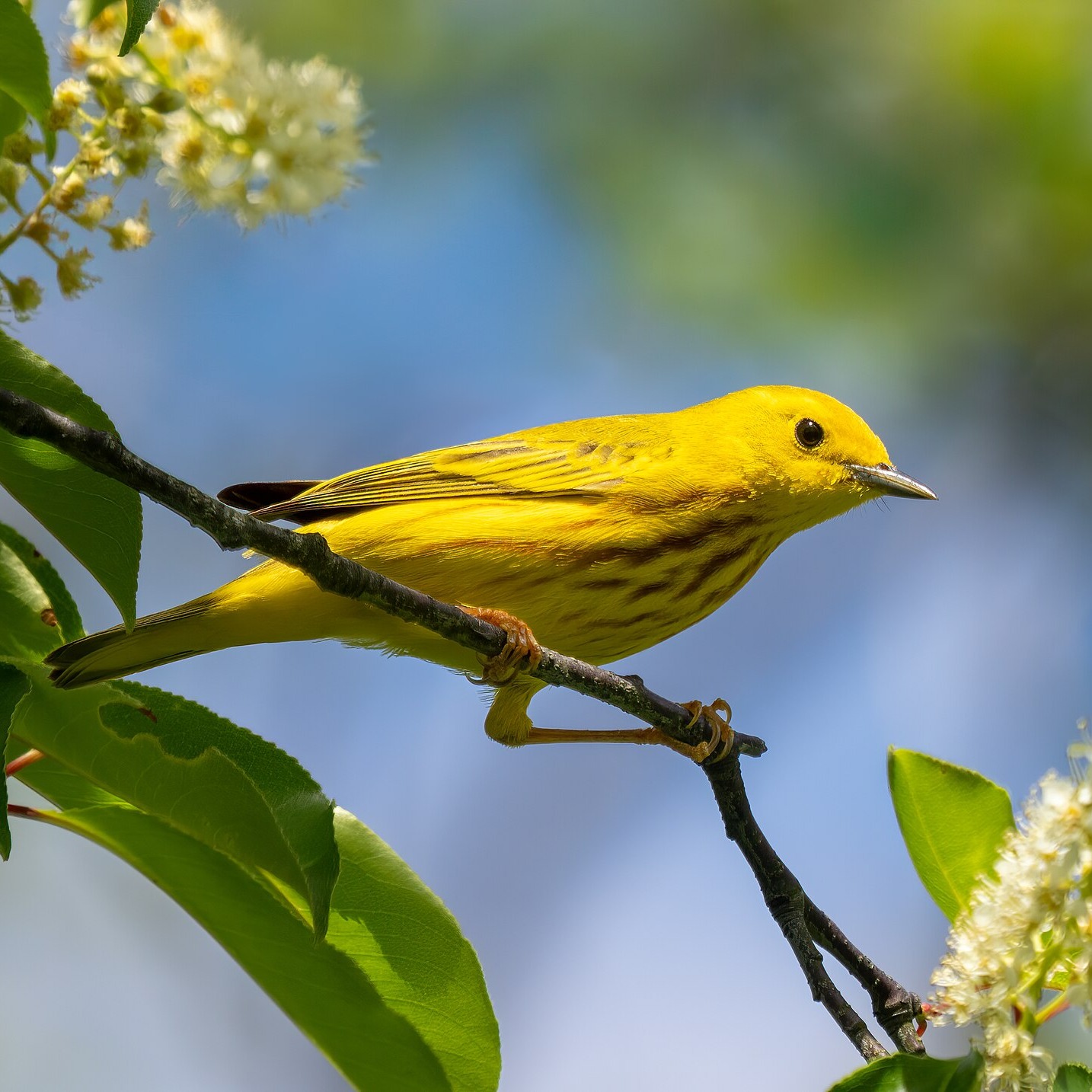
Setophaga petechia
Yellow Warbler
Linnaeus, 1766
Added by
Anonymous Curator
Reviewed by
Under Review
Last modified by
Julia Trouin
TaxonomyBiological classification ranks placing this species within the tree of life, from Kingdom down to Genus.
Ecology & StatusHow this species lives: habitat preferences, diet, behavior, population status, and role in its ecosystem.
OriginWhether the species is native (evolved here), endemic (found only here), or introduced by human activity.
Native
Population TrendDirection of change in population size over time: increasing, stable, decreasing, or unknown.
Stable
Breeding SeasonTime of year when this species typically reproduces or flowers.
--
Trophic RolePosition in the food chain: producer, herbivore, carnivore, omnivore, decomposer, or parasite.
Insectivore
Recent SightingsWhether this species has been observed in the wild in Costa Rica within recent years.
Yes
Habitat SummaryOverview of the specific ecosystems and environments where this species is found in Costa Rica. Multi-lang
It has an immense geographical distribution, ranging from Alaska and Canada to northern South America. In Costa Rica and Central America, it occurs under two statuses: a very common neotropical migratory subpopulation arriving from the north between August and May, and resident populations (such as the chrysendeta group) strictly confined to mangroves and coastal scrub. Its habitat includes edges of humid forests, young secondary vegetation, plantations, wooded swamps, suburban gardens, and, on the coasts, dense mid-canopy mangroves.BehaviourDaily activity patterns, movement, territory use, foraging style, and seasonal behavioral changes. Multi-lang
It is a diurnal, highly restless, agile, and territorial bird during the breeding season, though tolerant and solitary during the neotropical winter. It continuously moves through middle and high branches using small hops and short acrobatic flights, characteristically flicking its wings. Its acoustic communication is constant and musical; males emit a series of clear, cheerful, and accelerated whistles. Outside the breeding season, it defends small individual feeding territories in mangroves or flexibly joins local mixed flocks.Social ActivitySocial structure: whether the species is solitary, paired, or colonial; hierarchy and communication. Multi-lang
It is highly territorial during the reproductive period in the north, defending the nest area with vigorous singing and chasing displays. During migration and the non-breeding season in the Neotropics, it adopts a predominantly solitary habit, although it may temporarily participate in peaceful aggregations around trees with a high concentration of insects or integrate into mixed flocks without showing interspecific aggression.Feeding GuildWhat the species eats, how it forages or hunts, and its role as a consumer in the food web. Multi-lang
Generalist foliage insectivore. It captures its prey using an active method of gleaning and hovering among the leaves of outer branches. Its diet relies 98% on small arthropods, rarely supplemented with small wild berries during late winter.Trophic Chain DetailsSpecific interactions in local food webs: prey species, predators, competitors, and scavengers. Multi-lang
It occupies the niche of a specialized foliage insectivorous predator. It consumes an immense amount of caterpillars, aphids, beetles, flies, spiders, and ants, acting as a crucial natural biological regulator against forest and agricultural pests. In mangroves, it consumes small invertebrates associated with exposed roots. In turn, it is preyed upon by small falcons and hawks, while its nests are vulnerable to predation by arboreal snakes, squirrels, and larger birds such as cowbirds.Reproductive BehaviourMating strategies, courtship displays, nesting or spawning behavior, and parental care. Multi-lang
It is a monogamous species. The female builds a compact and firm open cup nest using bark fibers, fine grasses, spider webs, and plant down, located in the fork of a shrub or tree at heights between 1 and 12 meters. She lays 4 to 5 greenish-white or grayish eggs, densely mottled with brown. Incubation is performed exclusively by the female for 11 to 14 days. Both parents intensively feed the altricial chicks, which leave the nest between 9 and 12 days after hatching. Resident mangrove populations in Central America display similar behavior, adapting the nest location to mangrove branches.Physical Measures
Length (cm)
12.0 - 13.0 cm
Weight (Grams)
9 g - 11 g
Lifespan
Sexual MaturityAge at which the individual becomes capable of reproducing for the first time.
1 Years
Gestation / IncubationDuration from fertilization to birth (mammals) or to hatching (egg-laying species).
11 - 14