
Costa Rica Species
Trogon elegans
AnimaliaHighest rank in taxonomy. Groups all life into domains: Animalia, Plantae, Fungi, etc.IUCN LCInternational Union for Conservation of Nature — the world authority on species extinction risk, using standardized criteria. — Least Concern — widespread and abundant; not at immediate risk of extinction.In ProgressCurrent stage of this record in the editorial review workflow. Recent Sighting

Trogon elegans

Elegant Trogon

Gould, 1834

Detailed Texts Multi-lang
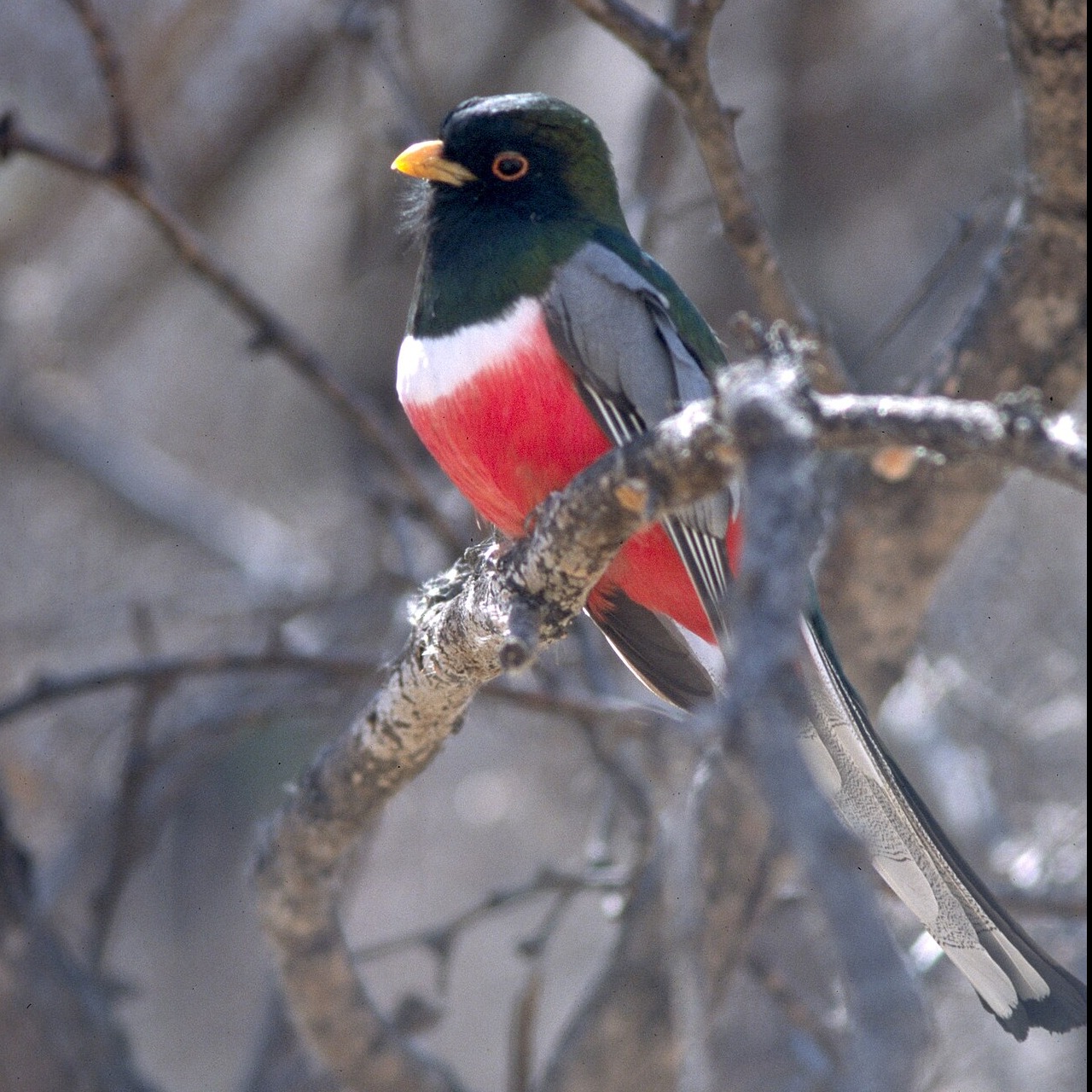
The Elegant Trogon (Trogon elegans) is a medium-sized bird with robust proportions, crowned by a strong yellow bill. The male is a spectacle of nature: his head and back shine with metallic green or bronze tones, separated from his striking crimson red belly by a pure white transverse chest band. His face features a dark mask accentuated by a red or orange eye-ring. His long tail, seen from below, is finely barred black and white, with large white patches at the tips (in Central American subspecies the upper tail has coppery tints). The female is considerably more sober, wearing grayish-brown tones on her back and chest, a paler red belly, and an unmistakable white teardrop-shaped mark just behind the eye.

Added by

Anonymous Curator

Reviewed by

Under Review

Last modified by

Julia Trouin

TaxonomyBiological classification ranks placing this species within the tree of life, from Kingdom down to Genus.

PhylumRank below Kingdom. Groups organisms sharing a fundamental body plan (e.g., Chordata = vertebrates and some invertebrates).Chordata
ClassRank below Phylum. Subdivides by structural traits (e.g., Mammalia, Aves, Reptilia, Insecta).Aves
OrderRank below Class. Groups related families sharing common ancestry (e.g., Carnivora, Primates).Trogoniformes
FamilyRank below Order. Groups closely related genera (e.g., Felidae = cats, Canidae = dogs).Trogonidae
GenusRank just above Species. The first word in the two-part binomial scientific name.Trogon
Taxonomic AuthorityThe scientist who first formally described and published this species, followed by the year of publication.Gould, 1834
Record Completeness
85%
Coming soon

Ecology & StatusHow this species lives: habitat preferences, diet, behavior, population status, and role in its ecosystem.

OriginWhether the species is native (evolved here), endemic (found only here), or introduced by human activity.

Native

Population TrendDirection of change in population size over time: increasing, stable, decreasing, or unknown.

Decreasing

Breeding SeasonTime of year when this species typically reproduces or flowers.

Dry Season

Trophic RolePosition in the food chain: producer, herbivore, carnivore, omnivore, decomposer, or parasite.

Insectivore

Recent SightingsWhether this species has been observed in the wild in Costa Rica within recent years.

Yes

Habitat SummaryOverview of the specific ecosystems and environments where this species is found in Costa Rica. Multi-lang

It prefers semi-arid to moderately humid habitats. It is found in tropical deciduous forests, river canyons (gallery forests), thorny scrublands, and, at its northern limit, in montane pine-oak forests. It avoids very dense rainforests. In Costa Rica, it is a characteristic inhabitant of the lowlands and foothills in the Guanacaste province and the northwestern Pacific.

BehaviourDaily activity patterns, movement, territory use, foraging style, and seasonal behavioral changes. Multi-lang

It is a bird of calm habits, spending long intervals of time perching silently under the mid-canopy, with its back toward the observer to camouflage with the surroundings. It occasionally twitches its tail slowly in an arc forward and backward. Upon spotting an insect or fruit, it flies abruptly and slightly undulating, making a noisy snapping sound with its wings. It is a markedly monogamous bird during its breeding season.

Social ActivitySocial structure: whether the species is solitary, paired, or colonial; hierarchy and communication. Multi-lang

They are birds of a markedly solitary character, not associating in flocks with their own kind nor in mixed foraging groups, being seen only alone or in pairs.

Feeding GuildWhat the species eats, how it forages or hunts, and its role as a consumer in the food web. Multi-lang

Omnivore / Hover-gleaner.

Trophic Chain DetailsSpecific interactions in local food webs: prey species, predators, competitors, and scavengers. Multi-lang

Seasonal omnivore. In the dry season, it leans heavily towards frugivory (eating small fruits, laurel berries, and ficus), crushing the pulp and regurgitating the seeds intact. During the breeding season, it becomes almost exclusively insectivorous, catching large caterpillars, grasshoppers, cicadas, and beetles to meet the protein needs of its chicks. Its nests are targeted by climbing snakes and small mammals.

Reproductive BehaviourMating strategies, courtship displays, nesting or spawning behavior, and parental care. Multi-lang

Monogamous birds. Unlike other trogons that excavate termitaria, the elegant is a cavity nester that relies almost entirely on old woodpecker holes carved in dry snags and dead trees, usually between 3 and 12 meters high. They do not add nest material, laying 2 to 3 white eggs directly on the residual sawdust. Incubation takes about 18 days, with both parents taking turns to provide warmth. The altricial chicks are fed by mom and dad and leave the safety of the hole at 3 weeks of age.

Physical Measures

Length (cm)

28.0 - 30.0 cm

Weight (Grams)

60 g - 78 g

Offspring per cycleTypical number of young (live births, eggs, or seeds) produced by one adult in a single reproductive event or breeding season.2 - 3
Sexual DimorphismObservable physical differences between males and females of the same species (e.g., size, coloration, features).Yes

Lifespan

Sexual MaturityAge at which the individual becomes capable of reproducing for the first time.

12 - 24 Months

Gestation / IncubationDuration from fertilization to birth (mammals) or to hatching (egg-laying species).

18 - 19

Lifespan EstimatedExpected duration of life from birth to natural death under wild conditions.
Males7 - 10 Years
Females7 - 10 Years

Sexual DimorphismPhysical differences in size, coloration, or morphology between males and females of this species.

Males Multi-lang

Dark metallic green or bronze head with black face and throat, bright red/orange eye-ring, white chest band, crimson belly. Tail finely barred black and white underneath.

Females Multi-lang

Head, back, and upper chest are brown or grayish-brown, light red belly, dull eye-ring, and a striking white vertical mark (teardrop-shaped) behind the eye.

Evolutionary AdaptationsInherited traits and behaviors that improve the species' survival and reproduction in its specific environment. Multi-lang

Heterodactyly (Vertical Grip): Like all members of its order, it possesses heterodactyl feet (digits 1 and 2 pointing backward, 3 and 4 forward). This conformation grants it an unparalleled grip strength on horizontal forest branches, allowing it to maintain its typical static, immovable posture for prolonged periods without fatiguing.
Hover-Gleaning: Although its flight is heavy and noisy, it makes quick dashes from its perch into the foliage. It hovers in the air for one or two seconds in front of a leaf or fruit and snatches it with its strong curved bill without landing on branches too flimsy to support its weight.

Main ThreatsDocumented pressures reducing the population: habitat loss, hunting, disease, climate change, and invasive species. Multi-lang

Loss of Riparian Forests: Especially in the northern part of its range, the logging and overexploitation of gallery forests along river canyons destroys the vital corridors they need to reproduce and seek refuge from the heat.
Lack of Nesting Cavities: As a secondary cavity nester that does not excavate hard wood, it relies heavily on large woodpeckers to create holes in dead trees or snags. The cleaning of dead trunks in agricultural areas drastically reduces their breeding opportunities.

Interesting FactsSurprising or notable facts that highlight what makes this species unique or ecologically important. Multi-lang

Forest Barking: Despite its beauty, its song is not melodic. During the courtship season, the male emits a hoarse, resonant sound that resembles the bark of a small dog or the croak of a bullfrog: 'coa, coa, coa, coa!', which is the source of one of its common names.
The Border Trogon: It is the only member of the Trogonidae family found regularly breeding within the territory of the United States. The southern mountains of Arizona (like the Chiricahua Mountains) are an annual mecca for American birdwatchers looking to spot this tropical visitor.