
Costa Rica Species
Clathrus ruber
FungiHighest rank in taxonomy. Groups all life into domains: Animalia, Plantae, Fungi, etc.IUCN NEInternational Union for Conservation of Nature — the world authority on species extinction risk, using standardized criteria. — Not Evaluated — not yet assessed against the IUCN Red List criteria.In ProgressCurrent stage of this record in the editorial review workflow. Recent Sighting

Clathrus ruber

Latticed Stinkhorn / Red Cage Fungus

P.Micheli ex Pers., 1801

Detailed Texts Multi-lang
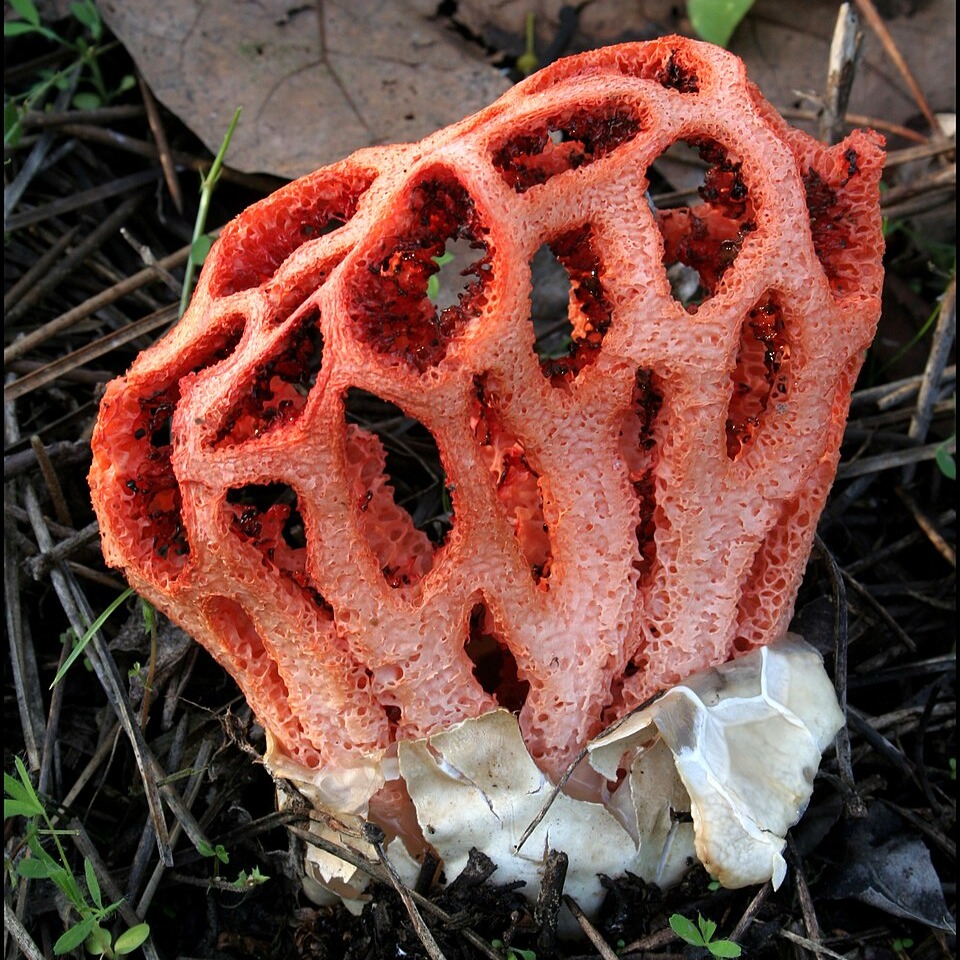
Clathrus ruber is a spectacular and geometrically-shaped saprophytic fungus that looks like an extraterrestrial structure emerging from the ground. It begins its development as a whitish, gelatinous 'egg' partially buried. Upon maturity, the peridium breaks, and a receptacle expands in the form of a spherical, hollow red or vibrant orange cage or lattice. The arms of the cage are spongy and covered on their inner face by a dark olive-brown slimy mass called gleba, which contains the spores. This gleba emits a penetrating, foul odor of decaying organic matter to attract insects. It is an ephemeral organism whose striking structure collapses in a few days, but whose presence is vital for the degradation of plant matter in the soil.

Added by

Anonymous Curator

Reviewed by

Under Review

Last modified by

Julia Trouin

TaxonomyBiological classification ranks placing this species within the tree of life, from Kingdom down to Genus.

PhylumRank below Kingdom. Groups organisms sharing a fundamental body plan (e.g., Chordata = vertebrates and some invertebrates).Basidiomycota
ClassRank below Phylum. Subdivides by structural traits (e.g., Mammalia, Aves, Reptilia, Insecta).Agaricomycetes
OrderRank below Class. Groups related families sharing common ancestry (e.g., Carnivora, Primates).Phallales
FamilyRank below Order. Groups closely related genera (e.g., Felidae = cats, Canidae = dogs).Phallaceae
GenusRank just above Species. The first word in the two-part binomial scientific name.Clathrus
Taxonomic AuthorityThe scientist who first formally described and published this species, followed by the year of publication.P.Micheli ex Pers., 1801
Record Completeness
93%
Coming soon

Ecology & StatusHow this species lives: habitat preferences, diet, behavior, population status, and role in its ecosystem.

OriginWhether the species is native (evolved here), endemic (found only here), or introduced by human activity.

Native

Population TrendDirection of change in population size over time: increasing, stable, decreasing, or unknown.

Stable

Trophic RolePosition in the food chain: producer, herbivore, carnivore, omnivore, decomposer, or parasite.

--

EdibilityWhether this mushroom is edible, toxic, hallucinogenic, or of unknown safety. Never eat based solely on this data.

--

Cap ShapeShape of the mushroom cap (pileus): convex, flat, umbonate, funnel-shaped, bell-shaped, etc.

--

Hymenium TypeThe spore-bearing surface of a fungus: gills, pores, teeth, ridges, smooth, or wrinkled.

--

Fruiting SeasonTime of year when this species typically reproduces or flowers.

Wet Season

Recent SightingsWhether this species has been observed in the wild in Costa Rica within recent years.

Yes

Habitat SummaryOverview of the specific ecosystems and environments where this species is found in Costa Rica. Multi-lang

It inhabits humus-rich soils, wood-mulched areas, gardens, grasslands, and mixed forests. It prefers warm climates and high-soil moisture. It is commonly found near decaying wood debris or in disturbed forest soils. In Costa Rica, its appearance is more frequent during the peaks of the rainy season, from lowlands to intermediate elevations, often surprising passersby in suburban areas with its shape and color.

SubstrateThe organic material or host organism this fungus colonizes and decomposes. Multi-lang

Information not available in English. Help us expand this record!

BehaviourDaily activity patterns, movement, territory use, foraging style, and seasonal behavioral changes. Multi-lang

It is a fundamental nutrient recycler. As a saprotroph, it breaks down complex plant remains that other organisms cannot process, reintegrating carbon into the soil. Its fruiting structure lasts only 24 to 48 hours before collapsing into a shapeless mass, but its underground mycelium network is persistent and can span several square meters.

Physical Measures

Length (cm)

8.0 - 15.0 cm

Hymenium StructuresMacro photographs of the spore-bearing surfaces used for mushroom identification.

No hymenium surface images available.

Evolutionary AdaptationsInherited traits and behaviors that improve the species' survival and reproduction in its specific environment. Multi-lang

Lattice Geometry for Dispersal: The net structure maximizes the exposed surface area of the gleba while maintaining structural integrity with minimum biomass. This shape allows the foul odor to disperse in all directions and enables multiple insects to land simultaneously to transport spores.
Chemical Mimicry (Carrion Odor): Like other phallales, it synthesizes volatile compounds that mimic rotting meat. This adaptation ensures that flies, attracted by the possibility of food or a spawning site, unintentionally collect spores on their legs and bodies.

Main ThreatsDocumented pressures reducing the population: habitat loss, hunting, disease, climate change, and invasive species. Multi-lang

Human removal (Mycophobia): Due to its intense color (sometimes associated with being poisonous) and repulsive odor, people often destroy them in gardens and parks, limiting their ability to complete the dispersal cycle in human-influenced areas.

Interesting FactsSurprising or notable facts that highlight what makes this species unique or ecologically important. Multi-lang

The Witch's Heart: In the folklore of some regions in Europe and the Americas, this fungus has been associated with witchcraft and the supernatural due to its blood-red color and almost magical sudden appearance after rain.
High-Intensity Visibility: The red color of the receptacle is so vibrant that it can be detected by insects even in the understory dimness, acting as a visual beacon that complements the chemical scent signal.