
Costa Rica Species
PlantaeHighest rank in taxonomy. Groups all life into domains: Animalia, Plantae, Fungi, etc.IUCN LCInternational Union for Conservation of Nature — the world authority on species extinction risk, using standardized criteria. — Least Concern — widespread and abundant; not at immediate risk of extinction.ApprovedCurrent stage of this record in the editorial review workflow. Recent Sighting

Prosthechea cochleata

Clamshell Orchid

(L.) W.E.Higgins, 1997

Detailed Texts Multi-lang
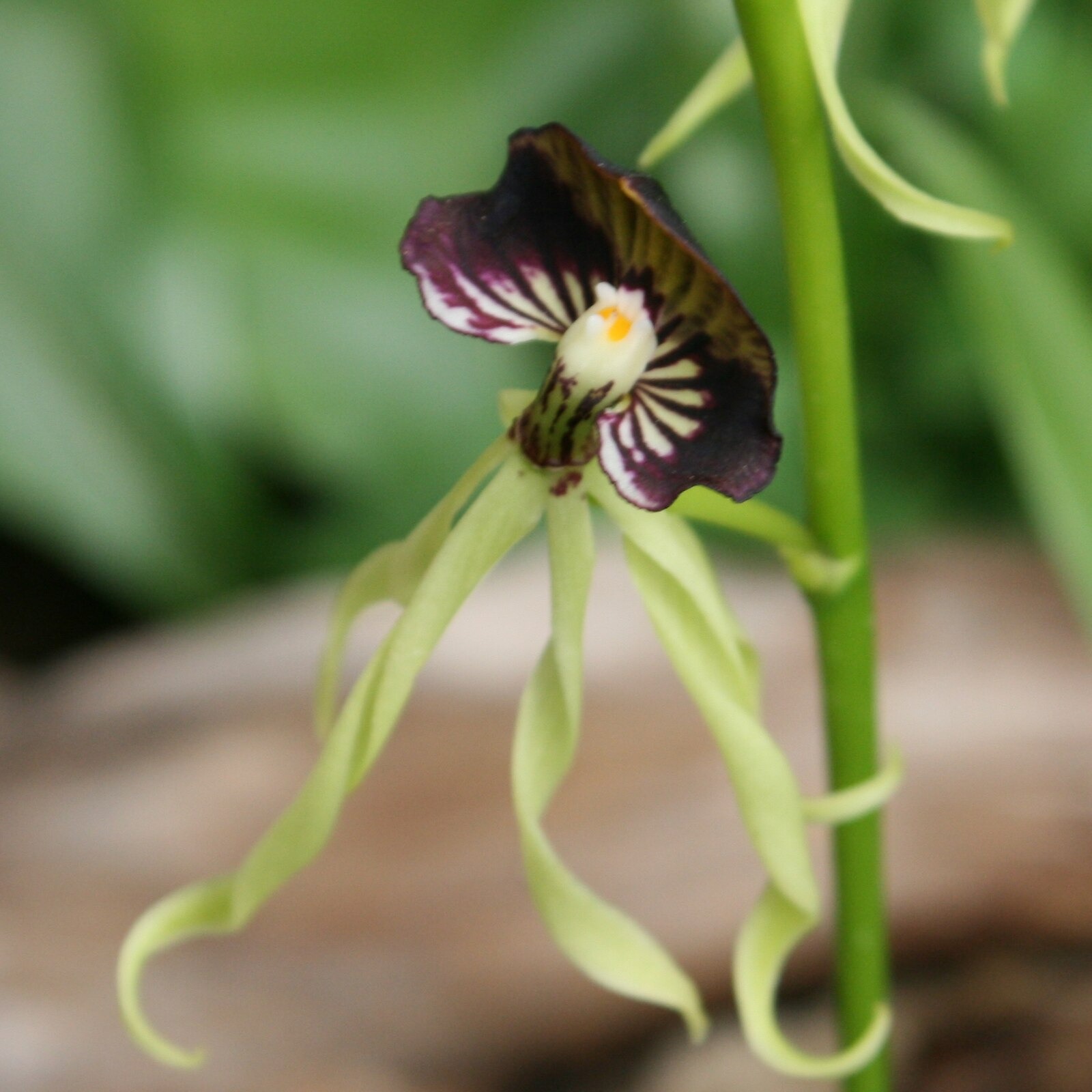
A highly distinctive, medium-sized epiphytic orchid featuring clusters of prominent, flattened, pear-shaped or egg-shaped glossy green pseudobulbs, each carrying two to three narrowly lance-shaped, leathery leaves. The plant is celebrated for its highly unusual, upside-down (non-resupinate) flowers produced sequentially on a long, erect, central terminal spike. The unique blossoms present a deep blackish-purple, hood-like, deeply concave lip that resembles a cockleshell sitting at the top of the flower, while the remaining long, narrow, ribbon-like sepals and petals of a pale yellowish-green droop directly downward like the tentacles of an octopus.

Added by

Anonymous Curator

Reviewed by

Under Review

Other Names (Global)Regional and multilingual names used for this species across different countries and languages.

Clamshell OrchidOrquídea PulpoCockleshell OrchidBlack OrchidAnacheilium cochleatum

TaxonomyBiological classification ranks placing this species within the tree of life, from Kingdom down to Genus.

PhylumRank below Kingdom. Groups organisms sharing a fundamental body plan (e.g., Chordata = vertebrates and some invertebrates).Tracheophyta
ClassRank below Phylum. Subdivides by structural traits (e.g., Mammalia, Aves, Reptilia, Insecta).Magnoliopsida
OrderRank below Class. Groups related families sharing common ancestry (e.g., Carnivora, Primates).Asparagales
FamilyRank below Order. Groups closely related genera (e.g., Felidae = cats, Canidae = dogs).Orchidaceae
GenusRank just above Species. The first word in the two-part binomial scientific name.Prosthechea
Taxonomic AuthorityThe scientist who first formally described and published this species, followed by the year of publication.(L.) W.E.Higgins, 1997
Record Completeness
93%
Coming soon

Ecology & StatusHow this species lives: habitat preferences, diet, behavior, population status, and role in its ecosystem.

OriginWhether the species is native (evolved here), endemic (found only here), or introduced by human activity.

Native

Population TrendDirection of change in population size over time: increasing, stable, decreasing, or unknown.

Stable

Trophic RolePosition in the food chain: producer, herbivore, carnivore, omnivore, decomposer, or parasite.

Herbivore

Growth HabitPhysical form and structure of the plant: tree, shrub, herb, vine, epiphyte, aquatic, etc.

--

Leaf TypeLeaf characteristics: deciduous (seasonal shed), evergreen, simple, compound, needle-like, etc.

--

Flowering SeasonTime of year when this species typically reproduces or flowers.

Year Round

Recent SightingsWhether this species has been observed in the wild in Costa Rica within recent years.

Yes

Habitat SummaryOverview of the specific ecosystems and environments where this species is found in Costa Rica. Multi-lang

Widely distributed throughout the Neotropics, including Southern Florida, the West Indies, Mexico, Central America, and northern South America. It is a highly adaptable generalist epiphyte that populates diverse biomes ranging from humid, low-elevation tropical evergreen rainforests and damp cypress swamps to dry seasonal oak forests and pine savannas, thriving from sea level up to 1,900 meters on a vast array of hardwood bark hosts under dappled shade.

Light & Water NeedsSunlight intensity and moisture levels this plant needs to grow and reproduce successfully. Multi-lang

Information not available in English. Help us expand this record!

BehaviourDaily activity patterns, movement, territory use, foraging style, and seasonal behavioral changes. Multi-lang

Grows as clustered epiphytic groups on major low-hanging limbs or tree trunks, forming long-term structural colonies. The species relies heavily on self-pollination (autogamy) in several of its northern island populations (such as parts of Florida and the Bahamas), ensuring high fruit set even in the absence of specialized insects. In mainland populations, it utilizes steady chemical signaling to invite small native bees to interact with the column underneath its hooded lip.

Toxicity / UsesToxic compounds present and their documented effects on humans or other organisms. Multi-lang

Information not available in English. Help us expand this record!

Physical Measures

Length (cm)

15.0 - 45.0 cm

Reproductive StructuresFlowers, fruits, and seeds — the reproductive organs and their seasonal appearance.

Flower Photos (Max 2)

No image

Fruit Photos (Max 2)

No image

Evolutionary AdaptationsInherited traits and behaviors that improve the species' survival and reproduction in its specific environment. Multi-lang

Possesses robust, water-storing pseudobulbs covered in a thick cuticle that allow the plant to withstand prolonged dry intervals common in seasonal pine savannas and deciduous forest canopies.
Employs an absolute sequential blooming mechanism on its inflorescence spike, opening only 1 to 3 flowers simultaneously over many months; this conserves metabolic energy and ensures extended pollination windows rather than wasting resources all at once.

Main ThreatsDocumented pressures reducing the population: habitat loss, hunting, disease, climate change, and invasive species. Multi-lang

Localized declines driven by rampant, unsustainable wild collection for urban and international plant nurseries, due to its global popularity as an easy-to-grow, uniquely structured home orchid.
Deforestation and continuous fragmentation of subtropical hardwood hammocks and swamp ecosystems, particularly on the edges of its northern range in Florida and urbanizing zones of Central America.

Interesting FactsSurprising or notable facts that highlight what makes this species unique or ecologically important. Multi-lang

It is famous for its non-resupinate flowers; unlike 95% of other orchids which twist 180 degrees during development to position the lip at the bottom, this species does not twist, causing the lip to point straight up over the column.
Prosthechea cochleata is the official National Flower of Belize, where it is colloquially referred to as the 'Black Orchid' because of the extremely dark purple coloration of its veined clamshell lip.