
AnimaliaIUCN LCIn Progress Recent Sighting
Diasporus diastema
Common Tink Frog
Taylor, 1955
Detailed Texts Multi-lang
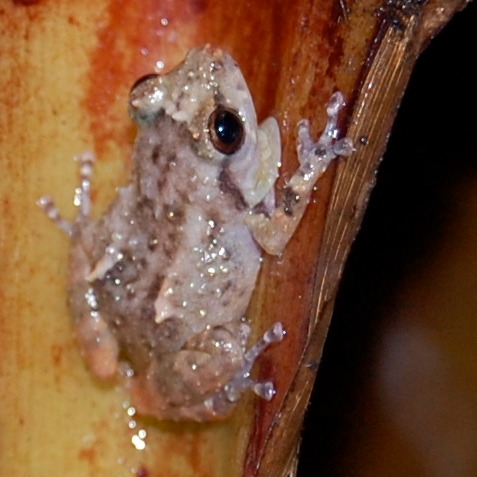
A tiny anuran with a delicate and slender body. It has a variable base coloration that usually ranges between yellowish tones, light green, or brown, often with a pale vertebral line that helps break up its silhouette among the leaves. Its fingers have prominent adhesive disks, adapted for a semi-arboreal life.
Added by
Anonymous Curator
Reviewed by
Under Review
Last modified by
Julia Trouin
Taxonomy
PhylumChordata
ClassAmphibia
OrderAnura
FamilyEleutherodactylidae
GenusDiasporus
Taxonomic AuthorityTaylor, 1955
Ecology & Status
Origin
Native
Population Trend
Stable
Breeding Season
Year Round
Trophic Role
Insectivore
Recent Sightings
Yes
Habitat Summary Multi-lang
Inhabits the understory and lower levels of vegetation in humid forests and premontane forests. It is common to find it in bromeliads and other epiphytic plants that retain water, vital for its microhabitat.Behaviour Multi-lang
Mostly nocturnal species. It is active for much of the night, moving with agility among the humid vegetation. Its song is most frequent after rains, when environmental humidity is optimal.Social Activity Multi-lang
Solitary, except during the breeding season. Males occupy small patches in epiphytic plants from where they emit their songs to attract females and defend their territory from other males.Feeding Guild Multi-lang
Active micro-prey hunter. Uses binocular vision and its protractile tongue to capture small prey with great precision, taking advantage of plant surfaces as hunting platforms.Trophic Chain Details Multi-lang
Insectivore. Feeds on a wide variety of micro-arthropods that inhabit bromeliads and the lower canopy, including mites, springtails, and small ants.Reproductive Behaviour Multi-lang
Oviparous with direct development. Females deposit their eggs in water-filled bromeliads or protected tree holes. No extensive parental care has been recorded after laying.Physical Measures
Length (cm)
1.5 - 2.5 cm
Weight (Grams)
1 g - 4 g
Offspring per cycle3 - 8
Sexual DimorphismYes
Lifespan
Sexual Maturity
1 - 2 Years
Gestation / Incubation
1 - 2
Lifespan Estimated
Males1 - 2 Years
Females1 - 2 Years
Sexual Dimorphism
Males Multi-lang
Males are significantly smaller, with vocal sacs clearly visible when inflated. Their behavior is more active in terms of defensive and territorial vocalizations.
Females Multi-lang
Females possess a larger size, with a wider and heavier body structure to facilitate the production of their eggs. They are less vocal than males in their daily behavior.
Evolutionary Adaptations Multi-lang
Metallic Vocalization: Males possess an expandable vocal sac that allows them to emit a song reminiscent of metal striking metal, an adaptation to communicate effectively in environments with a lot of environmental insect noise.
Main Threats Multi-lang
Environmental Sensitivity: As small species with highly permeable skin, they are extremely sensitive to desiccation and changes in water quality, making them excellent bioindicators of forest health.
Interesting Facts Multi-lang
Direct Development: Like many frogs in its family, the tink frog avoids the tadpole phase. Its eggs are deposited in bromeliads, where embryos complete their development until emerging as tiny froglets.