
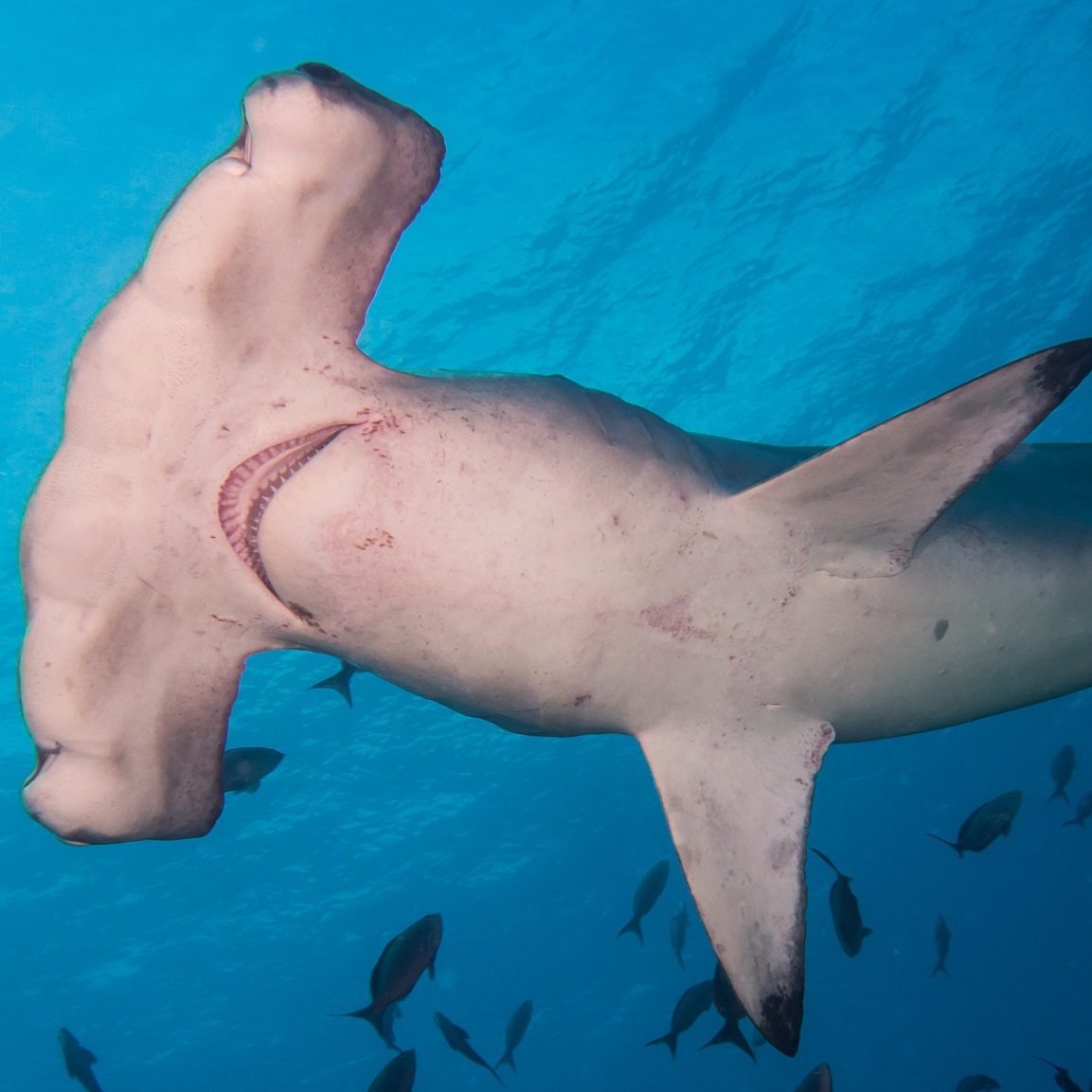
Sphyrna lewini
Scalloped Hammerhead
(Griffith & Smith, 1834)
Added by
Anonymous Curator
Reviewed by
Under Review
Last modified by
Julia Trouin
TaxonomyBiological classification ranks placing this species within the tree of life, from Kingdom down to Genus.
Ecology & StatusHow this species lives: habitat preferences, diet, behavior, population status, and role in its ecosystem.
OriginWhether the species is native (evolved here), endemic (found only here), or introduced by human activity.
Native
Population TrendDirection of change in population size over time: increasing, stable, decreasing, or unknown.
Decreasing
Breeding SeasonTime of year when this species typically reproduces or flowers.
Summer
Trophic RolePosition in the food chain: producer, herbivore, carnivore, omnivore, decomposer, or parasite.
Carnivore
Recent SightingsWhether this species has been observed in the wild in Costa Rica within recent years.
Yes
Habitat SummaryOverview of the specific ecosystems and environments where this species is found in Costa Rica. Multi-lang
It is a coastal and pelagic species with a circumglobal distribution, inhabiting warm, temperate, and tropical seas. It demonstrates a deep affinity for continental shelves, island terraces, and near-shore pelagic ecosystems. During its neonatal and juvenile stages, it relies entirely on shallow bays, turbid estuaries, and coastal mangrove forests that act as protective biological nurseries against larger predators. As adults, they undertake epic oceanic migrations to open-ocean volcanic seamounts, with Cocos Island (Costa Rica) and the Galapagos Islands (Ecuador) serving as crucial global sanctuaries where they congregate by the hundreds in cold, nutrient-rich currents.BehaviourDaily activity patterns, movement, territory use, foraging style, and seasonal behavioral changes. Multi-lang
The behavior of the scalloped hammerhead presents a fascinating dichotomy dictated by the sun. During daylight hours, they are profoundly social and gregarious creatures, congregating around volcanic vents and seamounts in gigantic schools that can exceed hundreds of individuals. In these breathtaking swimming vortexes, they communicate through subtle body contortions and head shakes, establishing hierarchies dominated by the largest females positioned in the protective center of the school. This schooling behavior provides them with a formidable collective defense and facilitates mating. However, as night falls, the imposing social structure completely dissolves. The sharks disperse in spectral silence, descending solitary and aggressive into the depths or actively combing coastal sandy bottoms, transforming into highly specialized and ruthless nocturnal predators.Social ActivitySocial structure: whether the species is solitary, paired, or colonial; hierarchy and communication. Multi-lang
Extremely gregarious during the day, forming massive hierarchical schools of hundreds of individuals in pelagic zones; strictly solitary during nocturnal hunting.Feeding GuildWhat the species eats, how it forages or hunts, and its role as a consumer in the food web. Multi-lang
Nektonic and benthic carnivore, specialized predator of elasmobranchs (rays) and cephalopods.Trophic Chain DetailsSpecific interactions in local food webs: prey species, predators, competitors, and scavengers. Multi-lang
As an avid pelagic and benthic apex predator, the scalloped hammerhead regulates mid-level ocean populations. Its menu is diverse, including squids, sardines, mackerel, and crustaceans, but its absolute specialty—for which its head acts as a master tool—is subduing benthic elasmobranchs, particularly stingrays and eagle rays. It uses the extremes of its cephalofoil to batter, pin, and physically press rays against the seabed before devouring them. On the other side of the food chain, while adults are rarely hunted naturally, young and neonatal hammerheads face a terrifying gauntlet of predation in their coastal habitats, frequently being devoured by bull sharks (Carcharhinus leucas), massive tiger sharks (Galeocerdo cuvier), and even pods of orcas.Reproductive BehaviourMating strategies, courtship displays, nesting or spawning behavior, and parental care. Multi-lang
Reproduction is placental viviparous, a highly advanced reproductive trait. Following a violent courtship where the male relentlessly bites the female's pectoral fins to submit her and achieve copulation, embryos develop in the uterus initially sustained by a yolk sac. Once depleted, the sac transforms into a direct placental connection to the mother's uterine wall, drawing nutrients directly from her bloodstream, much like in mammals. After an extensive gestation of 9 to 12 months, gravid females migrate to warm, shallow coastal estuaries and bays. There, they give birth to considerable litters ranging from 12 to over 40 pups (neonates). These pups are born with an extremely flexible cartilaginous cephalofoil folded backward, which stiffens and takes its hammer shape minutes after birth. Immediately after birth, the pups are left completely alone, relying on their own instincts to survive.Physical Measures
Length (cm)
40.0 - 430.0 cm
Weight (Grams)
500 g - 152.00 kg
Lifespan
Sexual MaturityAge at which the individual becomes capable of reproducing for the first time.
10 - 15 Years
Gestation / IncubationDuration from fertilization to birth (mammals) or to hatching (egg-laying species).
9 - 12