
Costa Rica Species
Vochysia guatemalensis
PlantaeHighest rank in taxonomy. Groups all life into domains: Animalia, Plantae, Fungi, etc.IUCN LCInternational Union for Conservation of Nature — the world authority on species extinction risk, using standardized criteria. — Least Concern — widespread and abundant; not at immediate risk of extinction.In ProgressCurrent stage of this record in the editorial review workflow. Recent Sighting

Vochysia guatemalensis

Yemeri

Donn. Sm., 1888

Detailed Texts Multi-lang
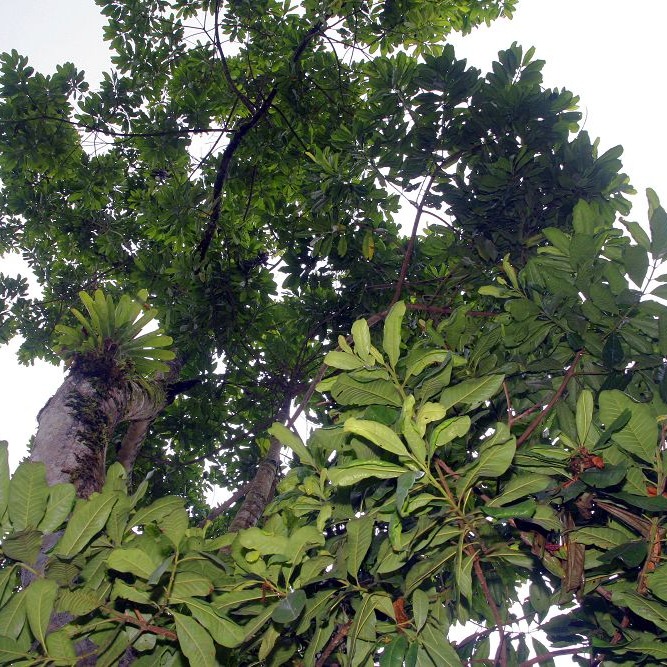
The cebo or chancho tree (Vochysia guatemalensis) is a fast-growing emergent giant of the Vochysiaceae family. Closely related to the botarrama (V. ferruginea), it is distinguished from it by reaching much larger sizes (up to 40 meters/130 feet in height and trunk diameters exceeding one meter) and by possessing glabrous leaves (smooth and lacking the rust-colored hairs on the underside). Its trunk is cylindrical, straight, and has grayish to light brown bark. It is immensely famous in Central America for its spectacular mass flowering; during the transition between the dry and rainy seasons, its immense canopy transforms into an explosion of intense golden yellow, visible from miles away. Its wood is a pale yellowish color, very light and soft, a characteristic that has earned it its pejorative local names (such as 'cebo' meaning tallow, or 'chancho' meaning pig). Its natural distribution ranges from Mexico to Colombia, being a dominant species in the rainy Caribbean zones of Costa Rica.

Added by

Anonymous Curator

Reviewed by

Under Review

Last modified by

Julia Trouin

TaxonomyBiological classification ranks placing this species within the tree of life, from Kingdom down to Genus.

PhylumRank below Kingdom. Groups organisms sharing a fundamental body plan (e.g., Chordata = vertebrates and some invertebrates).Tracheophyta
ClassRank below Phylum. Subdivides by structural traits (e.g., Mammalia, Aves, Reptilia, Insecta).Magnoliopsida
OrderRank below Class. Groups related families sharing common ancestry (e.g., Carnivora, Primates).Myrtales
FamilyRank below Order. Groups closely related genera (e.g., Felidae = cats, Canidae = dogs).Vochysiaceae
GenusRank just above Species. The first word in the two-part binomial scientific name.Vochysia
Taxonomic AuthorityThe scientist who first formally described and published this species, followed by the year of publication.Donn. Sm., 1888
Record Completeness
91%
Coming soon

Ecology & StatusHow this species lives: habitat preferences, diet, behavior, population status, and role in its ecosystem.

OriginWhether the species is native (evolved here), endemic (found only here), or introduced by human activity.

Native

Population TrendDirection of change in population size over time: increasing, stable, decreasing, or unknown.

Stable

Trophic RolePosition in the food chain: producer, herbivore, carnivore, omnivore, decomposer, or parasite.

--

Growth HabitPhysical form and structure of the plant: tree, shrub, herb, vine, epiphyte, aquatic, etc.

--

Leaf TypeLeaf characteristics: deciduous (seasonal shed), evergreen, simple, compound, needle-like, etc.

--

Flowering SeasonTime of year when this species typically reproduces or flowers.

--

Recent SightingsWhether this species has been observed in the wild in Costa Rica within recent years.

Yes

Habitat SummaryOverview of the specific ecosystems and environments where this species is found in Costa Rica. Multi-lang

It is a species typically confined to humid and very humid tropical lowland forests, from sea level to approximately 1,000 meters in altitude. It acts as an aggressive colonizer in secondary forests, fallow lands, abandoned pastures, and along rivers and roads. It has a notable preference for deep volcanic and clay soils that receive extremely high rainfall (even above 4,000 mm annually). It demands direct exposure to sunlight to germinate and thrive, being completely intolerant to the shade of dense primary forest canopies.

Light & Water NeedsSunlight intensity and moisture levels this plant needs to grow and reproduce successfully. Multi-lang

Information not available in English. Help us expand this record!

BehaviourDaily activity patterns, movement, territory use, foraging style, and seasonal behavioral changes. Multi-lang

The phenology of the cebo is marked by dazzling synchrony. Just as the first drizzles fall after the hot summer months, an adult cebo in the secondary forest literally explodes in yellow cylindrical panicles at the tips of all its branches before pushing out new leaves. Since they are very tall, heliophilic trees, these blooms create clouds of gold along the mountain profile. Given that they mass-flower for only about 3 to 5 weeks, they act as a frenzied magnet that instantly concentrates millions of foraging insects, providing the first major seasonal glucose shock to wildlife.

Toxicity / UsesToxic compounds present and their documented effects on humans or other organisms. Multi-lang

Information not available in English. Help us expand this record!

Physical Measures

Length (cm)

1000.0 - 4000.0 cm

Reproductive StructuresFlowers, fruits, and seeds — the reproductive organs and their seasonal appearance.

Flower Photos (Max 2)

No image

Fruit Photos (Max 2)

No image

Evolutionary AdaptationsInherited traits and behaviors that improve the species' survival and reproduction in its specific environment. Multi-lang

Aluminum hyperaccumulation: Just like V. ferruginea, this species possesses the rare metabolism that allows it to sequester enormous concentrations of elemental aluminum from the acidic clay soil into its foliar tissues without becoming intoxicated. This not only allows it to dominate degraded areas that other species avoid, but the aluminum-rich leaf biomass it drops to the forest floor outlines a particular ecosystem that favors certain microorganisms.
Ultra-fast pioneer growth: It is biologically designed to be a fast-growing secondary species, victoriously competing for direct sunlight. It invests its photosynthetic energy into creating wood of very low structural density, allowing it to add several meters of height per year to its straight trunk and dominate the emergent canopy above hardwood trees in record time.
Anemochory via samara seeds: Its fruits are three-lobed capsules that mature during the time when rains decrease and winds increase. Upon opening, they release oblong seeds equipped with an asymmetrical papery wing that acts like an autogyro propeller. This aerodynamic design ensures that, falling from 40 meters high, the seeds can glide for hundreds of meters in search of newly opened clearings in the forest.

Main ThreatsDocumented pressures reducing the population: habitat loss, hunting, disease, climate change, and invasive species. Multi-lang

Stigmatization for wood quality: Its main threat is the cultural prejudice of the timber sector. Its wood, of a yellowish tone and rich in moisture, is susceptible to chromogenic fungi (blue stain fungus) hours after being cut and lacks resistance against pests. Because of this, ranchers and farmers often consider it a 'nuisance tree' or trash, massively felling or burning it standing when opening new pasture areas.
Replacement of forest recovery areas: Industrial plantations of fast-growing exotic species (such as teak or melina) and intensive pineapple and banana agriculture in the humid tropics are replacing the landscapes where Vochysia would naturally form stabilizing secondary forests, limiting its population recovery.

Interesting FactsSurprising or notable facts that highlight what makes this species unique or ecologically important. Multi-lang

Modern redemption: The 'Tallow Tree': For centuries, its name was synonymous with useless wood. Recently, with rapid kiln drying technologies that prevent fungi and modern preservatives, the 'Cebo' has drastically revalued in Costa Rica's industrial sector. Because it is so light and abundant, it is now used massively in concrete construction formworks, fruit crates, and cores for lightweight furniture, giving immense value to its rapid reforestation.
A 'nurse tree' for the deep jungle: V. guatemalensis is often used in the first step of environmental recovery projects. As a pioneer, it grows furiously in direct sun, creating a quick shade canopy that exterminates aggressive invasive pasture grasses underneath. That new, cool shade it provides becomes the perfect nursery under which the valuable and fragile seeds of slow primary trees (like cedars, mahogany, or mountain almonds) can germinate without burning up in the tropical sun.
It is a natural hydrological indicator: Because its leafy canopy cannot withstand the severe water stress of the strong dry season in dry coastal areas, its dense and emerald presence indicates soil where groundwater flows permanently. In Costa Rica, farmers use the growth line of cebo trees to locate shallow underground springs.