
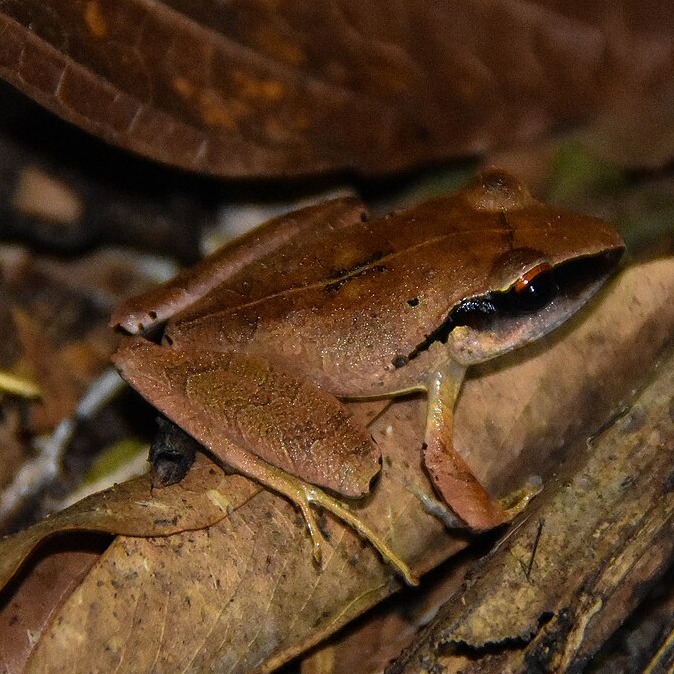
Craugastor noblei
Noble's Robber Frog
(Barbour & Dunn, 1921)
Added by
Anonymous Curator
Reviewed by
Julia Trouin
Last modified by
Julia Trouin
TaxonomyBiological classification ranks placing this species within the tree of life, from Kingdom down to Genus.
Ecology & StatusHow this species lives: habitat preferences, diet, behavior, population status, and role in its ecosystem.
OriginWhether the species is native (evolved here), endemic (found only here), or introduced by human activity.
Native
Population TrendDirection of change in population size over time: increasing, stable, decreasing, or unknown.
Decreasing
Breeding SeasonTime of year when this species typically reproduces or flowers.
Year Round
Trophic RolePosition in the food chain: producer, herbivore, carnivore, omnivore, decomposer, or parasite.
Carnivore
Recent SightingsWhether this species has been observed in the wild in Costa Rica within recent years.
Yes
Habitat SummaryOverview of the specific ecosystems and environments where this species is found in Costa Rica. Multi-lang
Primarily found in undisturbed lowland humid forests and premontane wet forests. It is strongly restricted to the pristine leaf litter matrix of primary rainforests and is rarely seen in heavily altered habitats.BehaviourDaily activity patterns, movement, territory use, foraging style, and seasonal behavioral changes. Multi-lang
Mainly active at night, though individuals can sometimes be flushed from the leaf litter during overcast days. They spend the dark hours foraging on the ground or climbing onto very low vegetation stems and ferns to survey their immediate surroundings.Social ActivitySocial structure: whether the species is solitary, paired, or colonial; hierarchy and communication. Multi-lang
Solitary and territorial. Males use faint, localized vocalizations from secluded positions on the ground to advertise ownership and attract mates, avoiding high-density choruses to minimize risks from acoustic predators.Feeding GuildWhat the species eats, how it forages or hunts, and its role as a consumer in the food web. Multi-lang
Terrestrial nocturnal sit-and-wait invertivore.Trophic Chain DetailsSpecific interactions in local food webs: prey species, predators, competitors, and scavengers. Multi-lang
An opportunistic generalist carnivore that targets small forest floor invertebrates like ants, beetles, collembolans, and spiders. It is preyed upon by specialized litter snakes, predatory birds, larger amphibians, and small mammals.Reproductive BehaviourMating strategies, courtship displays, nesting or spawning behavior, and parental care. Multi-lang
Mating involves subtle male advertisement calls during wet periods. After amplexus, the female selects a cryptic, humid microsite deep under logs, roots, or dense leaf litter layers to lay the terrestrial, direct-developing eggs.Physical Measures
Length (cm)
2.8 - 6.5 cm
Weight (Grams)
3 g - 16 g
Lifespan
Sexual MaturityAge at which the individual becomes capable of reproducing for the first time.
10 - 15 Months
Gestation / IncubationDuration from fertilization to birth (mammals) or to hatching (egg-laying species).
30 - 45