
Costa Rica Species
Panulirus gracilis
AnimaliaHighest rank in taxonomy. Groups all life into domains: Animalia, Plantae, Fungi, etc.IUCN DDInternational Union for Conservation of Nature — the world authority on species extinction risk, using standardized criteria. — Data Deficient — not enough data to make a reliable assessment of extinction risk.In ProgressCurrent stage of this record in the editorial review workflow. Recent Sighting

Panulirus gracilis

Pacific spiny lobster

(Streets, 1871)

Detailed Texts Multi-lang
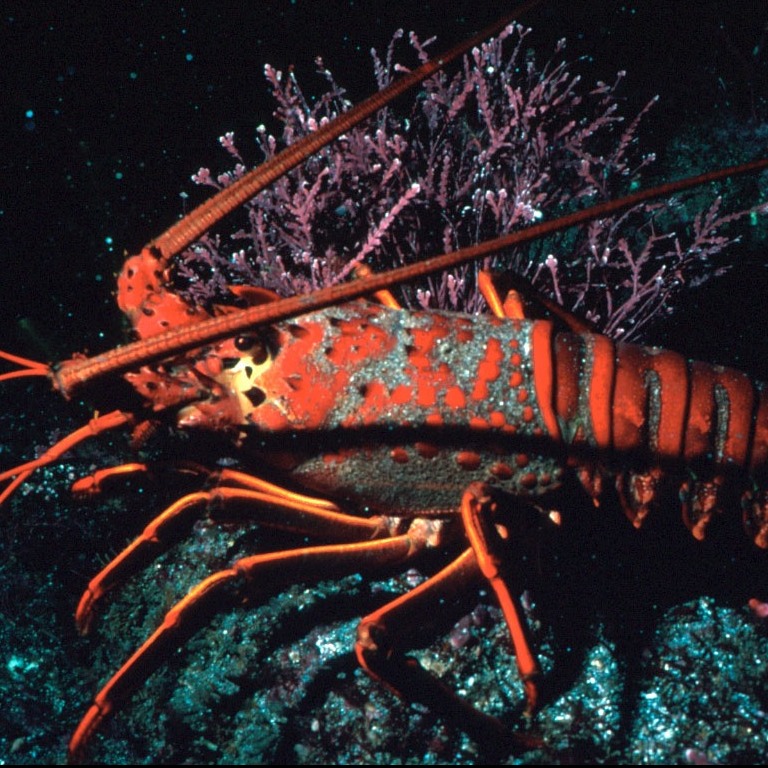
The Pacific spiny lobster (Panulirus gracilis) is a large benthic crustacean of high commercial value. Unlike true lobsters, it lacks front claws, using instead long, thick spiny antennae to defend itself. It typically features a green or brownish coloration with light bands on its walking legs.

Added by

Anonymous Curator

Reviewed by

Under Review

Last modified by

Julia Trouin

TaxonomyBiological classification ranks placing this species within the tree of life, from Kingdom down to Genus.

PhylumRank below Kingdom. Groups organisms sharing a fundamental body plan (e.g., Chordata = vertebrates and some invertebrates).Arthropoda
ClassRank below Phylum. Subdivides by structural traits (e.g., Mammalia, Aves, Reptilia, Insecta).Malacostraca
OrderRank below Class. Groups related families sharing common ancestry (e.g., Carnivora, Primates).Decapoda
FamilyRank below Order. Groups closely related genera (e.g., Felidae = cats, Canidae = dogs).Palinuridae
GenusRank just above Species. The first word in the two-part binomial scientific name.Panulirus
Taxonomic AuthorityThe scientist who first formally described and published this species, followed by the year of publication.(Streets, 1871)
Record Completeness
96%
Coming soon

Ecology & StatusHow this species lives: habitat preferences, diet, behavior, population status, and role in its ecosystem.

OriginWhether the species is native (evolved here), endemic (found only here), or introduced by human activity.

Native

Population TrendDirection of change in population size over time: increasing, stable, decreasing, or unknown.

Decreasing

Breeding SeasonTime of year when this species typically reproduces or flowers.

Year Round

Trophic RolePosition in the food chain: producer, herbivore, carnivore, omnivore, decomposer, or parasite.

Carnivore

Recent SightingsWhether this species has been observed in the wild in Costa Rica within recent years.

Yes

Habitat SummaryOverview of the specific ecosystems and environments where this species is found in Costa Rica. Multi-lang

Inhabits the sublittoral and coastal zone, hiding during the day in crevices and caves of rocky reefs, corals, and artificial structures, generally at depths between 1 and 20 meters.

BehaviourDaily activity patterns, movement, territory use, foraging style, and seasonal behavioral changes. Multi-lang

Markedly nocturnal species. It spends the daylight hours sheltered in its hiding place to avoid predators and emerges to actively forage on the seabed under the cover of darkness.

Social ActivitySocial structure: whether the species is solitary, paired, or colonial; hierarchy and communication. Multi-lang

Highly gregarious during the day, frequently sharing the same reef crevices with multiple individuals to increase their collective defense.

Feeding GuildWhat the species eats, how it forages or hunts, and its role as a consumer in the food web. Multi-lang

Benthic carnivore / scavenger. It feeds primarily by crushing snails, bivalves, small crabs, sea urchins, and the remains of dead animals.

Trophic Chain DetailsSpecific interactions in local food webs: prey species, predators, competitors, and scavengers. Multi-lang

Intermediate benthic predator. It helps control populations of small invertebrates but is a favorite prey of octopuses, moray eels, large groupers, and nurse sharks.

Reproductive BehaviourMating strategies, courtship displays, nesting or spawning behavior, and parental care. Multi-lang

The male attaches a sperm packet to the female’s sternum. Upon spawning, the female carries hundreds of thousands of orange eggs under her abdomen until they hatch into planktonic larvae.

Physical Measures

Length (cm)

15.0 - 40.0 cm

Weight (Grams)

400 g - 2.50 kg

Offspring per cycleTypical number of young (live births, eggs, or seeds) produced by one adult in a single reproductive event or breeding season.100000 - 1000000
Sexual DimorphismObservable physical differences between males and females of the same species (e.g., size, coloration, features).Yes

Lifespan

Sexual MaturityAge at which the individual becomes capable of reproducing for the first time.

3 - 5 Years

Gestation / IncubationDuration from fertilization to birth (mammals) or to hatching (egg-laying species).

21 - 35

Lifespan EstimatedExpected duration of life from birth to natural death under wild conditions.
Males10 - 20 Years
Females10 - 20 Years

Sexual DimorphismPhysical differences in size, coloration, or morphology between males and females of this species.

Males Multi-lang

Adult males tend to reach a significantly larger size, possess proportionally longer walking legs, and lack small claws on their last pair of legs.

Females Multi-lang

The female has a noticeably broader abdomen to house the eggs and has small claws (chelae) on her fifth pair of walking legs to groom the clutch.

Evolutionary AdaptationsInherited traits and behaviors that improve the species' survival and reproduction in its specific environment. Multi-lang

Spiny antennae: Its powerful, thick antennae are covered in sharp spines that it uses like whips to strike and deter predators.
Escape propulsion: Its strong muscular abdomen allows it to make rapid contractions, propelling itself backwards at high speed to flee from danger.

Main ThreatsDocumented pressures reducing the population: habitat loss, hunting, disease, climate change, and invasive species. Multi-lang

Overfishing: It is an intensively harvested species using traps, nets, and free diving for local consumption and export, which has significantly depleted its populations.

Interesting FactsSurprising or notable facts that highlight what makes this species unique or ecologically important. Multi-lang

Acoustic stridulation: To scare its enemies, it produces a loud, harsh, chirping sound by rubbing the base of its antennae against a specialized patch on its head.