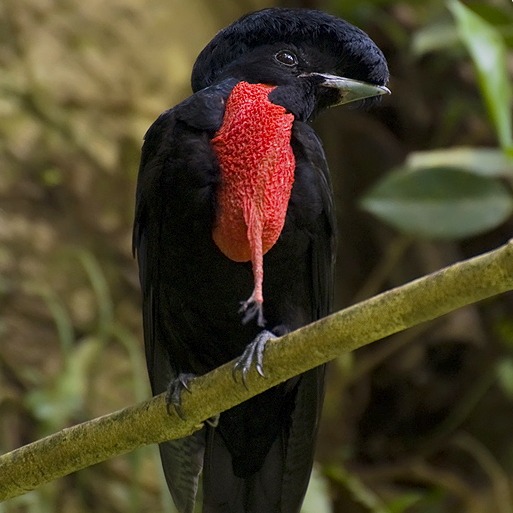
Cephalopterus glabricollis
Bare-necked Umbrellabird
Gould, 1851
Added by
Anonymous Curator
Reviewed by
Under Review
Last modified by
Julia Trouin
TaxonomyBiological classification ranks placing this species within the tree of life, from Kingdom down to Genus.
Ecology & StatusHow this species lives: habitat preferences, diet, behavior, population status, and role in its ecosystem.
OriginWhether the species is native (evolved here), endemic (found only here), or introduced by human activity.
Endemic
Population TrendDirection of change in population size over time: increasing, stable, decreasing, or unknown.
Decreasing
Breeding SeasonTime of year when this species typically reproduces or flowers.
Dry Season
Trophic RolePosition in the food chain: producer, herbivore, carnivore, omnivore, decomposer, or parasite.
Omnivore
Recent SightingsWhether this species has been observed in the wild in Costa Rica within recent years.
Yes
Habitat SummaryOverview of the specific ecosystems and environments where this species is found in Costa Rica. Multi-lang
It is an endemic species to Costa Rica and Panama, and a highly pronounced altitudinal migrant. During its breeding season, it inhabits the canopy and mid-story of mature cloud forests, between 800 and 2,000 meters in elevation (such as in the Monteverde Cloud Forest Reserve). After the breeding season, it descends in complex migrations to the humid lowland forests of the Caribbean coast and some Pacific areas, seeking refuge and food during the heaviest rainy months.BehaviourDaily activity patterns, movement, territory use, foraging style, and seasonal behavioral changes. Multi-lang
It is a bird of calm habits. Despite its enormous size, it often goes unnoticed because it perches completely silent and motionless in the mid and upper levels of the forest, flying with slow, heavy wingbeats resembling those of a crow. During the breeding season, males form courtship assemblies called 'leks' in the cloud canopy. They perch on bare branches, inflate their scarlet red gular sac, and project their heads forward to emit their resonant boom, trying to acoustically dominate the valley.Social ActivitySocial structure: whether the species is solitary, paired, or colonial; hierarchy and communication. Multi-lang
Outside of the loose groups of males singing in leks, it is a strictly solitary bird. It is never observed in flocks and rarely associates with other forest species. The female breeds in complete isolation.Feeding GuildWhat the species eats, how it forages or hunts, and its role as a consumer in the food web. Multi-lang
Canopy frugivore / Omnivore.Trophic Chain DetailsSpecific interactions in local food webs: prey species, predators, competitors, and scavengers. Multi-lang
Seasonal omnivore, but primarily frugivorous. Its diet is highly specialized on large fruits of the Lauraceae, palm, and Annonaceae families. By spitting out large seeds far from the mother plant, it promotes forest regeneration. They occasionally supplement their diet by catching large insects (katydids, beetles) or small lizards and frogs, especially when feeding their chicks. Their nests are constant targets for toucans, coatis, and monkeys, while adults fear crested eagles and hawks.Reproductive BehaviourMating strategies, courtship displays, nesting or spawning behavior, and parental care. Multi-lang
Polygynous birds (Lekking). After mating with the most attractive male in the lek, the female leaves to handle all rearing duties exclusively. She is a poor architect: she builds an incredibly loose and fragile cup nest made of thin twigs in the fork of a tree, usually between 4 and 15 meters high in the cloud forest. The nest is so sparse that the single egg can often be seen from below. The female lays 1 heavily mottled egg and incubates it alone. She provisions the altricial chick with insects and fruits until it manages to leave the flimsy nest weeks later.Physical Measures
Length (cm)
35.0 - 41.0 cm
Weight (Grams)
300 g - 500 g
Lifespan
Sexual MaturityAge at which the individual becomes capable of reproducing for the first time.
24 - 36 Months
Gestation / IncubationDuration from fertilization to birth (mammals) or to hatching (egg-laying species).
20 - 22