
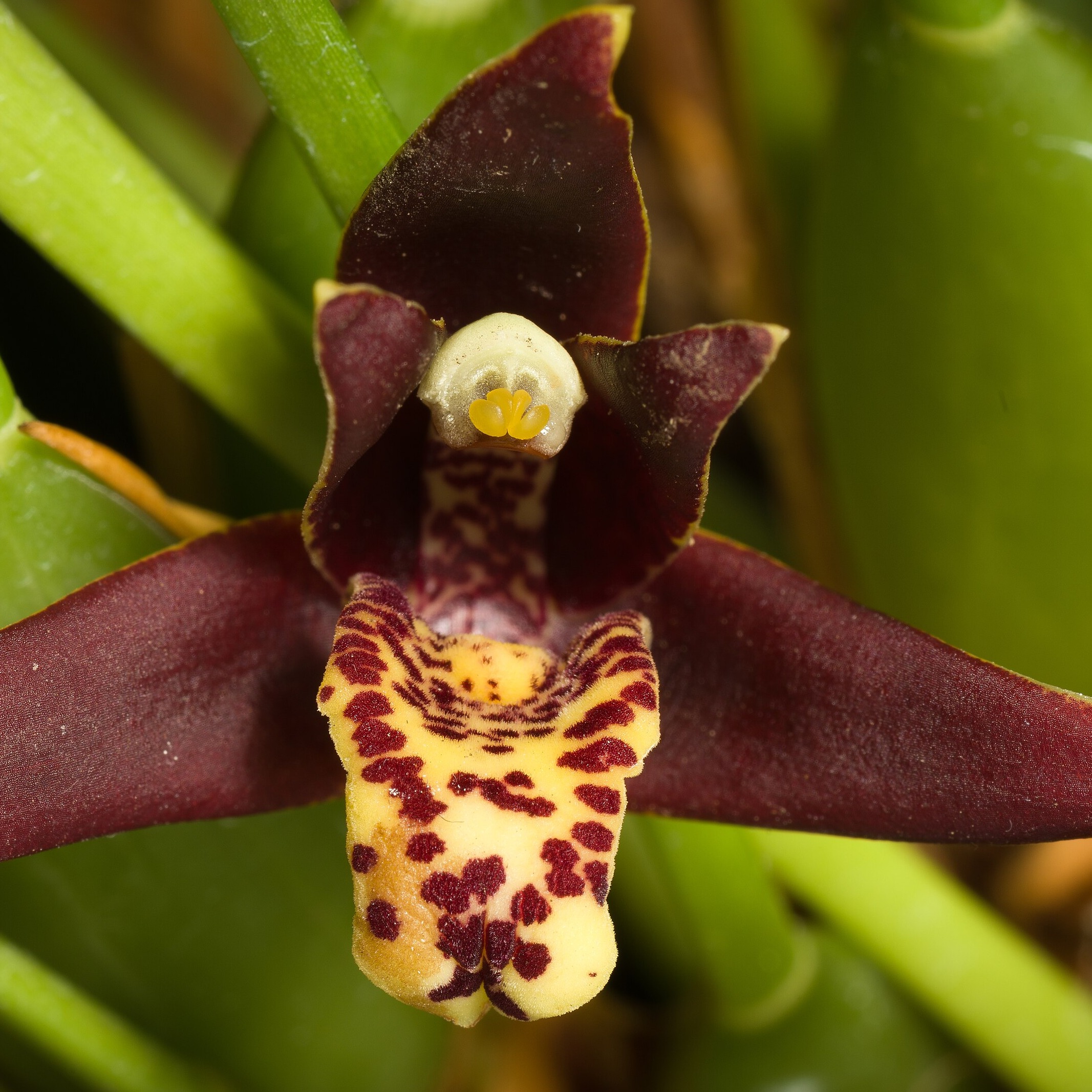
Maxillaria tenuifolia
Coconut Pie Orchid
Lindl., 1837
Added by
Anonymous Curator
Reviewed by
Julia Trouin
Last modified by
Julia Trouin
TaxonomyBiological classification ranks placing this species within the tree of life, from Kingdom down to Genus.
Ecology & StatusHow this species lives: habitat preferences, diet, behavior, population status, and role in its ecosystem.
OriginWhether the species is native (evolved here), endemic (found only here), or introduced by human activity.
Native
Population TrendDirection of change in population size over time: increasing, stable, decreasing, or unknown.
Stable
Trophic RolePosition in the food chain: producer, herbivore, carnivore, omnivore, decomposer, or parasite.
Herbivore
Growth HabitPhysical form and structure of the plant: tree, shrub, herb, vine, epiphyte, aquatic, etc.
--
Leaf TypeLeaf characteristics: deciduous (seasonal shed), evergreen, simple, compound, needle-like, etc.
--
Flowering SeasonTime of year when this species typically reproduces or flowers.
Year Round
Recent SightingsWhether this species has been observed in the wild in Costa Rica within recent years.
Yes
Habitat SummaryOverview of the specific ecosystems and environments where this species is found in Costa Rica. Multi-lang
Widely distributed throughout the wet tropical biomes of Mexico and Central America, including Guatemala, Belize, El Salvador, Honduras, Nicaragua, and Costa Rica. It thrives primarily as a low-to-mid elevation epiphyte from sea level up to 1,500 meters, anchoring onto branches in humid tropical rainforests, seasonal semi-deciduous woodlands, and shaded ravines within warm oak forests, favoring regions with excellent air movement and filtered or dappled canopy light.Light & Water NeedsSunlight intensity and moisture levels this plant needs to grow and reproduce successfully. Multi-lang
Information not available in English. Help us expand this record!BehaviourDaily activity patterns, movement, territory use, foraging style, and seasonal behavioral changes. Multi-lang
Grows primarily as an epiphyte, constructing expansive, elevated mats that bridge branch bifurcations and stabilize overhead moisture dynamics. Blooming is synchronized in spring and early summer, triggered by the rising temperatures that follow the winter dry resting period. The intense, long-distance coconut scent profile acts as a massive olfactory beacon within the lower canopy layers, drawing in native insect networks during peak daily temperature hours.Toxicity / UsesToxic compounds present and their documented effects on humans or other organisms. Multi-lang
Information not available in English. Help us expand this record!Physical Measures
Length (cm)
20.0 - 60.0 cm