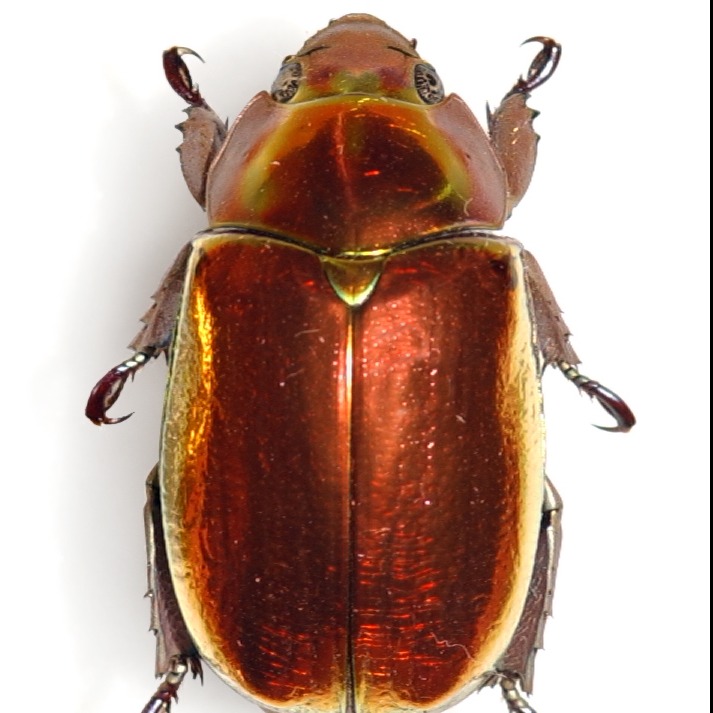
Chrysina aurigans
Golden Jewel Scarab
(Rothschild & Jordan, 1894)
Added by
Anonymous Curator
Reviewed by
Under Review
Last modified by
Julia Trouin
TaxonomyBiological classification ranks placing this species within the tree of life, from Kingdom down to Genus.
Ecology & StatusHow this species lives: habitat preferences, diet, behavior, population status, and role in its ecosystem.
OriginWhether the species is native (evolved here), endemic (found only here), or introduced by human activity.
Native
Population TrendDirection of change in population size over time: increasing, stable, decreasing, or unknown.
Unknown
Breeding SeasonTime of year when this species typically reproduces or flowers.
Year Round
Trophic RolePosition in the food chain: producer, herbivore, carnivore, omnivore, decomposer, or parasite.
Herbivore
Recent SightingsWhether this species has been observed in the wild in Costa Rica within recent years.
Yes
Habitat SummaryOverview of the specific ecosystems and environments where this species is found in Costa Rica. Multi-lang
Endemic to the pristine, high-elevation mid-montane cloud forests and humid oak-dominated rainforests of Costa Rica and western Panama. It is restricted to undisturbed canopy environments, generally operating between 1,200 and 2,500 meters above sea level.BehaviourDaily activity patterns, movement, territory use, foraging style, and seasonal behavioral changes. Multi-lang
Nocturnal. Adults spend daylight hours hidden high within the canopy foliage, resting motionless on leaves. At night, they become active, flying swiftly through the canopy to locate feeding sites and mates. They are strongly attracted to artificial lights, which is how they are most frequently encountered by researchers.Social ActivitySocial structure: whether the species is solitary, paired, or colonial; hierarchy and communication. Multi-lang
Solitary. They interact only during mating encounters in the high canopy, without forming groups or aggregations, except when multiple individuals are inadvertently drawn to the same light trap or artificial light source.Feeding GuildWhat the species eats, how it forages or hunts, and its role as a consumer in the food web. Multi-lang
Herbivore (Detritivore as larvae, Folivore as adults).Trophic Chain DetailsSpecific interactions in local food webs: prey species, predators, competitors, and scavengers. Multi-lang
Larvae are typical white grubs that live underground or inside decaying wood, strictly consuming rotting logs and organic rich humus. Adult beetles feed directly on the tender leaves of high-altitude forest trees, particularly mountain oaks (Quercus species). Natural predators include high-altitude cloud forest birds, small arboreal mammals, and larger bats.Reproductive BehaviourMating strategies, courtship displays, nesting or spawning behavior, and parental care. Multi-lang
Mating takes place at night high in the forest branches during the onset of the wet season. Females follow volatile chemical signals to locate optimal decomposing nurse logs or humus pockets rich in fungal mycelium, where they bury themselves deeply to lay individual white, oval eggs.Physical Measures
Length (cm)
2.5 - 3.5 cm
Weight (Grams)
3 g - 5.5 g
Lifespan
Sexual MaturityAge at which the individual becomes capable of reproducing for the first time.
11 - 13 Months
Gestation / IncubationDuration from fertilization to birth (mammals) or to hatching (egg-laying species).
14 - 22