
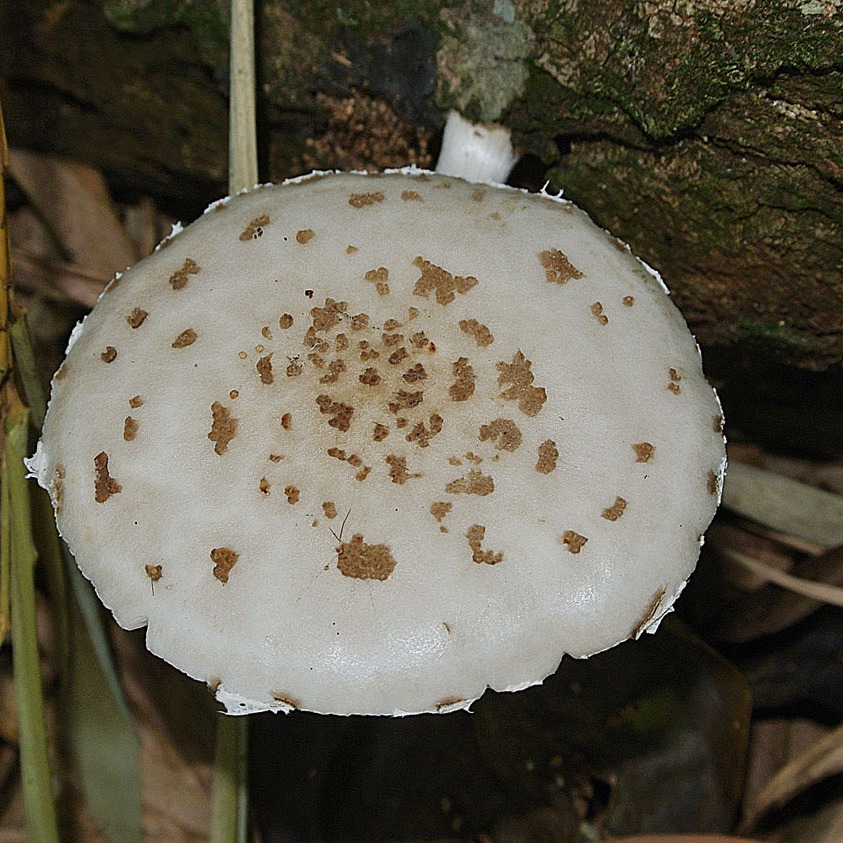
Oudemansiella canarii
Soft Wood Mushroom
(Jungh.) Höhn., 1909
Added by
Anonymous Curator
Reviewed by
Under Review
Last modified by
Julia Trouin
TaxonomyBiological classification ranks placing this species within the tree of life, from Kingdom down to Genus.
Ecology & StatusHow this species lives: habitat preferences, diet, behavior, population status, and role in its ecosystem.
OriginWhether the species is native (evolved here), endemic (found only here), or introduced by human activity.
Native
Population TrendDirection of change in population size over time: increasing, stable, decreasing, or unknown.
Stable
Trophic RolePosition in the food chain: producer, herbivore, carnivore, omnivore, decomposer, or parasite.
--
EdibilityWhether this mushroom is edible, toxic, hallucinogenic, or of unknown safety. Never eat based solely on this data.
--
Cap ShapeShape of the mushroom cap (pileus): convex, flat, umbonate, funnel-shaped, bell-shaped, etc.
--
Hymenium TypeThe spore-bearing surface of a fungus: gills, pores, teeth, ridges, smooth, or wrinkled.
--
Fruiting SeasonTime of year when this species typically reproduces or flowers.
Wet Season
Recent SightingsWhether this species has been observed in the wild in Costa Rica within recent years.
Yes
Habitat SummaryOverview of the specific ecosystems and environments where this species is found in Costa Rica. Multi-lang
It inhabits wet and very wet tropical rainforests, from sea level to middle elevations. It is found exclusively growing on dead wood (logs, branches, and stumps) of soft-wood trees in the process of decomposition. It prefers shaded microclimates with very high ambient humidity. In Costa Rica, it is a common fungus on both slopes during the rainy season, especially in well-conserved primary and secondary forest areas.SubstrateThe organic material or host organism this fungus colonizes and decomposes. Multi-lang
Information not available in English. Help us expand this record!BehaviourDaily activity patterns, movement, territory use, foraging style, and seasonal behavioral changes. Multi-lang
It is a fundamental primary decomposer in the forest's carbon cycle. By breaking down the hard wood of fallen logs, it releases nutrients that are absorbed by the soil and other plants. Although it does not attract insects by smell like stinkhorns, its viscous structure interacts uniquely with understory fauna, providing a humid microhabitat on the wood.Physical Measures
Length (cm)
5.0 - 12.0 cm