Costa Rica Species
Phaethornis superciliosus
AnimaliaHighest rank in taxonomy. Groups all life into domains: Animalia, Plantae, Fungi, etc.IUCN LCInternational Union for Conservation of Nature — the world authority on species extinction risk, using standardized criteria. — Least Concern — widespread and abundant; not at immediate risk of extinction.In ProgressCurrent stage of this record in the editorial review workflow. Recent Sighting

Phaethornis superciliosus

Long-tailed Hermit

(Linnaeus, 1766)

Detailed Texts Multi-lang
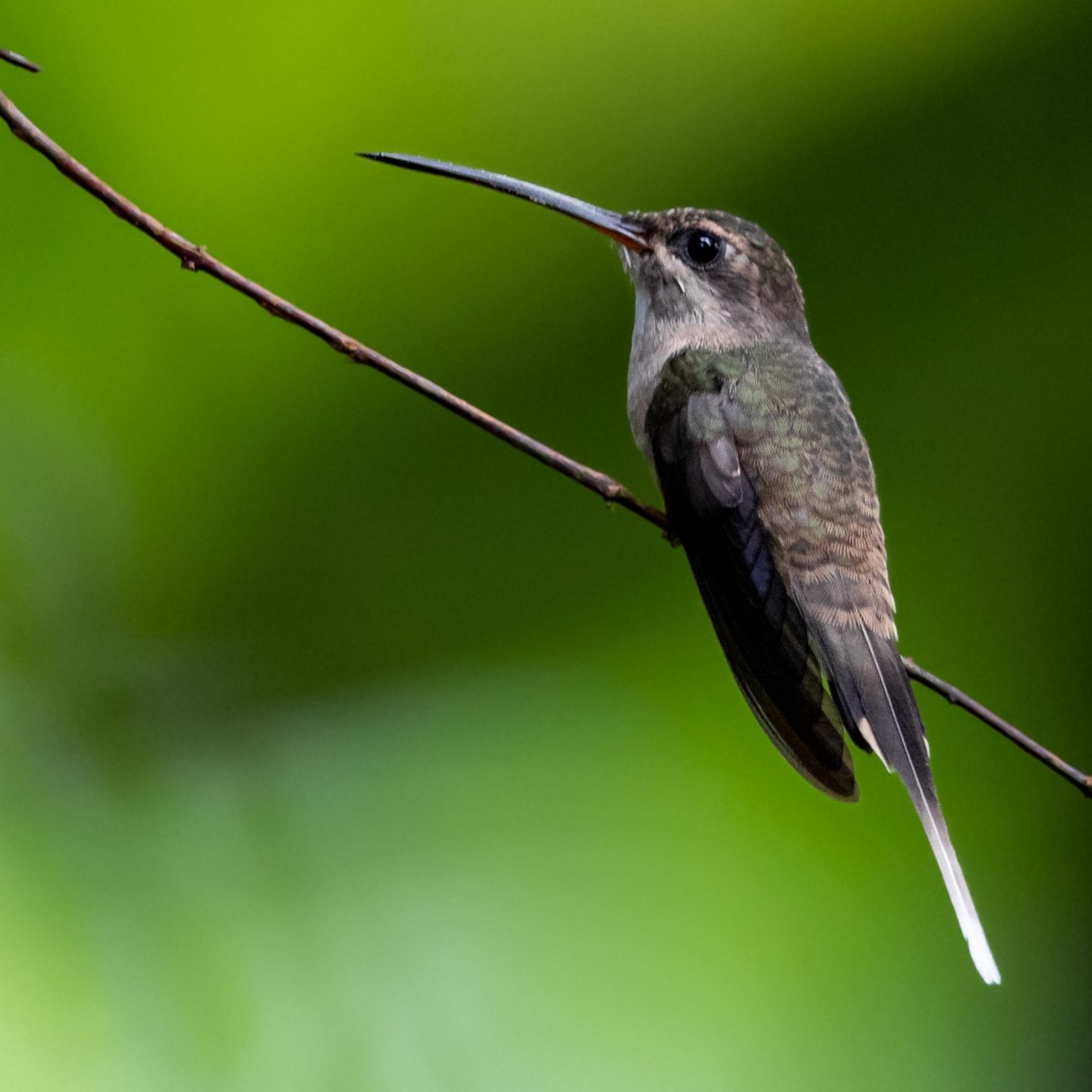
The Long-tailed Hermit (Phaethornis superciliosus) is a relatively large hummingbird adapted to the gloom of the tropical understory. Its plumage lacks the bright, iridescent metallic colors typical of canopy hummingbirds; instead, it wears an elaborate cryptic suit of browns, grays, bronzes, and dull olive greens. Its face features a distinctive dark 'mask' crossed by pale stripes above and below the eye (superciliary and malar). Its most impressive feature is its bill: extremely long and strongly decurved, designed like a master key for tubular flowers. In addition, it possesses a disproportionately long, graduated tail, where the two central feathers extend far beyond the rest and end in striking white tips.

Added by

Anonymous Curator

Reviewed by

Under Review

Last modified by

Julia Trouin

TaxonomyBiological classification ranks placing this species within the tree of life, from Kingdom down to Genus.

PhylumRank below Kingdom. Groups organisms sharing a fundamental body plan (e.g., Chordata = vertebrates and some invertebrates).Chordata
ClassRank below Phylum. Subdivides by structural traits (e.g., Mammalia, Aves, Reptilia, Insecta).Aves
OrderRank below Class. Groups related families sharing common ancestry (e.g., Carnivora, Primates).Apodiformes
FamilyRank below Order. Groups closely related genera (e.g., Felidae = cats, Canidae = dogs).Trochilidae
GenusRank just above Species. The first word in the two-part binomial scientific name.Phaethornis
Taxonomic AuthorityThe scientist who first formally described and published this species, followed by the year of publication.(Linnaeus, 1766)
Record Completeness
95%
Coming soon

Ecology & StatusHow this species lives: habitat preferences, diet, behavior, population status, and role in its ecosystem.

OriginWhether the species is native (evolved here), endemic (found only here), or introduced by human activity.

Native

Population TrendDirection of change in population size over time: increasing, stable, decreasing, or unknown.

Decreasing

Breeding SeasonTime of year when this species typically reproduces or flowers.

Dry Season

Trophic RolePosition in the food chain: producer, herbivore, carnivore, omnivore, decomposer, or parasite.

Herbivore

Recent SightingsWhether this species has been observed in the wild in Costa Rica within recent years.

Yes

Habitat SummaryOverview of the specific ecosystems and environments where this species is found in Costa Rica. Multi-lang

It is an exclusive inhabitant of the understory (the lowest, darkest stratum) of humid lowland tropical rainforests, dense primary forests, gallery forests, and mature forest edges. It avoids the direct sunlight of the canopy and completely deforested spaces. It requires a high density of understory plants, such as Heliconias and Passifloras. In the Neotropics (and sister species in Central America), it dominates the lower levels of humid Caribbean and Pacific forests.

BehaviourDaily activity patterns, movement, territory use, foraging style, and seasonal behavioral changes. Multi-lang

They fly low and fast through the dense underbrush, producing a loud, directional hum. They are skittish and solitary birds while foraging. They move quickly from flower to flower hovering briefly, and often engage in 'nectar robbing' by piercing the base of flowers that are too long even for their own bills. They are frequently seen bathe-flying, smacking the surface of forest streams and immediately darting up to a perch to preen.

Social ActivitySocial structure: whether the species is solitary, paired, or colonial; hierarchy and communication. Multi-lang

Very solitary during the day as they patrol their feeding routes independently. The only significant social interaction occurs at the 'leks', where several males vocalize competitively, or during the brief act of copulation.

Feeding GuildWhat the species eats, how it forages or hunts, and its role as a consumer in the food web. Multi-lang

Nectarivore / Trapline forager.

Trophic Chain DetailsSpecific interactions in local food webs: prey species, predators, competitors, and scavengers. Multi-lang

Strict nectarivore with insect supplementation. It extracts the high sugar content from nectar-rich flowers (Heliconia, Costus, Passiflora). However, it actively hunts small spiders and soft insects (catching them in spiderwebs or in flight) to obtain essential proteins. Its main predators are arboreal snakes (Vine snakes, Fer-de-lance) and small felines that hunt them in the dark understory.

Reproductive BehaviourMating strategies, courtship displays, nesting or spawning behavior, and parental care. Multi-lang

The male mates and leaves the female. She single-handedly builds the ingenious hanging nest under a palm or Heliconia leaf. She lays 2 white eggs which she incubates alone for about 14 to 16 days. The chicks are altricial (born blind and naked). The female feeds them by regurgitating nectar and insects, plunging her long bill into the throats of the young. The fledglings leave the nest at 20-23 days of age.

Physical Measures

Length (cm)

13.0 - 16.0 cm

Weight (Grams)

4 g - 7 g

Offspring per cycleTypical number of young (live births, eggs, or seeds) produced by one adult in a single reproductive event or breeding season.2 - 2
Sexual DimorphismObservable physical differences between males and females of the same species (e.g., size, coloration, features).No

Lifespan

Sexual MaturityAge at which the individual becomes capable of reproducing for the first time.

10 - 12 Months

Gestation / IncubationDuration from fertilization to birth (mammals) or to hatching (egg-laying species).

14 - 16

Lifespan EstimatedExpected duration of life from birth to natural death under wild conditions.
Males3 - 7 Years
Females3 - 7 Years

Evolutionary AdaptationsInherited traits and behaviors that improve the species' survival and reproduction in its specific environment. Multi-lang

Trapline Foraging: Unlike other hummingbirds that are aggressively territorial and defend a single bush, the hermit has a brain adapted for complex spatial navigation. It memorizes routes spanning several kilometers through the jungle, visiting widely scattered flowers (traplines) in an exact circuit each day, calculating the nectar refill time of each flower.
Coevolutionary Bill: Its bill is dramatically curved to fit perfectly like a key in a lock into the curved corollas of specific understory plants, such as Heliconias and Centropogon. This coevolution ensures the flower is pollinated exclusively by this hummingbird, while the bird gains a nectar monopoly.

Main ThreatsDocumented pressures reducing the population: habitat loss, hunting, disease, climate change, and invasive species. Multi-lang

Understory Clearing: Because it depends on shaded ground-level flowers, clearing the understory (even if large canopy trees are left standing) for shade agriculture or livestock completely destroys its food source.
Forest Fragmentation: Their traplines require uninterrupted expanses of humid forest. Fragmentation isolates plant populations and forces hermits to cross open areas where they are easy prey or simply run out of food.

Interesting FactsSurprising or notable facts that highlight what makes this species unique or ecologically important. Multi-lang

Singing Leks: Males do not care for the young or the female. Instead, they gather in small forest areas called 'leks'. There, several males perch a short distance from each other and sing incessantly for hours every day, wagging their long tails to attract females traveling through the forest.
Anti-gravity Engineering: Their nests are small marvels of physics. They build a cone of moss and plant fibers under the tip of a large, drooping leaf (like a palm or Heliconia), gluing it with spiderwebs. To prevent the nest from flipping, they hang a 'counterweight' of dirt and debris at the base of the cone.