
AnimaliaIUCN LCApproved Recent Sighting
Dermophis parviceps
Slender caecilian
Dunn, 1924
Detailed Texts Multi-lang
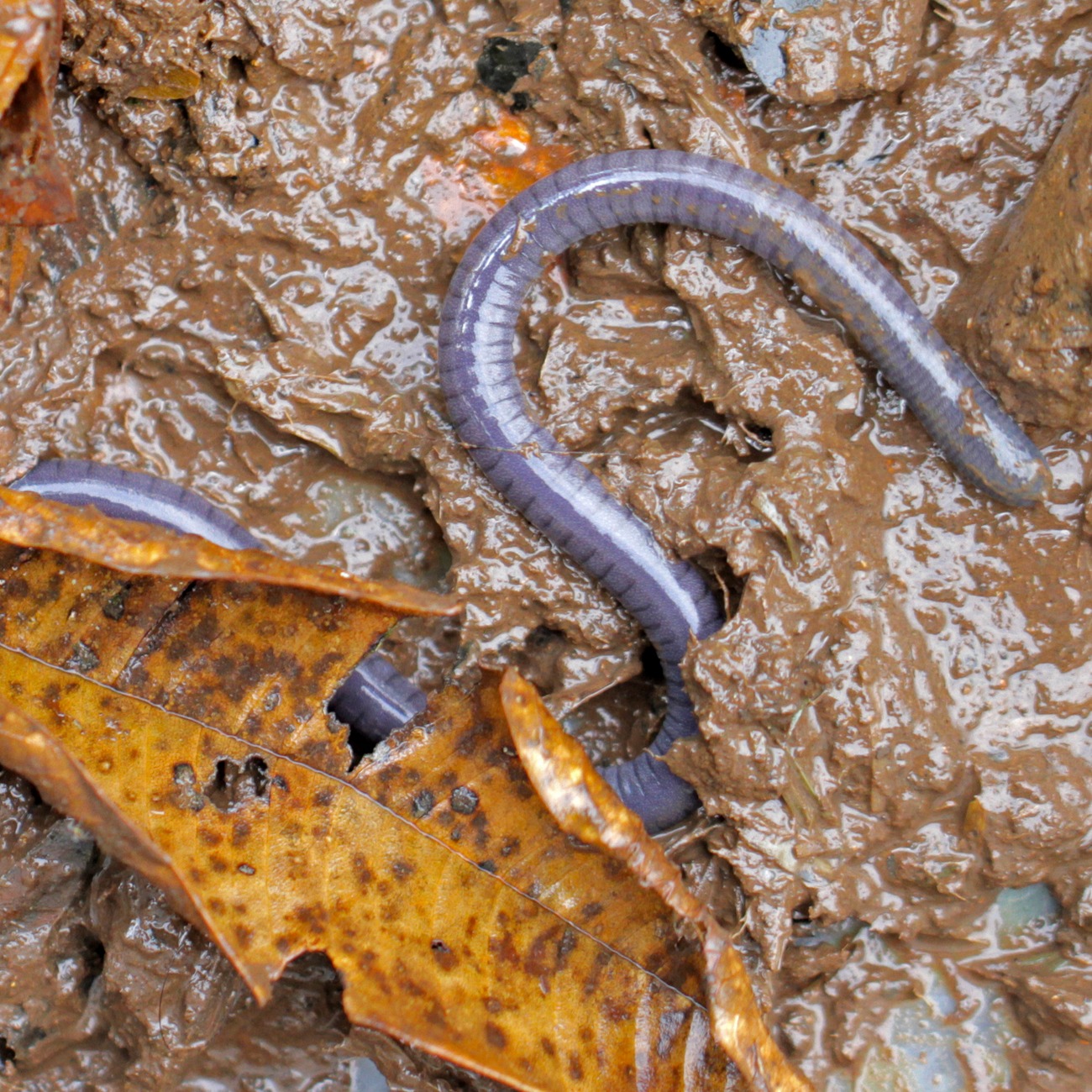
Caecilian with a remarkably slender and elongated body, with a small head and uniform coloration tending towards grayish or brownish tones.
Added by
Anonymous Curator
Reviewed by
Julia Trouin
Last modified by
Julia Trouin
Taxonomy
PhylumChordata
ClassAmphibia
OrderGymnophiona
FamilyDermophiidae
GenusDermophis
Taxonomic AuthorityDunn, 1924
Ecology & Status
Origin
Native
Population Trend
Stable
Breeding Season
Year Round
Trophic Role
Carnivore
Recent Sightings
Yes
Habitat Summary Multi-lang
Inhabits soil rich in organic matter in tropical humid forests and secondary vegetation areas.Behaviour Multi-lang
Strictly fossorial, rarely leaves its underground galleries.Social Activity Multi-lang
Solitary, interacts with other individuals only during the mating season.Feeding Guild Multi-lang
Tactile and vibrational hunter, locates prey in the dark.Trophic Chain Details Multi-lang
Predator of small soil invertebrates.Reproductive Behaviour Multi-lang
Viviparity, the female nourishes its young internally.Physical Measures
Length (cm)
15.0 - 25.0 cm
Weight (Grams)
5 g - 20 g
Offspring per cycle3 - 8
Sexual DimorphismYes
Lifespan
Sexual Maturity
2 - 3 Years
Gestation / Incubation
150 - 200
Lifespan Estimated
Males--
Females--
Sexual Dimorphism
Males Multi-lang
Males with slightly longer tail.
Females Multi-lang
Females with larger body and reproductive capacity.
Evolutionary Adaptations Multi-lang
Highly specialized body for burrowing, with a reinforced skull that allows it to force its way through dense substrates.
Main Threats Multi-lang
Sensitive to soil degradation and chemical contamination from agricultural pesticides.
Interesting Facts Multi-lang
Despite its appearance, it is neither an earthworm nor a reptile, but an amphibian perfectly adapted to subterranean life.