
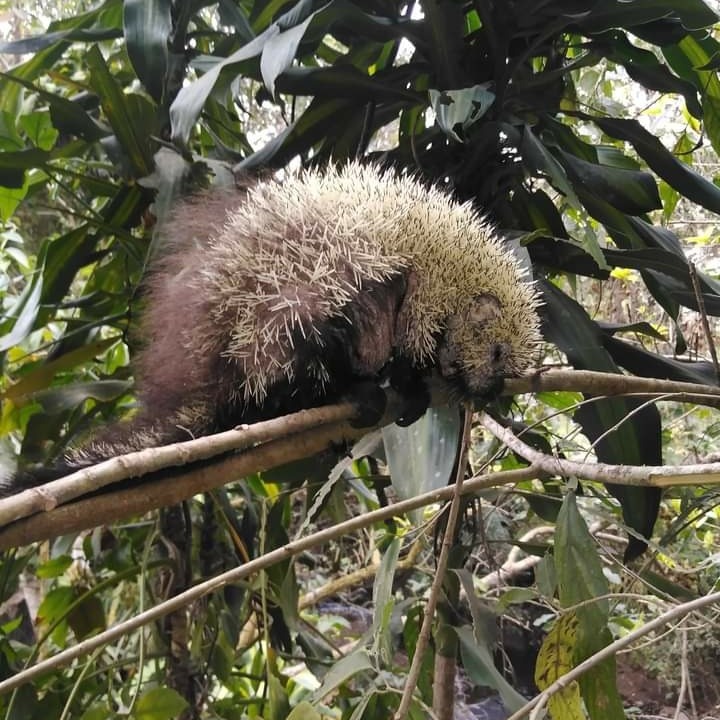
Sphiggurus mexicanus
Mexican Hairy Dwarf Porcupine
(Brandt, 1835)
Added by
Anonymous Curator
Reviewed by
Under Review
Last modified by
Julia Trouin
TaxonomyBiological classification ranks placing this species within the tree of life, from Kingdom down to Genus.
Ecology & StatusHow this species lives: habitat preferences, diet, behavior, population status, and role in its ecosystem.
OriginWhether the species is native (evolved here), endemic (found only here), or introduced by human activity.
Native
Population TrendDirection of change in population size over time: increasing, stable, decreasing, or unknown.
Decreasing
Breeding SeasonTime of year when this species typically reproduces or flowers.
Year Round
Trophic RolePosition in the food chain: producer, herbivore, carnivore, omnivore, decomposer, or parasite.
Herbivore
Recent SightingsWhether this species has been observed in the wild in Costa Rica within recent years.
Yes
Habitat SummaryOverview of the specific ecosystems and environments where this species is found in Costa Rica. Multi-lang
The Mexican hairy dwarf porcupine preferentially occupies the canopy and subcanopy of lowland and premontane tropical moist and very moist forests, gallery forests, and mature secondary forests with high canopy connectivity. It rarely descends to the ground: it spends virtually its entire life between 5 and 30 meters in height, where it forages, sleeps, and reproduces. It shows a marked preference for zones with high density of fruit trees and trees with sweet or starch-rich bark. It tolerates some degree of disturbance if canopy continuity is maintained, but disappears quickly from heavily fragmented landscapes. In Costa Rica it is recorded from sea level to 2,700 meters altitude on both slopes, with highest density in the humid forests of the Caribbean and the South Pacific. It is more frequently detected by its vocalizations than by direct observation, given its extremely cryptic nature.BehaviourDaily activity patterns, movement, territory use, foraging style, and seasonal behavioral changes. Multi-lang
The Mexican hairy dwarf porcupine is strictly nocturnal and arboreal. It begins activity at nightfall and returns to its resting site — generally a fork of thick branches or a hollow in an old trunk — before dawn. It moves with slow, deliberate movements, advancing along branches with its head low and its body compact. Unlike the kinkajou and olingo, it does not jump between trees: it prefers to partially descend and re-ascend the adjacent tree trunk. It has a small home range of 5 to 35 hectares that it travels along relatively fixed routes. Its primary defense strategy is immobility and camouflage; if detected and cornered, it turns its spiny back toward the aggressor, bristles its spines, and can strike with its armored tail. It rarely flees actively from a predator.Social ActivitySocial structure: whether the species is solitary, paired, or colonial; hierarchy and communication. Multi-lang
The Mexican hairy dwarf porcupine is fundamentally solitary. Adult individuals maintain individual home ranges that overlap minimally and avoid direct contact outside the reproductive period through chemical communication — odoriferous marks from facial and perianal glands on branches and trunks — and low-intensity nasal vocalizations. During courtship, male and female may briefly share the same tree. Intra- and interspecific communication is complemented by dental warning clicks, spine erection, and percussion of the armed tail against branches when threatened. Young remain with the mother until approximately 5–6 months, when they reach 70% of adult size and begin establishing their own home ranges.Feeding GuildWhat the species eats, how it forages or hunts, and its role as a consumer in the food web. Multi-lang
Specialized arboreal herbivore-frugivore. Its diet consists primarily of soft ripe fruits — especially Ficus spp., palms, and Cecropia spp. — tender canopy leaves and buds, flowers, inner bark rich in sugars and starches, and seeds with not-very-hard coatings. The proportion of each component varies seasonally: during the rainy season fruits predominate; during the dry season consumption of bark, leaves, and flowers increases. It does not significantly consume invertebrates or animal material. It does not store food. It locates food primarily by smell and spatial memory of productive trees in its territory.Trophic Chain DetailsSpecific interactions in local food webs: prey species, predators, competitors, and scavengers. Multi-lang
Herbivorous-frugivorous primary consumer. Its diet is composed of ripe fruits, tender leaves, flowers, buds, inner bark, and seeds of various canopy tree species. By consuming whole fruits and defecating seeds at considerable distances from the mother tree, it acts as a secondary seed disperser of various Ficus species, palms, and subcanopy plants. Its bark 'girdling' habit can cause the death of branches and trees, generating dead wood that benefits xylophagous insects, woodpeckers, and fungi. Its main predators are the jaguar (Panthera onca), puma (Puma concolor), ocelot (Leopardus pardalis), harpy eagle (Harpia harpyja), spectacled owl (Pulsatrix perspicillata), and boa constrictor (Boa constrictor). The tayra (Eira barbara) and raccoon (Procyon lotor) may attack young or resting individuals.Reproductive BehaviourMating strategies, courtship displays, nesting or spawning behavior, and parental care. Multi-lang
Reproduction can occur year-round, although birth peaks have been documented at the onset of the rainy season in several countries within its range. Courtship is prolonged and vocally noisy: the male pursues the female for several days emitting continuous vocalizations, and there may be competition between males for access to an estrous female. Copulation occurs in the canopy, with the female suspended by her tail while the male carefully balances to avoid the spines. After a gestation of 195–210 days — one of the longest of any rodent of its size — a single precocial young is born with open eyes, already-hardened spines, and the ability to climb within hours. The young is born with soft spines covered by a membrane that hardens within the first hours of life. Lactation lasts approximately 3 to 4 months. Young reach independence between 5 and 8 months and sexual maturity between 18 and 24 months.Physical Measures
Length (cm)
30.0 - 48.0 cm
Weight (Grams)
900 g - 2.50 kg
Lifespan
Sexual MaturityAge at which the individual becomes capable of reproducing for the first time.
18 - 24 Months
Gestation / IncubationDuration from fertilization to birth (mammals) or to hatching (egg-laying species).
195 - 210