AnimaliaIUCN LCIn Progress Recent Sighting
Sphiggurus mexicanus
Mexican Hairy Dwarf Porcupine
(Brandt, 1835)
Detailed Texts Multi-lang
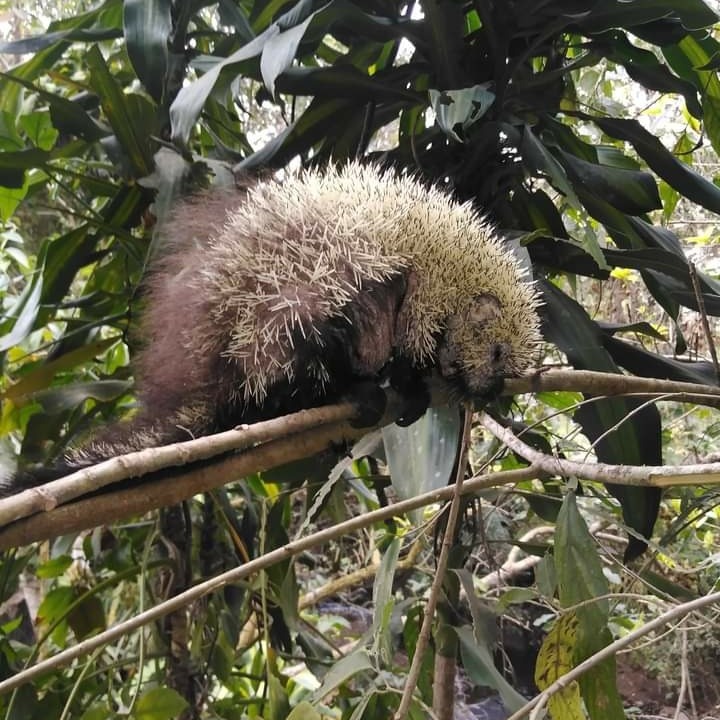
The Mexican hairy dwarf porcupine (Sphiggurus mexicanus) is a nocturnal arboreal rodent belonging to the family Erethizontidae, the New World porcupines. It is considerably smaller than the North American porcupine (Erethizon dorsatum) and occupies exclusively the canopy of tropical forests. Its compact, rounded body is covered by a characteristic mixture of short, robust spines — quills — interspersed with long, yellowish or brownish hair that semi-conceals them, giving it a woolly appearance that distinguishes it from Old World porcupines and other Neotropical species. The spines are smooth at the base and end in a microscopically backward-barbed tip, making them extremely difficult to extract once embedded in a predator's skin. It has a short, blunt snout, small dark eyes, tiny ears almost hidden under the fur, and a long, muscular tail that is prehensile in its distal third, with a bare ventral surface to maximize grip. The feet have specialized plantar pads and robust curved claws. It is distributed from southern Mexico to northwestern Colombia and Venezuela, including all of Central America.
Added by
Anonymous Curator
Reviewed by
Under Review
Last modified by
Julia Trouin
Taxonomy
PhylumChordata
ClassMammalia
OrderRodentia
FamilyErethizontidae
GenusSphiggurus
Taxonomic Authority(Brandt, 1835)
Ecology & Status
Origin
Native
Population Trend
Decreasing
Breeding Season
Year Round
Trophic Role
Herbivore
Recent Sightings
Yes
Habitat Summary Multi-lang
The Mexican hairy dwarf porcupine preferentially occupies the canopy and subcanopy of lowland and premontane tropical moist and very moist forests, gallery forests, and mature secondary forests with high canopy connectivity. It rarely descends to the ground: it spends virtually its entire life between 5 and 30 meters in height, where it forages, sleeps, and reproduces. It shows a marked preference for zones with high density of fruit trees and trees with sweet or starch-rich bark. It tolerates some degree of disturbance if canopy continuity is maintained, but disappears quickly from heavily fragmented landscapes. In Costa Rica it is recorded from sea level to 2,700 meters altitude on both slopes, with highest density in the humid forests of the Caribbean and the South Pacific. It is more frequently detected by its vocalizations than by direct observation, given its extremely cryptic nature.Behaviour Multi-lang
The Mexican hairy dwarf porcupine is strictly nocturnal and arboreal. It begins activity at nightfall and returns to its resting site — generally a fork of thick branches or a hollow in an old trunk — before dawn. It moves with slow, deliberate movements, advancing along branches with its head low and its body compact. Unlike the kinkajou and olingo, it does not jump between trees: it prefers to partially descend and re-ascend the adjacent tree trunk. It has a small home range of 5 to 35 hectares that it travels along relatively fixed routes. Its primary defense strategy is immobility and camouflage; if detected and cornered, it turns its spiny back toward the aggressor, bristles its spines, and can strike with its armored tail. It rarely flees actively from a predator.Social Activity Multi-lang
The Mexican hairy dwarf porcupine is fundamentally solitary. Adult individuals maintain individual home ranges that overlap minimally and avoid direct contact outside the reproductive period through chemical communication — odoriferous marks from facial and perianal glands on branches and trunks — and low-intensity nasal vocalizations. During courtship, male and female may briefly share the same tree. Intra- and interspecific communication is complemented by dental warning clicks, spine erection, and percussion of the armed tail against branches when threatened. Young remain with the mother until approximately 5–6 months, when they reach 70% of adult size and begin establishing their own home ranges.Feeding Guild Multi-lang
Specialized arboreal herbivore-frugivore. Its diet consists primarily of soft ripe fruits — especially Ficus spp., palms, and Cecropia spp. — tender canopy leaves and buds, flowers, inner bark rich in sugars and starches, and seeds with not-very-hard coatings. The proportion of each component varies seasonally: during the rainy season fruits predominate; during the dry season consumption of bark, leaves, and flowers increases. It does not significantly consume invertebrates or animal material. It does not store food. It locates food primarily by smell and spatial memory of productive trees in its territory.Trophic Chain Details Multi-lang
Herbivorous-frugivorous primary consumer. Its diet is composed of ripe fruits, tender leaves, flowers, buds, inner bark, and seeds of various canopy tree species. By consuming whole fruits and defecating seeds at considerable distances from the mother tree, it acts as a secondary seed disperser of various Ficus species, palms, and subcanopy plants. Its bark 'girdling' habit can cause the death of branches and trees, generating dead wood that benefits xylophagous insects, woodpeckers, and fungi. Its main predators are the jaguar (Panthera onca), puma (Puma concolor), ocelot (Leopardus pardalis), harpy eagle (Harpia harpyja), spectacled owl (Pulsatrix perspicillata), and boa constrictor (Boa constrictor). The tayra (Eira barbara) and raccoon (Procyon lotor) may attack young or resting individuals.Reproductive Behaviour Multi-lang
Reproduction can occur year-round, although birth peaks have been documented at the onset of the rainy season in several countries within its range. Courtship is prolonged and vocally noisy: the male pursues the female for several days emitting continuous vocalizations, and there may be competition between males for access to an estrous female. Copulation occurs in the canopy, with the female suspended by her tail while the male carefully balances to avoid the spines. After a gestation of 195–210 days — one of the longest of any rodent of its size — a single precocial young is born with open eyes, already-hardened spines, and the ability to climb within hours. The young is born with soft spines covered by a membrane that hardens within the first hours of life. Lactation lasts approximately 3 to 4 months. Young reach independence between 5 and 8 months and sexual maturity between 18 and 24 months.Physical Measures
Length (cm)
30.0 - 48.0 cm
Weight (Grams)
900 g - 2.50 kg
Offspring per cycle1 - 1
Sexual DimorphismNo
Lifespan
Sexual Maturity
18 - 24 Months
Gestation / Incubation
195 - 210
Lifespan Estimated
Males10 - 27 Years
Females10 - 27 Years
Evolutionary Adaptations Multi-lang
Backward-barbed spines with a microstructure of overlapping scales that expand upon contact with moist tissue, making extraction cause more damage than initial insertion. This architecture causes the spines to passively migrate through the muscular tissue of an impacted predator, constituting one of the most effective passive defenses in the animal kingdom.
Muscular prehensile tail with callused, hairless ventral surface on the distal third, capable of supporting the animal's full weight in an inverted position during foraging on terminal branches. This tail acts as an independent functional fifth limb, allowing the animal to free all four limbs simultaneously for feeding or defense.
Feet with thickened, non-slip plantar pads and curved claws that hook into bark. All four limbs can act independently and asynchronously to adjust grip during movement on branches of highly variable diameters, granting it remarkable arboreal agility for an animal of its weight and body morphology.
Interspersed coat of long hairs and short spines that creates an optical concealment effect: the spines remain partially hidden among the resting fur, reducing the visual signal that would alert predators to the presence of defenses. When threatened, the animal simultaneously bristles its fur and spines, increasing its apparent volume and maximally exposing the spiny armor.
Main Threats Multi-lang
Loss and fragmentation of forested habitat due to deforestation for livestock, agriculture, and urban development, which eliminates the continuous tree cover it depends on for movement, feeding, and reproduction. As a strictly arboreal animal, canopy fragmentation isolates it in forest patches too small to sustain viable populations, with no possibility of crossing open matrices.
Electrocution on high and medium voltage power lines in border zones between forest and urbanized or agricultural landscapes. When moving between isolated trees or electric poles in search of food or mates, the porcupine can simultaneously contact two active conductors, resulting in immediate death. This problem has been extensively documented in Costa Rica in peri-urban zones of the provinces of Limón, Puntarenas, and Alajuela.
Illegal capture for the exotic pet trade, favored by its striking appearance and relatively slow behavior. Individuals captured at early ages frequently die from nutritional diseases, chronic stress, and secondary infections, as it is impossible to replicate in captivity the complexity of their wild diet, which includes dozens of different plant species.
Interesting Facts Multi-lang
Porcupine quills do not actively shoot out — contrary to popular belief — but detach with extreme ease upon contact. They are attached to the body via hair follicles that release with the slightest pressure. However, the backward-barbed microscales on their surface mean that once inserted into muscular tissue, the quill actively migrates inward driven by the muscular contractions of the impacted animal, potentially penetrating vital organs if not surgically extracted in time.
The porcupine is the second longest-lived rodent in Central America after the paca: it can live up to 27 years in captivity, exceptional longevity for a rodent of its size. This long life is associated with its low basal metabolic rate, diet rich in natural antioxidants present in tropical fruits, and the effectiveness of its spiny defense system, which drastically reduces predation mortality compared to equivalent-sized mammals.
The porcupine produces surprisingly varied and complex vocalizations for a rodent: sharp alarm squeals, nasal contact moans, dental threat clicks, and during courtship, a variety of grunts, whimpers, and whine-like sounds audible up to 100 meters away in the nocturnal forest. In Costa Rica, rural residents frequently identify the animal's presence in the canopy by its vocalizations before visual observation.
Tree bark — especially the inner bark rich in starches and sugars — can constitute up to 30–50% of the porcupine's diet during the dry season, when ripe fruit availability decreases. By actively gnawing bark in complete circles around trunks and branches — behavior known as 'girdling' — it can cause the death of entire branches and even whole trees, paradoxically acting as a minor forest disturbance agent that generates dead wood microhabitats used by xylophagous insects, woodpeckers, and saprotrophic fungi.