
Costa Rica Species
Tigrisoma lineatum
AnimaliaHighest rank in taxonomy. Groups all life into domains: Animalia, Plantae, Fungi, etc.IUCN LCInternational Union for Conservation of Nature — the world authority on species extinction risk, using standardized criteria. — Least Concern — widespread and abundant; not at immediate risk of extinction.In ProgressCurrent stage of this record in the editorial review workflow. Recent Sighting

Tigrisoma lineatum

Rufescent Tiger-Heron

(Boddaert, 1783)

Detailed Texts Multi-lang
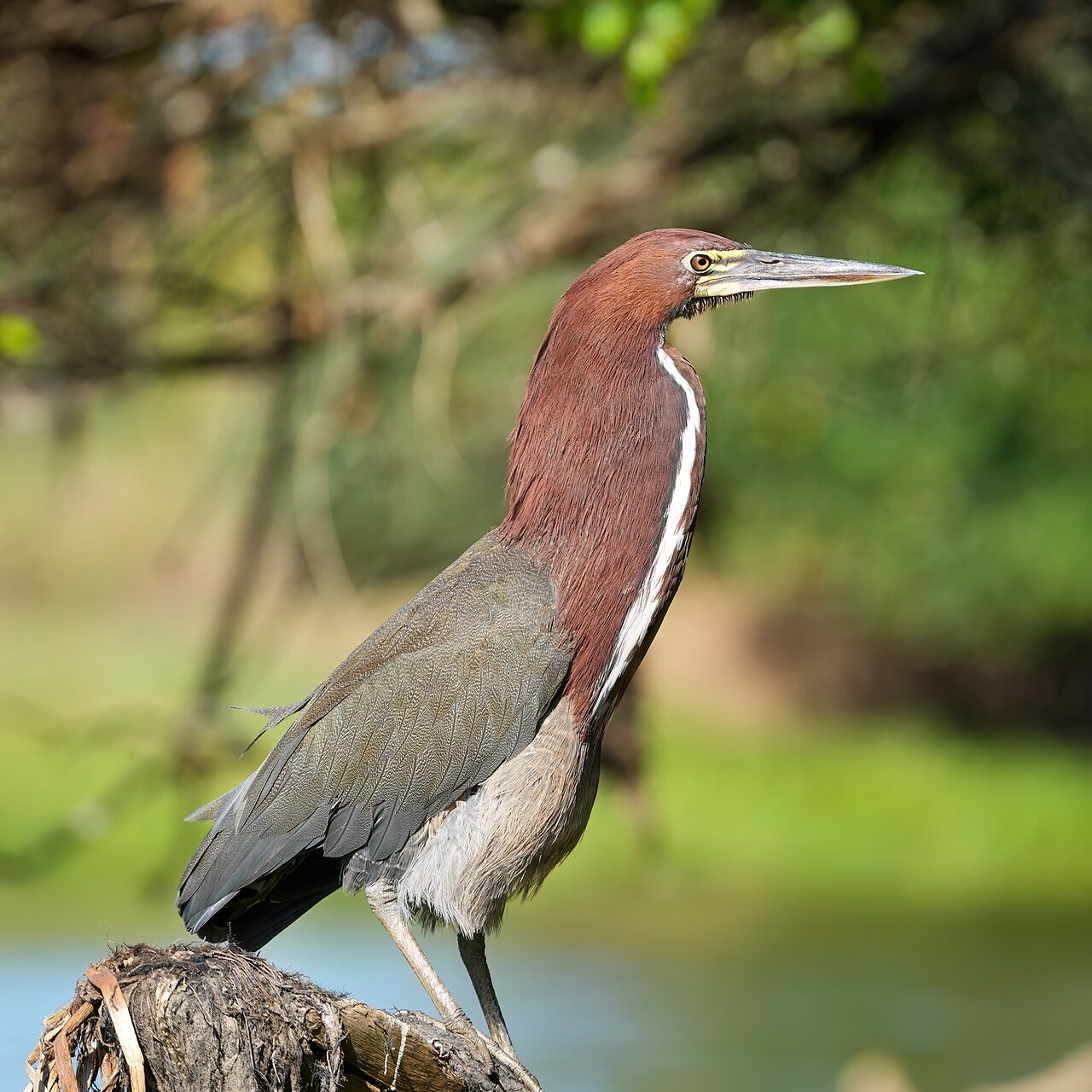
The Rufescent Tiger-Heron (Tigrisoma lineatum) is a medium-sized ardeid with a long, thick neck and a dagger-like bill. Adults have an elegant appearance: their head, neck, and chest are a rich rufous-chestnut color, with a distinctive white line flanked by black borders running down the center of the neck. Their back is dark olive-green to grayish, finely vermiculated. They have a patch of bare skin between the bill and the eye (lores) that is bright yellow or green. However, their 'tiger' name comes from their juvenile plumage: immatures are completely different from adults, covered in a dense pattern of broad black and dark cinnamon bars that make them look like a striped feline. It is a stealthy, solitary bird, a master of camouflage in the shadows of the swamps.

Added by

Anonymous Curator

Reviewed by

Under Review

Last modified by

Julia Trouin

TaxonomyBiological classification ranks placing this species within the tree of life, from Kingdom down to Genus.

PhylumRank below Kingdom. Groups organisms sharing a fundamental body plan (e.g., Chordata = vertebrates and some invertebrates).Chordata
ClassRank below Phylum. Subdivides by structural traits (e.g., Mammalia, Aves, Reptilia, Insecta).Aves
OrderRank below Class. Groups related families sharing common ancestry (e.g., Carnivora, Primates).Pelecaniformes
FamilyRank below Order. Groups closely related genera (e.g., Felidae = cats, Canidae = dogs).Ardeidae
GenusRank just above Species. The first word in the two-part binomial scientific name.Tigrisoma
Taxonomic AuthorityThe scientist who first formally described and published this species, followed by the year of publication.(Boddaert, 1783)
Record Completeness
95%
Coming soon

Ecology & StatusHow this species lives: habitat preferences, diet, behavior, population status, and role in its ecosystem.

OriginWhether the species is native (evolved here), endemic (found only here), or introduced by human activity.

Native

Population TrendDirection of change in population size over time: increasing, stable, decreasing, or unknown.

Decreasing

Breeding SeasonTime of year when this species typically reproduces or flowers.

Dry Season

Trophic RolePosition in the food chain: producer, herbivore, carnivore, omnivore, decomposer, or parasite.

Carnivore

Recent SightingsWhether this species has been observed in the wild in Costa Rica within recent years.

Yes

Habitat SummaryOverview of the specific ecosystems and environments where this species is found in Costa Rica. Multi-lang

It is a specialist of forested and closed wetlands. Unlike egrets that prefer open water, the tiger-heron prefers the densely wooded margins of slow rivers, jungle streams, mangroves, swamps, and gallery forests. It requires dense shadows and overhanging vegetation to hunt. In Costa Rica, it is common in the lowlands of the Caribbean and South Pacific slopes, in shaded wetlands like Tortuguero, Caño Negro, and Corcovado.

BehaviourDaily activity patterns, movement, territory use, foraging style, and seasonal behavioral changes. Multi-lang

It is a strictly solitary bird outside the breeding season. Primarily crepuscular, it takes advantage of the first and last hours of the day to hunt more actively. Its foraging method is static ambush: it selects a shaded perch just above the water surface, retracts its neck into a tense 'S' shape, and waits motionless. When a fish swims near, it releases its neck with the force of a spring, spearing or grabbing the prey with lightning speed.

Social ActivitySocial structure: whether the species is solitary, paired, or colonial; hierarchy and communication. Multi-lang

Highly solitary and territorial. It does not tolerate the presence of other tiger-herons in its stretch of river and never forms large flocks or massive nesting colonies (unlike egrets).

Feeding GuildWhat the species eats, how it forages or hunts, and its role as a consumer in the food web. Multi-lang

Carnivore / Piscivore.

Trophic Chain DetailsSpecific interactions in local food webs: prey species, predators, competitors, and scavengers. Multi-lang

Ambush predator. Feeds mostly on fish, frogs, tadpoles, large aquatic insects, and occasionally small water snakes. Healthy adults have few predators (occasionally crocodiles or anacondas). Eggs and chicks are vulnerable to attacks by white-faced capuchins, toucans, forest hawks, and snakes.

Reproductive BehaviourMating strategies, courtship displays, nesting or spawning behavior, and parental care. Multi-lang

They are monogamous birds that nest solitarily. They build a bulky platform nest using thick sticks, situated on a horizontal branch of a large tree, often at considerable height (5 to 15 meters) above or near the water. The female typically lays 2 (sometimes 3) pale blue eggs with reddish spots. Incubation is shared and lasts 30 to 34 days. The chicks are altricial but gain strength quickly, acquiring their intricate tiger-striped plumage to camouflage themselves as they grow in the nest.

Physical Measures

Length (cm)

66.0 - 76.0 cm

Weight (Grams)

600 g - 1.00 kg

Offspring per cycleTypical number of young (live births, eggs, or seeds) produced by one adult in a single reproductive event or breeding season.2 - 3
Sexual DimorphismObservable physical differences between males and females of the same species (e.g., size, coloration, features).No

Lifespan

Sexual MaturityAge at which the individual becomes capable of reproducing for the first time.

24 - 30 Months

Gestation / IncubationDuration from fertilization to birth (mammals) or to hatching (egg-laying species).

30 - 34

Lifespan EstimatedExpected duration of life from birth to natural death under wild conditions.
Males8 - 15 Years
Females8 - 15 Years

Evolutionary AdaptationsInherited traits and behaviors that improve the species' survival and reproduction in its specific environment. Multi-lang

Bittern Posture: When they feel threatened or when they want to go completely unnoticed by prey, they stretch their neck and point their bill vertically towards the sky, freezing in that position. In this posture, the lines of their neck blend perfectly with reeds, tall grasses, and vertical branches.
Extreme Juvenile Mimicry: The immature's plumage (the black and tawny bars) is evolutionarily designed to break up the bird's silhouette under the dappled light of the flooded understory. They retain this plumage for nearly two years, an unusually long period for birds, to maximize survival while learning to hunt.

Main ThreatsDocumented pressures reducing the population: habitat loss, hunting, disease, climate change, and invasive species. Multi-lang

Loss of Gallery Forests: Unlike pasture egrets, the tiger-heron cannot survive in deforested wetlands. Logging on riverbanks destroys its hunting and nesting habitat irreversibly.
Wetland Pollution: Agricultural runoff containing pesticides severely affects the amphibian and fish populations on which it feeds.

Interesting FactsSurprising or notable facts that highlight what makes this species unique or ecologically important. Multi-lang

The Bull's Bellow: In Brazil, it is known as 'Socó-boi' (Ox Heron) due to its incredible call. At dawn and dusk during the breeding season, they emit a deep, low, resonant sound that sounds exactly like the distant mooing of a heavy bull or ox ('huum-huum-huum').
Patient Hunters: It is one of the least physically active herons. It can stand in the exact same spot (like a submerged log or a shaded rock) for hours without moving a single muscle, waiting for prey to approach unsuspectingly.