Tursiops truncatus
Bottlenose Dolphin
Montagu, 1821
Added by
Anonymous Curator
Reviewed by
Under Review
Last modified by
Julia Trouin
TaxonomyBiological classification ranks placing this species within the tree of life, from Kingdom down to Genus.
Ecology & StatusHow this species lives: habitat preferences, diet, behavior, population status, and role in its ecosystem.
OriginWhether the species is native (evolved here), endemic (found only here), or introduced by human activity.
Native
Population TrendDirection of change in population size over time: increasing, stable, decreasing, or unknown.
Stable
Breeding SeasonTime of year when this species typically reproduces or flowers.
Year Round
Trophic RolePosition in the food chain: producer, herbivore, carnivore, omnivore, decomposer, or parasite.
Carnivore
Recent SightingsWhether this species has been observed in the wild in Costa Rica within recent years.
Yes
Habitat SummaryOverview of the specific ecosystems and environments where this species is found in Costa Rica. Multi-lang
It is an extraordinarily adaptable species, broadly divided into two main ecotypes: coastal and pelagic (oceanic). The coastal ecotype frequents warm waters, shallow bays, estuaries, mangroves, and lagoons, often traveling into large rivers near the coast. In Costa Rica, the coastal ecotype is common inside the large gulfs (Golfo Dulce and Gulf of Nicoya). The pelagic ecotype inhabits the open sea, preferring deeper and cooler waters along the continental slope. They do not migrate in the strict sense, but their local movements are influenced by prey availability and seasonal variations in water temperature.BehaviourDaily activity patterns, movement, territory use, foraging style, and seasonal behavioral changes. Multi-lang
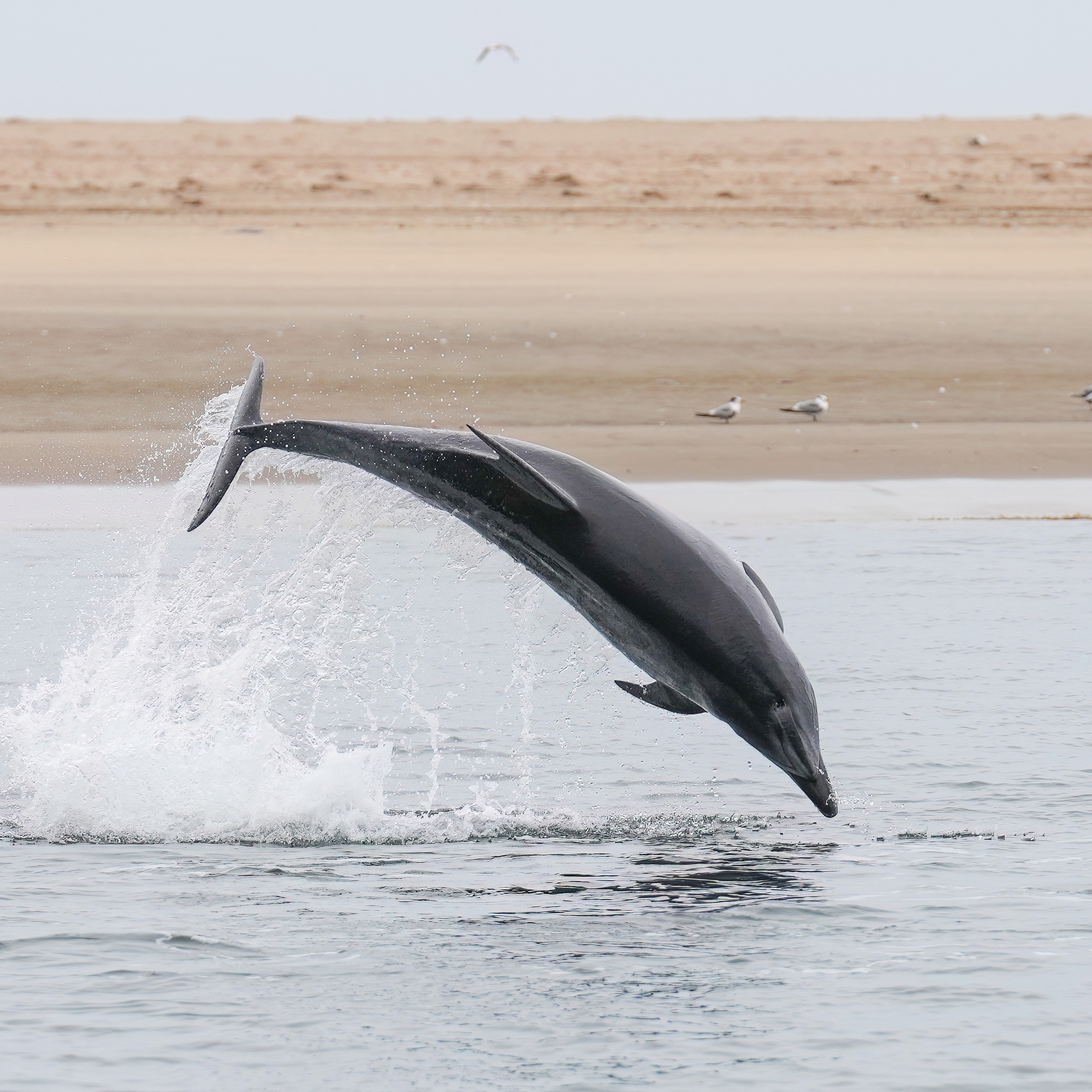
It is a highly acrobatic and gregarious mammal. They spend a large portion of the day traveling, socializing, and playing. They have the fun habit of 'bow-riding', intentionally surfing the pressure waves created at the bows of fast boats to propel themselves effortlessly. Within groups, there are high levels of physical contact to strengthen bonds: they rub their pectoral flippers (analogous to a hug), stroke each other, and swim in total synchrony. However, their behavior is not always peaceful; encounters between male alliances can be violently aggressive, and some populations demonstrate lethal harassment and infanticide. In Costa Rica, they form interspecific associations, navigating peacefully alongside false killer whales (Pseudorca crassidens) or spotted dolphins, foraging cooperatively in the open ocean.Social ActivitySocial structure: whether the species is solitary, paired, or colonial; hierarchy and communication. Multi-lang
They are organized in a complex and dynamic system called 'fission-fusion', similar to that of chimpanzees. They do not live in a single pod for their entire lives. Groups (pods) constantly change composition, size, and structure throughout the day and year (fissioning or fusing). The most stable units are maternal associations (groups of related females with calves and juveniles that protect and rear together). Adult males usually form extremely tight 'male alliances' (pairs or trios) that travel together for life, cooperating to repel rivals, dominate groups, and herd estrous females. Coastal ecotypes form small pods (2 to 15 members), while pelagic ones form super-pods of hundreds.Feeding GuildWhat the species eats, how it forages or hunts, and its role as a consumer in the food web. Multi-lang
Highly specialized and intelligent carnivore. Primarily piscivorous (fish-eating) and teuthophagous (squid-eating). They have dozens of conical teeth designed to firmly grasp slippery prey. They use brilliant hunting strategies: they herd schools of fish by swimming around them at high speed, slap fish with their tail flukes to launch them stunned through the air, corral prey against shallow shorelines or boats, and use their acoustic echolocation as a direct sonic stunner.Trophic Chain DetailsSpecific interactions in local food webs: prey species, predators, competitors, and scavengers. Multi-lang
It is an agile apex predator or mesopredator (depending on the ecosystem). They hunt cooperatively to surround and bunch up dense schools of forage fish (herring, mullet, mackerel). They supplement with squid and crustaceans scavenged from the seafloor. They consume around 5 to 15 kilos of food daily without chewing (swallowing fish whole head-first to avoid spines). They have few natural predators as mature adults; however, calves and sick individuals are preferred targets of large sharks like the bull shark (Carcharhinus leucas) or tiger shark, and in more oceanic zones, they are occasionally attacked by specialized pods of killer whales (Orcinus orca).Reproductive BehaviourMating strategies, courtship displays, nesting or spawning behavior, and parental care. Multi-lang
Promiscuous polygamous mating system. Courtship is vigorous and typically occurs year-round. After an extensive gestation of exactly 12 months, the female gives birth to a single calf about 1 meter long. Astonishingly, the calf is born tail-first so it doesn't drown during labor in the water. Immediately, the mother and sometimes an assistant female ('auntie') gently push the newborn to the surface so it can take its first breath through its blowhole. Maternal dependence is extreme: the calf nurses on incredibly high-fat milk by rolling its tongue underwater, a process lasting 18 to 24 months. The calf swims alongside the mother's flank ('escort position'), utilizing the hydrodynamic slipstream of its parent to save energy, and may remain with her until 3 to 6 years of age to learn all survival and language skills before becoming independent.Physical Measures
Length (cm)
200.0 - 400.0 cm
Weight (Grams)
150.00 kg - 600.00 kg
Lifespan
Sexual MaturityAge at which the individual becomes capable of reproducing for the first time.
5 - 14 Years
Gestation / IncubationDuration from fertilization to birth (mammals) or to hatching (egg-laying species).
365