
Costa Rica Species
Calidris minutilla
AnimaliaHighest rank in taxonomy. Groups all life into domains: Animalia, Plantae, Fungi, etc.IUCN LCInternational Union for Conservation of Nature — the world authority on species extinction risk, using standardized criteria. — Least Concern — widespread and abundant; not at immediate risk of extinction.In ProgressCurrent stage of this record in the editorial review workflow. Recent Sighting

Calidris minutilla

Least Sandpiper

(Vieillot, 1819)

Detailed Texts Multi-lang
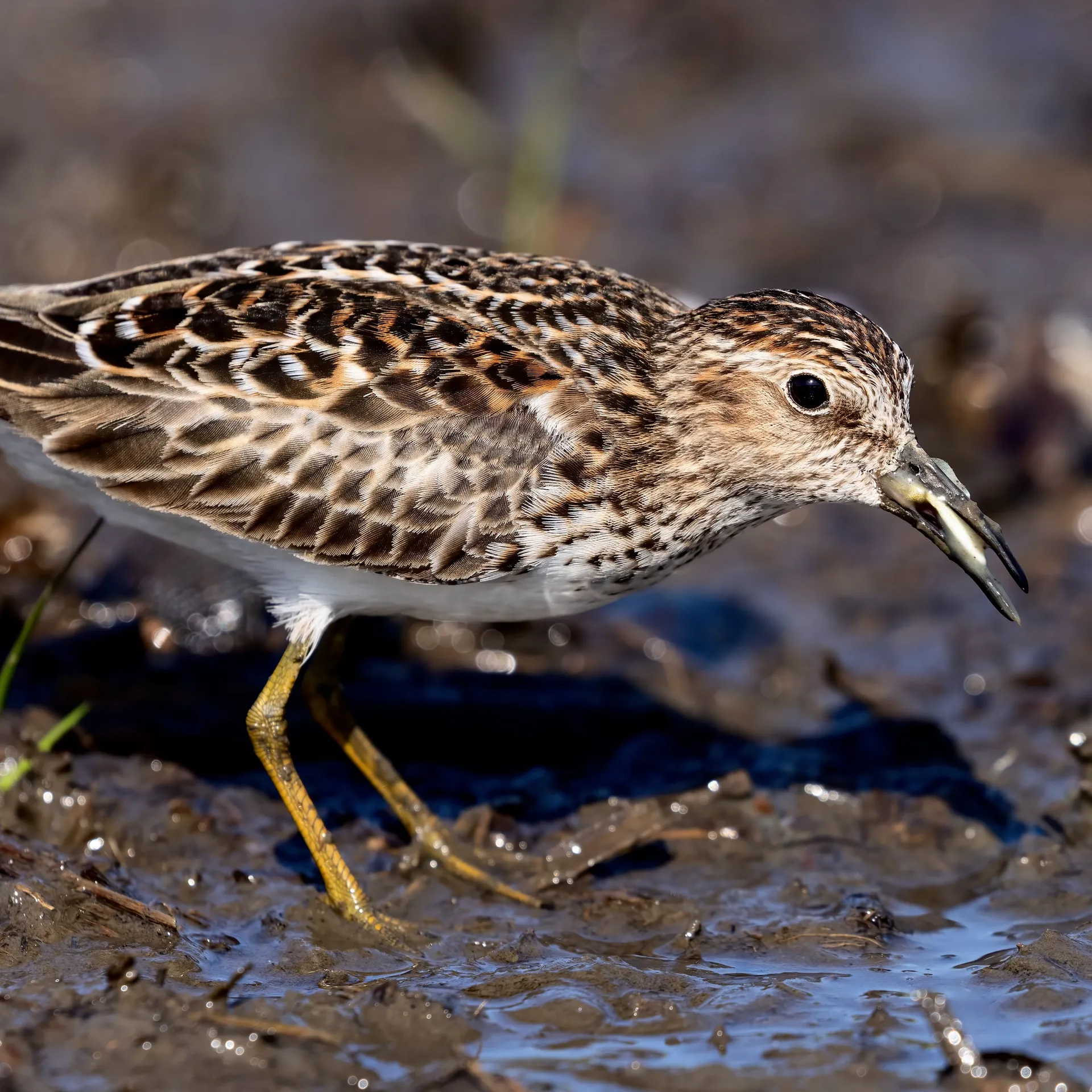
The smallest shorebird in the world, distinctively characterized by its diminutive size, fine, sharply pointed black bill that droops slightly at the tip, and yellowish to greenish-yellow legs. In breeding plumage, adults exhibit rich, mottled dark brown, rufous, and black upperparts with a white belly and a finely streaked brown breast. In winter plumage, they transition to a more uniform greyish-brown coloration above. In flight, they display a narrow, thin white wing stripe and white outer tail feathers split by a dark central line.

Added by

Anonymous Curator

Reviewed by

Under Review

Last modified by

Julia Trouin

TaxonomyBiological classification ranks placing this species within the tree of life, from Kingdom down to Genus.

PhylumRank below Kingdom. Groups organisms sharing a fundamental body plan (e.g., Chordata = vertebrates and some invertebrates).Chordata
ClassRank below Phylum. Subdivides by structural traits (e.g., Mammalia, Aves, Reptilia, Insecta).Aves
OrderRank below Class. Groups related families sharing common ancestry (e.g., Carnivora, Primates).Charadriiformes
FamilyRank below Order. Groups closely related genera (e.g., Felidae = cats, Canidae = dogs).Scolopacidae
GenusRank just above Species. The first word in the two-part binomial scientific name.Calidris
Taxonomic AuthorityThe scientist who first formally described and published this species, followed by the year of publication.(Vieillot, 1819)
Record Completeness
96%
Coming soon

Ecology & StatusHow this species lives: habitat preferences, diet, behavior, population status, and role in its ecosystem.

OriginWhether the species is native (evolved here), endemic (found only here), or introduced by human activity.

Native

Population TrendDirection of change in population size over time: increasing, stable, decreasing, or unknown.

Decreasing

Breeding SeasonTime of year when this species typically reproduces or flowers.

Year Round

Trophic RolePosition in the food chain: producer, herbivore, carnivore, omnivore, decomposer, or parasite.

Carnivore

Recent SightingsWhether this species has been observed in the wild in Costa Rica within recent years.

Yes

Habitat SummaryOverview of the specific ecosystems and environments where this species is found in Costa Rica. Multi-lang

Breeds in the subarctic tundra and northern boreal forest zones of North America, specifically nesting in damp, mossy muskegs, bogs, and sedge meadows. During migration and winter, it favors muddy, shallow wetlands, coastal lagoons, saltmarshes, and inland river edges, showing a marked preference for damp mudflats over open sandy beaches.

BehaviourDaily activity patterns, movement, territory use, foraging style, and seasonal behavioral changes. Multi-lang

A highly migratory, diurnal shorebird that travels in compact, fast-flying flocks. When foraging, it creeps slowly across mudflats with a distinctly hunched, mouse-like posture, probing its bill continuously into the mud. They are highly tolerant of other shorebird species and exhibit peaceful social spacing, though males become intensely territorial when executing low, hovering song flights over breeding territories.

Social ActivitySocial structure: whether the species is solitary, paired, or colonial; hierarchy and communication. Multi-lang

Highly gregarious outside the nesting season, aggregating into massive, fluid migratory and wintering flocks that can include hundreds of individuals. These flocks display remarkable synchronization during high-speed aerial evasive maneuvers. On the breeding grounds, social behavior shifts to strictly isolated, monogamous pairs spaced across vast tundra expanses.

Feeding GuildWhat the species eats, how it forages or hunts, and its role as a consumer in the food web. Multi-lang

Carnivore (wetland/mudflat invertebrate invertivore specialized in surface-gleaning and shallow probe-feeding).

Trophic Chain DetailsSpecific interactions in local food webs: prey species, predators, competitors, and scavengers. Multi-lang

Occupies a lower to mid-level consumer position within wet tundra and wetland trophic webs. Its diet is predominantly composed of tiny marine and freshwater invertebrates, including amphipods, isopods, dipteran larvae, snails, and small insects. Adults and chicks are preyed upon by falcons, harriers, owls, and invasive rats.

Reproductive BehaviourMating strategies, courtship displays, nesting or spawning behavior, and parental care. Multi-lang

Monogamous for the season. The male establishes a territory using hovering vocal flights and scrapes out several shallow depressions in mossy ground. The female selects one scrape and lines it with grass, lichens, and leaves. She lays a clutch of 4 buffy, brown-spotted eggs. Both parents share incubation duties for 19 to 21 days. The chicks are highly precocial, hatching with dense down and leaving the nest within hours to feed themselves under parental supervision. The female often deserts the brood before fledging, leaving the male to tend to the chicks.

Physical Measures

Length (cm)

13.0 - 15.0 cm

Weight (Grams)

19 g - 30 g

Offspring per cycleTypical number of young (live births, eggs, or seeds) produced by one adult in a single reproductive event or breeding season.3 - 4
Sexual DimorphismObservable physical differences between males and females of the same species (e.g., size, coloration, features).Yes

Lifespan

Sexual MaturityAge at which the individual becomes capable of reproducing for the first time.

1 - 2 Years

Gestation / IncubationDuration from fertilization to birth (mammals) or to hatching (egg-laying species).

19 - 21

Lifespan EstimatedExpected duration of life from birth to natural death under wild conditions.
Males4 - 7 Years
Females4 - 7 Years

Sexual DimorphismPhysical differences in size, coloration, or morphology between males and females of this species.

Males Multi-lang

No differences in plumage coloration across seasons. Displays subtle reverse structural size dimorphism; adult males are marginally smaller in skeletal dimensions, wingspan, and average slightly lighter in body mass than adult females.

Females Multi-lang

Shares identical cryptic plumage variations, but structurally larger in overall skeletal length and displays a marginally longer bill and heavier overall body mass values than the male.

Evolutionary AdaptationsInherited traits and behaviors that improve the species' survival and reproduction in its specific environment. Multi-lang

Possesses specialized, relatively long greenish-yellow legs that allow it to easily walk and navigate through dense emergent marsh vegetation and sticky inland mud fields where shorter-legged sandpipers struggle.
Its fine, tactile-rich bill tip is highly sensitive, housing dense clusters of Herbst corpuscles that detect sub-surface movements of tiny invertebrates in soft, damp soils without relying purely on visual cues.

Main ThreatsDocumented pressures reducing the population: habitat loss, hunting, disease, climate change, and invasive species. Multi-lang

Significantly threatened by global climate change, which causes the encroaching drying of subarctic breeding bogs. Coastal habitat degradation due to sea-level rise and urban development in migratory stopover sites limits vital energy replenishment resources.

Interesting FactsSurprising or notable facts that highlight what makes this species unique or ecologically important. Multi-lang

Weighing roughly the same as a single AA battery (around 20 grams), this minuscule bird successfully undertakes annual, heroic migrations spanning thousands of miles from arctic regions down to southern South America.
Because they consistently prefer muddy marsh habitats and edges over open sandy shores, birdwatchers can often distinguish them from other 'peeps' by looking at how high up the shore or marsh bank they choose to feed.