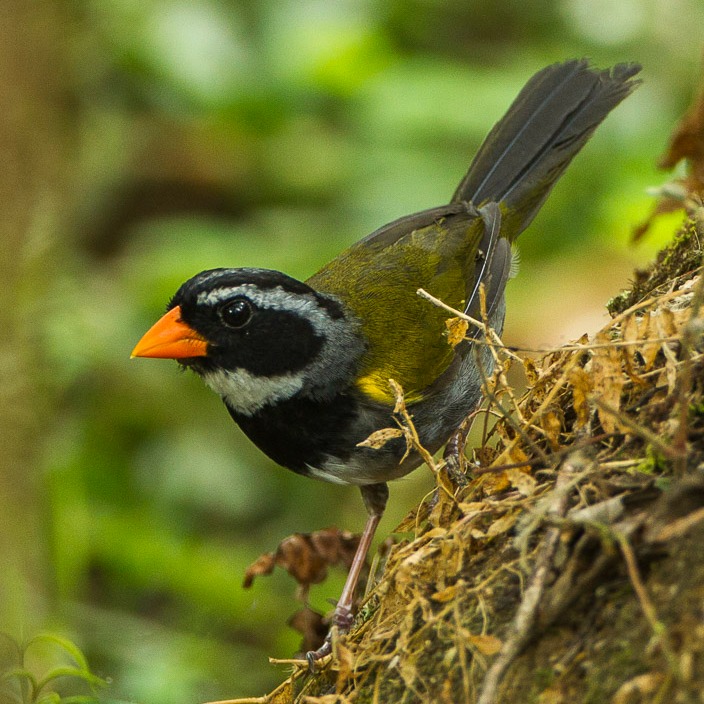
Arremon aurantiirostris
Orange-billed Sparrow
Lafresnaye, 1847
Added by
Anonymous Curator
Reviewed by
Under Review
Last modified by
Julia Trouin
TaxonomyBiological classification ranks placing this species within the tree of life, from Kingdom down to Genus.
Ecology & StatusHow this species lives: habitat preferences, diet, behavior, population status, and role in its ecosystem.
OriginWhether the species is native (evolved here), endemic (found only here), or introduced by human activity.
Native
Population TrendDirection of change in population size over time: increasing, stable, decreasing, or unknown.
Stable
Breeding SeasonTime of year when this species typically reproduces or flowers.
--
Trophic RolePosition in the food chain: producer, herbivore, carnivore, omnivore, decomposer, or parasite.
Omnivore
Recent SightingsWhether this species has been observed in the wild in Costa Rica within recent years.
Yes
Habitat SummaryOverview of the specific ecosystems and environments where this species is found in Costa Rica. Multi-lang
It strictly inhabits the dense understory and leaf litter of lowland humid and wet primary forests, gallery forests, and advanced secondary growth zones in the Neotropical slope, ranging from Mexico to northern Peru. It is a common species in the lowlands of Costa Rica (Atlantic and South Pacific slopes), distributing from sea level up to approximately 1,200 meters in altitude. It prefers shaded areas with high humidity and dense shrubby vegetation near small forest streams.BehaviourDaily activity patterns, movement, territory use, foraging style, and seasonal behavioral changes. Multi-lang
It spends most of its time walking or taking short hops in pairs over the dense leaf litter on the ground, moving with nervous yet stealthy motions. When threatened, instead of flying up to the canopy, it prefers to run rapidly through the dense low vegetation to hide. Males sing from low, concealed perches, emitting a sweet, leisurely whistle of a few notes.Social ActivitySocial structure: whether the species is solitary, paired, or colonial; hierarchy and communication. Multi-lang
It is an bird with eminently solitary habits or traveling strictly in monogamous pairs bonded for life. It rarely associates directly with mixed-species flocks, preferring to maintain and inspect its territory independently on the ground, though it may briefly follow army ant swarms if they cross its territory.Feeding GuildWhat the species eats, how it forages or hunts, and its role as a consumer in the food web. Multi-lang
Specialized terrestrial omnivore. It searches for food by actively tossing dry leaves with its bill or scratching with its feet to capture beetles, ants, forest cockroaches, spiders, centipedes, and woodlice. It significantly supplements its diet with fallen berries, small fleshy fruits from understory shrubs, and forest grass seeds.Trophic Chain DetailsSpecific interactions in local food webs: prey species, predators, competitors, and scavengers. Multi-lang
It functions as both a primary and secondary consumer within the forest floor food web. It consumes a vast quantity of understory plant seeds, contributing to seed dispersal, and regulates populations of small terrestrial invertebrates. It falls prey to terrestrial snakes (such as those of the genus Bothrops), small wild felines (such as the ocelot), and understory raptors.Reproductive BehaviourMating strategies, courtship displays, nesting or spawning behavior, and parental care. Multi-lang
During the breeding season, the pair defines their territory through song. They build a bulky, semi-roofed, deep cup or open oven-like nest made of broad dry leaves, twigs, plant fibers, and rootlets, lined internally with finer materials. This is located at a very low height (between 20 cm and 1 meter off the ground) hidden within a dense shrub, a large fern, or a thorny palm. The female lays 2 eggs (rarely 3) of a greenish-white or cream color with abundant reddish-brown speckles. Incubation lasts 12 to 14 days and is carried out exclusively by the female. Both parents intensely feed the chicks with soft insects until they fledge at 11-13 days old.Physical Measures
Length (cm)
14.5 - 16.5 cm
Weight (Grams)
24 g - 33 g
Lifespan
Sexual MaturityAge at which the individual becomes capable of reproducing for the first time.
1 Years
Gestation / IncubationDuration from fertilization to birth (mammals) or to hatching (egg-laying species).
12 - 14