
AnimaliaIUCN LCIn Progress Recent Sighting
Arremon aurantiirostris
Orange-billed Sparrow
Lafresnaye, 1847
Detailed Texts Multi-lang
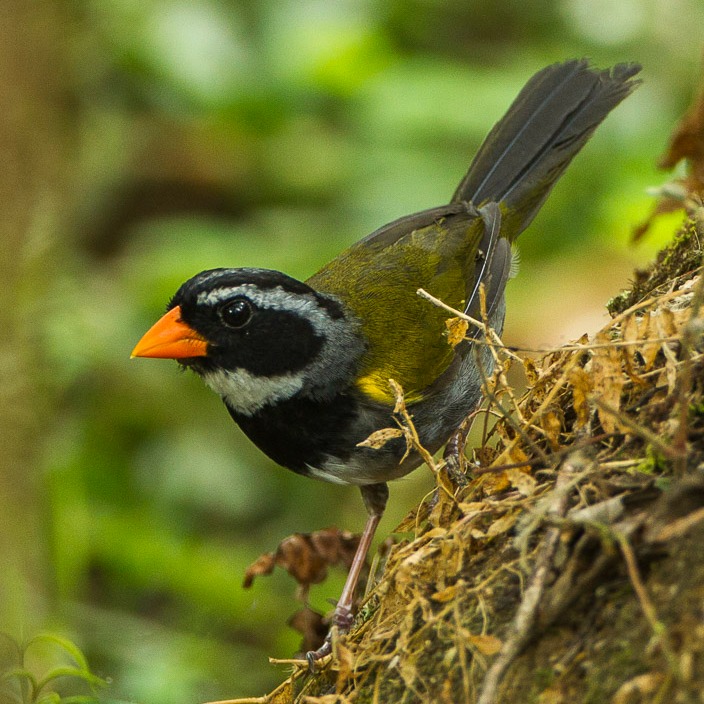
It is a medium-sized, ground-dwelling bird characterized by a striking, thick, bright reddish-orange or coral bill that stands out intensely. It features a jet-black head with a distinctive central white crown stripe and long white eyebrows framing its dark eyes. Its throat is pure white and is bordered by a wide, solid black pectoral band that crosses the chest from side to side. The back, wings, and tail show a deep olive-green or olivaceous-gray tone, while the belly is a dull grayish-white. Its legs are light brown or flesh-colored, perfectly adapted for agile terrestrial locomotion.
Added by
Anonymous Curator
Reviewed by
Under Review
Last modified by
Julia Trouin
Taxonomy
PhylumChordata
ClassAves
OrderPasseriformes
FamilyPasserellidae
GenusArremon
Taxonomic AuthorityLafresnaye, 1847
Ecology & Status
Origin
Native
Population Trend
Stable
Breeding Season
--
Trophic Role
Omnivore
Recent Sightings
Yes
Habitat Summary Multi-lang
It strictly inhabits the dense understory and leaf litter of lowland humid and wet primary forests, gallery forests, and advanced secondary growth zones in the Neotropical slope, ranging from Mexico to northern Peru. It is a common species in the lowlands of Costa Rica (Atlantic and South Pacific slopes), distributing from sea level up to approximately 1,200 meters in altitude. It prefers shaded areas with high humidity and dense shrubby vegetation near small forest streams.Behaviour Multi-lang
It spends most of its time walking or taking short hops in pairs over the dense leaf litter on the ground, moving with nervous yet stealthy motions. When threatened, instead of flying up to the canopy, it prefers to run rapidly through the dense low vegetation to hide. Males sing from low, concealed perches, emitting a sweet, leisurely whistle of a few notes.Social Activity Multi-lang
It is an bird with eminently solitary habits or traveling strictly in monogamous pairs bonded for life. It rarely associates directly with mixed-species flocks, preferring to maintain and inspect its territory independently on the ground, though it may briefly follow army ant swarms if they cross its territory.Feeding Guild Multi-lang
Specialized terrestrial omnivore. It searches for food by actively tossing dry leaves with its bill or scratching with its feet to capture beetles, ants, forest cockroaches, spiders, centipedes, and woodlice. It significantly supplements its diet with fallen berries, small fleshy fruits from understory shrubs, and forest grass seeds.Trophic Chain Details Multi-lang
It functions as both a primary and secondary consumer within the forest floor food web. It consumes a vast quantity of understory plant seeds, contributing to seed dispersal, and regulates populations of small terrestrial invertebrates. It falls prey to terrestrial snakes (such as those of the genus Bothrops), small wild felines (such as the ocelot), and understory raptors.Reproductive Behaviour Multi-lang
During the breeding season, the pair defines their territory through song. They build a bulky, semi-roofed, deep cup or open oven-like nest made of broad dry leaves, twigs, plant fibers, and rootlets, lined internally with finer materials. This is located at a very low height (between 20 cm and 1 meter off the ground) hidden within a dense shrub, a large fern, or a thorny palm. The female lays 2 eggs (rarely 3) of a greenish-white or cream color with abundant reddish-brown speckles. Incubation lasts 12 to 14 days and is carried out exclusively by the female. Both parents intensely feed the chicks with soft insects until they fledge at 11-13 days old.Physical Measures
Length (cm)
14.5 - 16.5 cm
Weight (Grams)
24 g - 33 g
Offspring per cycle2 - 3
Sexual DimorphismNo
Lifespan
Sexual Maturity
1 Years
Gestation / Incubation
12 - 14
Lifespan Estimated
Males4 - 6 Years
Females4 - 6 Years
Evolutionary Adaptations Multi-lang
Leaf-Scratching Foraging Technique: It uses both feet simultaneously in a backward hopping motion to clear away fallen leaves and organic debris from the forest floor, quickly exposing hidden insects and seeds underneath.
Understory Shadow Camouflage: The disruptive coloration pattern of its black head with stark white stripes breaks up the bird's silhouette in the dappled twilight of the understory, keeping it invisible to aerial predators while static.
Main Threats Multi-lang
Lowland Deforestation and Destruction: The conversion of dense primary forests into cattle pastures and extensive agricultural monocultures (such as pineapple and African oil palm) drastically reduces its vital space.
Nest Predation by Invasive Species: Because they build nests at ground level or at very low heights, they are extremely vulnerable to predation by domestic cats and rats along the edges of peri-urban forest fragments.
Interesting Facts Multi-lang
Strict Territorial Fidelity: Pairs defend small territories year-round and show such marked sedentarism that they rarely cross open roads or cleared pastures wider than just a few meters.
Post-mortem Bill Fading: The dazzling orange color of its bill is a result of carotenoids obtained from its diet; this vibrant color fades completely into a dull yellowish tone shortly after the bird dies.