
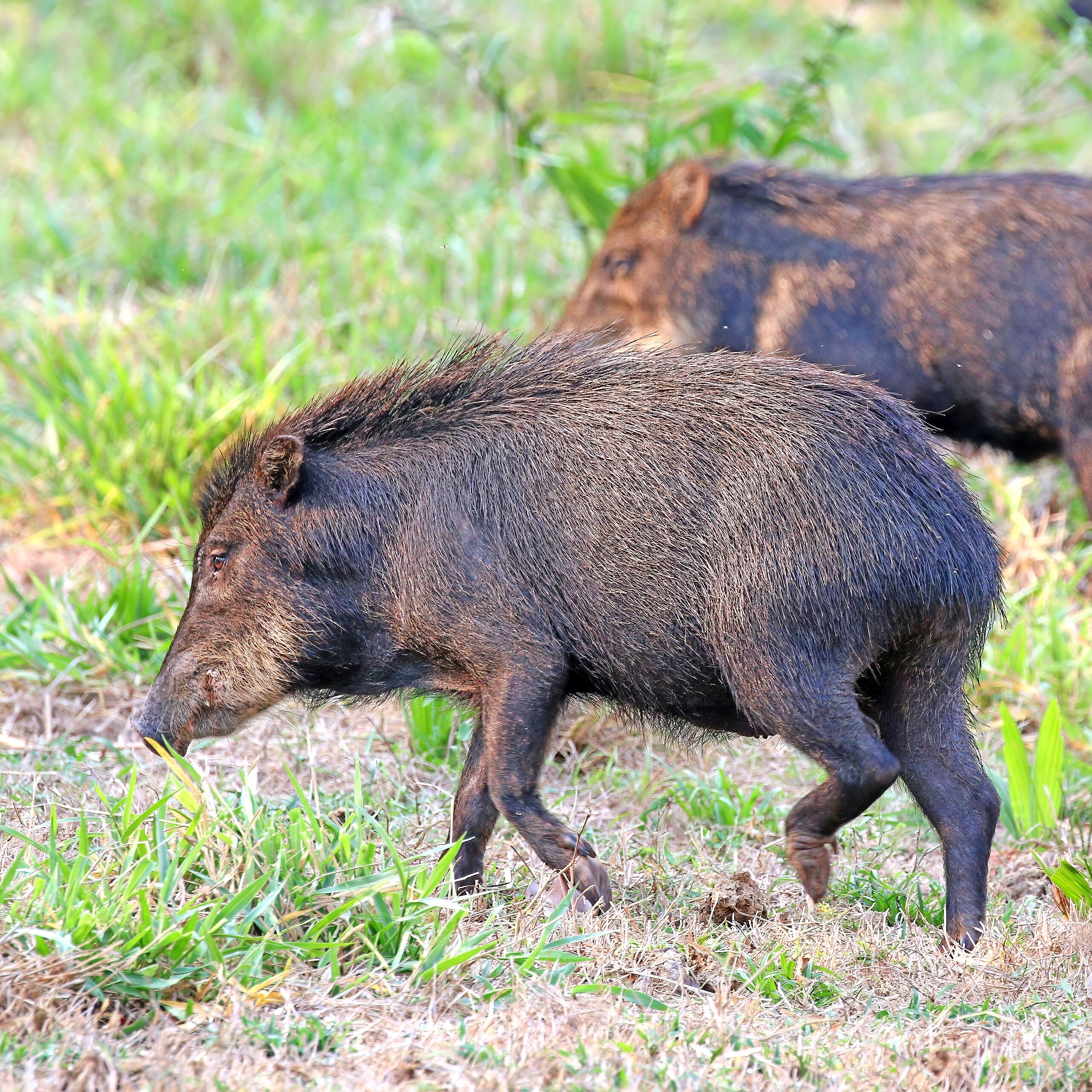
Tayassu pecari
White-lipped Peccary
(Link, 1795)
Added by
Anonymous Curator
Reviewed by
Under Review
Last modified by
Julia Trouin
TaxonomyBiological classification ranks placing this species within the tree of life, from Kingdom down to Genus.
Ecology & StatusHow this species lives: habitat preferences, diet, behavior, population status, and role in its ecosystem.
OriginWhether the species is native (evolved here), endemic (found only here), or introduced by human activity.
Native
Population TrendDirection of change in population size over time: increasing, stable, decreasing, or unknown.
Decreasing
Breeding SeasonTime of year when this species typically reproduces or flowers.
Year Round
Trophic RolePosition in the food chain: producer, herbivore, carnivore, omnivore, decomposer, or parasite.
Herbivore
Recent SightingsWhether this species has been observed in the wild in Costa Rica within recent years.
Yes
Habitat SummaryOverview of the specific ecosystems and environments where this species is found in Costa Rica. Multi-lang
It inhabits a wide variety of tropical forest ecosystems, from lowland rainforests to premontane forests and seasonal dry forests. It shows preference for continuous mature forests with high fruit availability and permanent water, but also occupies advanced secondary forests, riverbanks, wetlands, and gallery forests. It requires large areas of continuous territory — its home range can exceed 200 km² — making it one of the species most vulnerable to landscape fragmentation across Tropical America. In Costa Rica it is primarily recorded in the large forest blocks of the South Pacific (Osa, Corcovado), the Northern Zone, and the Caribbean foothills.BehaviourDaily activity patterns, movement, territory use, foraging style, and seasonal behavioral changes. Multi-lang
The white-lipped peccary is fundamentally diurnal, with peak activity in the early morning and at dusk, although in areas with high hunting pressure it may become partially crepuscular or nocturnal. It lives in herds of 50 to 300 individuals with complex social structure based on kinship relationships and dominance hierarchies. Herds travel daily between 3 and 12 km following memorized routes toward food and water sources. When they locate a tree with mass fruiting, the entire herd may congregate beneath it for days. Their presence physically modifies the forest: soil rooting, hoof tracks, and wallowing holes are reliable indicators of their recent activity.Social ActivitySocial structure: whether the species is solitary, paired, or colonial; hierarchy and communication. Multi-lang
The white-lipped peccary has the most complex social organization of all Neotropical ungulates. It lives in herds of 50 to 300 individuals with internal structure based on kinship subgroups. There is a dominance hierarchy with adult males and females as central individuals. Group cohesion is maintained through continuous olfactory contact — individuals mutually rub each other's dorsal gland as a social greeting — and constant low-level vocalizations during movement. Movement decisions are apparently collective and not imposed by a single leader. In threatening situations, the group adopts a circular defensive formation with the youngest individuals at the center. Outside the herd, solitary individuals are extremely rare and generally correspond to sick or severely injured animals.Feeding GuildWhat the species eats, how it forages or hunts, and its role as a consumer in the food web. Multi-lang
Omnivore with strong frugivorous-granivorous dominance. It consumes fallen fruits, seeds, roots, tubers, bulbs, fungi, leaves, soil invertebrates (earthworms, larvae, beetles), and occasionally small vertebrates, eggs, and carrion. In forests with palms, palm fruits constitute a dominant fraction of the diet. The rooting behavior — actively removing soil with the snout — allows it to access underground food inaccessible to other mammals of similar size. Its diet varies markedly between dry and rainy seasons, and between different forest types.Trophic Chain DetailsSpecific interactions in local food webs: prey species, predators, competitors, and scavengers. Multi-lang
Omnivorous primary consumer with herbivorous predominance. It ingests fruits, seeds, roots, fungi, soil invertebrates, and occasionally small vertebrates. Through its habit of swallowing large whole seeds and defecating them at considerable distances from the mother tree, it acts as a secondary seed disperser for trees such as Nazarene wood (Peltogyne purpurea) and several palm species. Its main predators are the jaguar (Panthera onca) — practically the only one capable of attacking adult herds — and the puma (Puma concolor), which prefers young or straggling individuals. The anaconda (Eunectes murinus) and spectacled caiman (Caiman crocodilus) are occasional predators in wetland zones. Its local extirpation generates cascade effects on vegetation, herbivory, and the soil structure of the forest.Reproductive BehaviourMating strategies, courtship displays, nesting or spawning behavior, and parental care. Multi-lang
Reproduction can occur year-round, although in areas with marked climatic seasonality, peaks of births are observed at the onset of the rainy season, when food availability is greatest. Courtship includes active chases within the herd and competition among males for access to estrous females. After a gestation of 156–162 days, the female briefly separates from the group to give birth, typically to two young (range 1–4) that can already move within the first hours of life. Young are precocial: born with open eyes, complete fur, and capable of following the herd within 24–48 hours. Lactation lasts 2 to 3 months. Females can reproduce every year if food conditions are favorable. There is no paternal care from the male.Physical Measures
Length (cm)
90.0 - 130.0 cm
Weight (Grams)
25.00 kg - 40.00 kg
Lifespan
Sexual MaturityAge at which the individual becomes capable of reproducing for the first time.
11 - 24 Months
Gestation / IncubationDuration from fertilization to birth (mammals) or to hatching (egg-laying species).
156 - 162