
Costa Rica Species
Laccaria laccata
FungiHighest rank in taxonomy. Groups all life into domains: Animalia, Plantae, Fungi, etc.IUCN LCInternational Union for Conservation of Nature — the world authority on species extinction risk, using standardized criteria. — Least Concern — widespread and abundant; not at immediate risk of extinction.In ProgressCurrent stage of this record in the editorial review workflow. Recent Sighting

Laccaria laccata

The Deceiver

(Scop.) Cooke, 1884

Detailed Texts Multi-lang
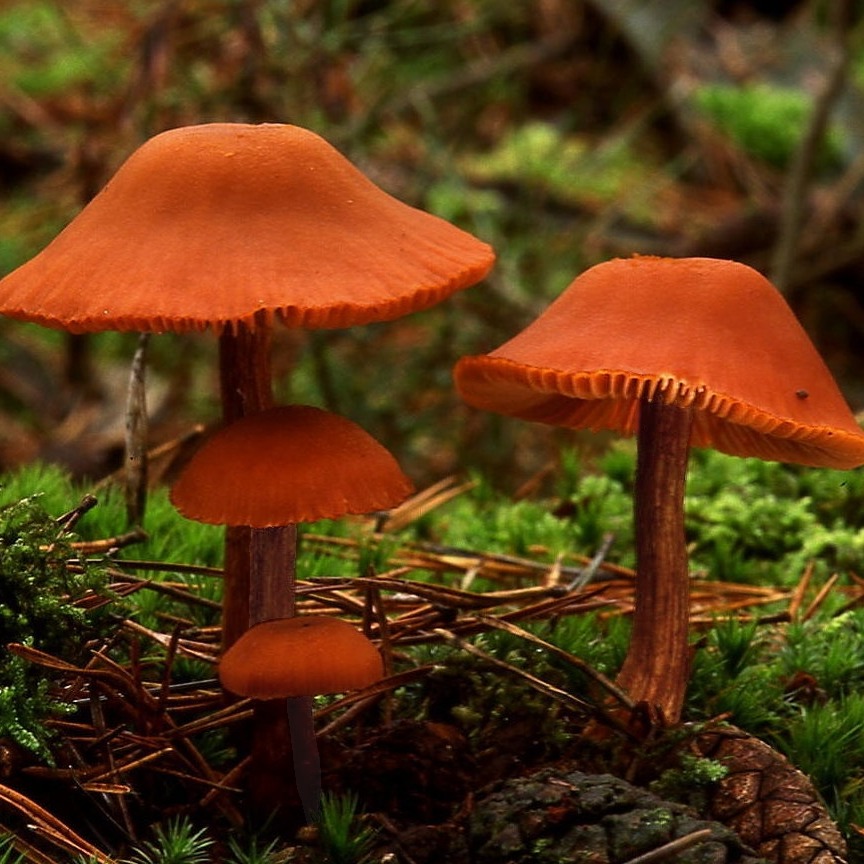
Laccaria laccata is a small to medium-sized basidiomycete fungus, famous for its extremely variable (hygrophanous) appearance. The cap measures 2 to 6 cm, initially convex and later flattened or depressed in the center, with wavy edges. Its color changes drastically with moisture: it is reddish-brown or flesh-orange when wet and turns pale or almost white when dry. The gills are thick, widely spaced, and a characteristic flesh-pink color, often dusted with white spore powder. The stalk is fibrous, tough, cylindrical, and the same color as the cap. It is called 'The Deceiver' because it can easily be mistaken for many other small brown mushroom species due to its changes in color and shape.

Added by

Anonymous Curator

Reviewed by

Under Review

Last modified by

Julia Trouin

TaxonomyBiological classification ranks placing this species within the tree of life, from Kingdom down to Genus.

PhylumRank below Kingdom. Groups organisms sharing a fundamental body plan (e.g., Chordata = vertebrates and some invertebrates).Basidiomycota
ClassRank below Phylum. Subdivides by structural traits (e.g., Mammalia, Aves, Reptilia, Insecta).Agaricomycetes
OrderRank below Class. Groups related families sharing common ancestry (e.g., Carnivora, Primates).Agaricales
FamilyRank below Order. Groups closely related genera (e.g., Felidae = cats, Canidae = dogs).Hydnangiaceae
GenusRank just above Species. The first word in the two-part binomial scientific name.Laccaria
Taxonomic AuthorityThe scientist who first formally described and published this species, followed by the year of publication.(Scop.) Cooke, 1884
Record Completeness
93%
Coming soon

Ecology & StatusHow this species lives: habitat preferences, diet, behavior, population status, and role in its ecosystem.

OriginWhether the species is native (evolved here), endemic (found only here), or introduced by human activity.

Native

Population TrendDirection of change in population size over time: increasing, stable, decreasing, or unknown.

Stable

Trophic RolePosition in the food chain: producer, herbivore, carnivore, omnivore, decomposer, or parasite.

--

EdibilityWhether this mushroom is edible, toxic, hallucinogenic, or of unknown safety. Never eat based solely on this data.

--

Cap ShapeShape of the mushroom cap (pileus): convex, flat, umbonate, funnel-shaped, bell-shaped, etc.

--

Hymenium TypeThe spore-bearing surface of a fungus: gills, pores, teeth, ridges, smooth, or wrinkled.

--

Fruiting SeasonTime of year when this species typically reproduces or flowers.

Wet Season

Recent SightingsWhether this species has been observed in the wild in Costa Rica within recent years.

Yes

Habitat SummaryOverview of the specific ecosystems and environments where this species is found in Costa Rica. Multi-lang

It is a ubiquitous species that inhabits almost any type of forest, both coniferous and broad-leaved. It establishes mycorrhizal associations with a wide range of trees. It prefers moist soils and can be found in heaths, moors, and forest clearings. In Costa Rica, it is reported in high-altitude forests, particularly in oak forests (Quercus spp.), where constant humidity allows frequent fruiting.

SubstrateThe organic material or host organism this fungus colonizes and decomposes. Multi-lang

Information not available in English. Help us expand this record!

BehaviourDaily activity patterns, movement, territory use, foraging style, and seasonal behavioral changes. Multi-lang

It is an essential mycorrhizal fungus that facilitates phosphorus and water absorption for trees in exchange for sugars. It is often a pioneer colonizer in young forests or degraded areas, helping new tree seedlings establish. Its fruiting bodies are durable and can persist for weeks in the forest.

Physical Measures

Length (cm)

2.0 - 6.0 cm

Hymenium StructuresMacro photographs of the spore-bearing surfaces used for mushroom identification.

No hymenium surface images available.

Evolutionary AdaptationsInherited traits and behaviors that improve the species' survival and reproduction in its specific environment. Multi-lang

Extreme Hygrophany: The ability to change color depending on hydration status is not just a visual trait but an adaptation that helps regulate the temperature and evaporation of the fruiting body, protecting the spore-producing tissue.
Symbiotic Versatility: Unlike other mycorrhizal fungi that are very specific, L. laccata can associate with multiple tree genera (pines, oaks, beeches), allowing it to colonize very diverse ecosystems.

Main ThreatsDocumented pressures reducing the population: habitat loss, hunting, disease, climate change, and invasive species. Multi-lang

Nitrogen pollution: High levels of nitrogen deposition in the soil (from fertilizers or pollution) can negatively affect mycorrhiza formation and reduce fruiting.

Interesting FactsSurprising or notable facts that highlight what makes this species unique or ecologically important. Multi-lang

The Deceiver: Its name comes from the frustration of Victorian mycologists, who often collected what they thought were different species only to discover they were variations of L. laccata.