
Costa Rica Species
Aetobatus narinari
AnimaliaHighest rank in taxonomy. Groups all life into domains: Animalia, Plantae, Fungi, etc.IUCN ENInternational Union for Conservation of Nature — the world authority on species extinction risk, using standardized criteria. — Endangered — faces a very high risk of extinction if threats are not urgently addressed.In ProgressCurrent stage of this record in the editorial review workflow. Recent Sighting

Aetobatus narinari

Spotted Eagle Ray

(Euphrasen, 1790)

Detailed Texts Multi-lang
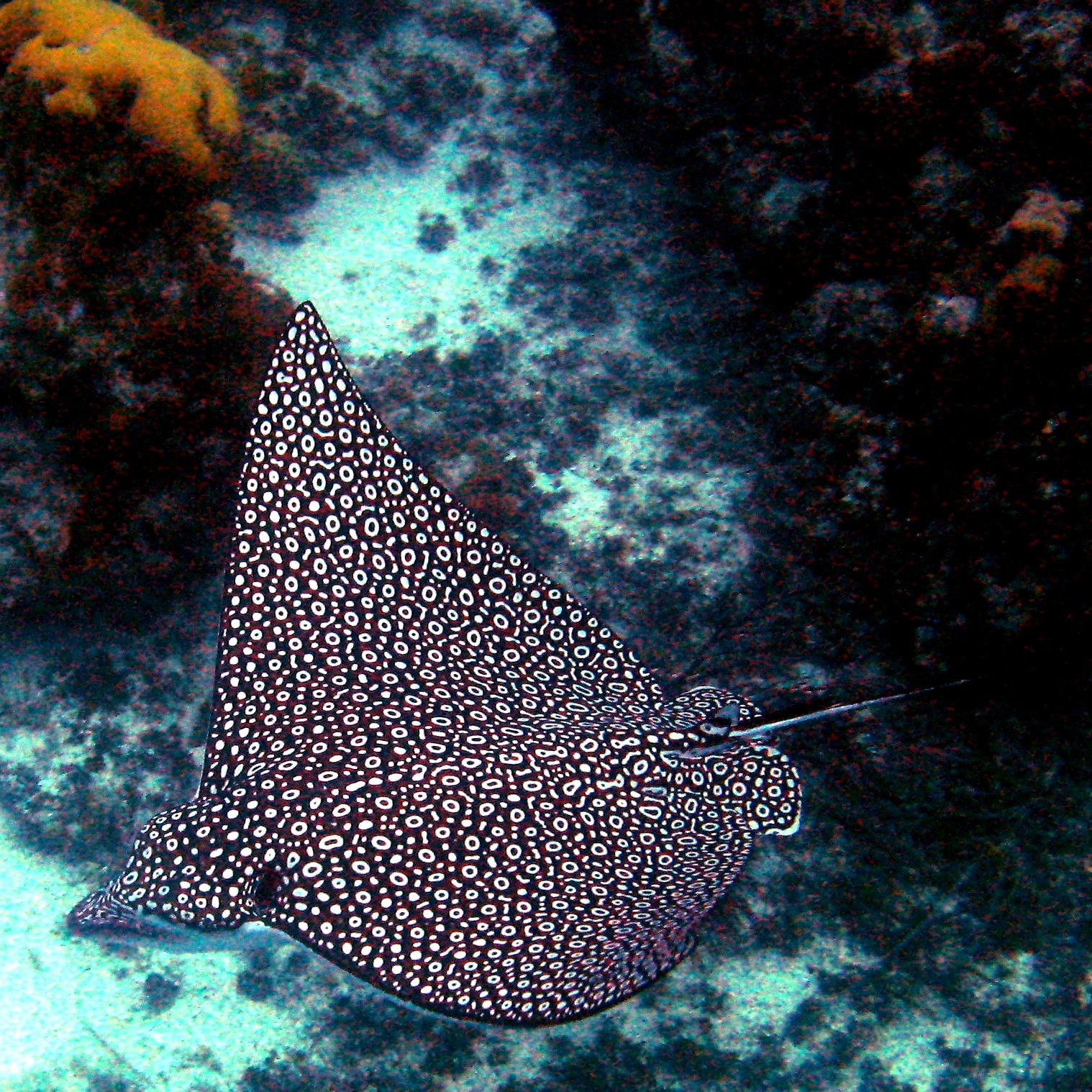
The spotted eagle ray is an elasmobranch of incomparable beauty and impeccable hydrodynamic design. Its markedly rhomboidal body disc is considerably wider than it is long, with sharply angled pectoral fins that resemble the diving wings of a falcon. Its dorsal surface features spectacular pigmentation: a dark background varying between deep black, midnight blue, and coppery brown, profusely constellated with hundreds of white or yellowish rings, ocelli, and spots. This intricate pattern, resembling a starry sky, is unique to each individual and provides effective disruptive camouflage when viewed from above. The belly is entirely white to blend with the surface light when stalked from the depths. Anatomically, it stands out for a distinctive, elongated, and flattened snout resembling a duck's bill (rostrum), which is highly flexible and equipped with high-precision electroreceptors. Its tail, which can measure up to three times its body length, is extremely slender and whip-like. At the base of this long tail, hidden just behind a small dorsal fin, it houses between one and six serrated, venomous spines—a defensive arsenal used exclusively when cornered or threatened with death.

Added by

Anonymous Curator

Reviewed by

Under Review

Last modified by

Julia Trouin

TaxonomyBiological classification ranks placing this species within the tree of life, from Kingdom down to Genus.

PhylumRank below Kingdom. Groups organisms sharing a fundamental body plan (e.g., Chordata = vertebrates and some invertebrates).Chordata
ClassRank below Phylum. Subdivides by structural traits (e.g., Mammalia, Aves, Reptilia, Insecta).Elasmobranchii
OrderRank below Class. Groups related families sharing common ancestry (e.g., Carnivora, Primates).Myliobatiformes
FamilyRank below Order. Groups closely related genera (e.g., Felidae = cats, Canidae = dogs).Aetobatidae
GenusRank just above Species. The first word in the two-part binomial scientific name.Aetobatus
Taxonomic AuthorityThe scientist who first formally described and published this species, followed by the year of publication.(Euphrasen, 1790)
Record Completeness
62%
Coming soon

Ecology & StatusHow this species lives: habitat preferences, diet, behavior, population status, and role in its ecosystem.

OriginWhether the species is native (evolved here), endemic (found only here), or introduced by human activity.

Native

Population TrendDirection of change in population size over time: increasing, stable, decreasing, or unknown.

Decreasing

Breeding SeasonTime of year when this species typically reproduces or flowers.

Summer

Trophic RolePosition in the food chain: producer, herbivore, carnivore, omnivore, decomposer, or parasite.

Carnivore

Recent SightingsWhether this species has been observed in the wild in Costa Rica within recent years.

Yes

Habitat SummaryOverview of the specific ecosystems and environments where this species is found in Costa Rica. Multi-lang

It displays a marked amphibious nature between the benthic and pelagic worlds. It has a circumglobal distribution in warm tropical and temperate waters, frequently venturing into enclosed bays, brackish estuaries, and seagrass meadows. It exhibits a critical affinity for structurally complex coral reefs, such as those adorning the Caribbean coast of Costa Rica or the steep volcanic walls of Cocos Island and the Golfo Dulce in the Pacific. While commonly observed patrolling shallow sand flats at less than 30 meters in search of buried prey, they are supremely agile divers, capable of abruptly descending to over 80 meters in the open ocean to navigate currents or evade large predators.

BehaviourDaily activity patterns, movement, territory use, foraging style, and seasonal behavioral changes. Multi-lang

Its behavioral ecology unfolds as a delicate balance between absolute solitude and highly synchronized sociability. Although often observed wandering as solitary benthic predators or in small, silent formations of two to five individuals, during changing tides or periods of inter-reef migration, they congregate in massive nomadic squadrons that can exceed 200 individuals. Much like the coordinated flight of a flock of migratory birds, these massive schools flow in unison, providing them with a formidable defense against the fierce ambushes of the great hammerhead shark (Sphyrna mokarran) and the swift silky shark, their sworn predators on oceanic coral shelves.

Social ActivitySocial structure: whether the species is solitary, paired, or colonial; hierarchy and communication. Multi-lang

Highly gregarious and socially structured; forms formidable choreographed schools (squadrons) for migration, defense, and collaborative foraging in strong currents, although they do not hesitate to hunt isolated in shallow bays.

Feeding GuildWhat the species eats, how it forages or hunts, and its role as a consumer in the food web. Multi-lang

Benthopelagic carnivore; strict specialist in durophagy (crusher of hard-shelled invertebrates).

Trophic Chain DetailsSpecific interactions in local food webs: prey species, predators, competitors, and scavengers. Multi-lang

Positioned as a critical meso-predator, the eagle ray rules population control over substrate invertebrates. Its heavily durophagous diet prevents the exponential growth and collapse of dense populations of bivalves, benthic gastropods (such as the queen conch), and tough decapod crustaceans. In the reverse cycle of life, adult eagle rays pay a steep biological toll, serving as a primary caloric source for colossal great hammerhead sharks and huge tiger sharks, who actively hunt the rays by amputating their pectoral fins to immobilize them mid-marine flight.

Reproductive BehaviourMating strategies, courtship displays, nesting or spawning behavior, and parental care. Multi-lang

The biological mating cycle is violent, demanding, and spectacular. Multiple males form a rapid pursuit train following a mature female, attempting to exhaust her. To ensure copulation, a victorious male must bite and tenaciously grip the female's pectoral fin with his teeth (an aggressive maneuver that frequently leaves deep, lifelong scars), managing to flip her body to align belly-to-belly and insert his mixopterygium (clasper). They exhibit aplacental viviparity (ovoviviparity) supplemented with histotrophy: embryos hatch from their eggs inside the mother, and once the original yolk sac is depleted, they feed voraciously on a rich uterine milk secreted by the uterine walls. After a heavy and uninterrupted gestational lethargy lasting an absolute 12 months, the matriarchy seeks highly protected estuaries to give birth. Litters are extremely low (k-strategists), bearing a minimal 1 to 4 independent live pups, whose fragile venomous whips are born coated by a protective cartilaginous sheath to prevent tearing the maternal uterine tract.

Physical Measures

Length (cm)

17.0 - 330.0 cm

Weight (Grams)

1.00 kg - 230.00 kg

Offspring per cycleTypical number of young (live births, eggs, or seeds) produced by one adult in a single reproductive event or breeding season.1 - 4
Sexual DimorphismObservable physical differences between males and females of the same species (e.g., size, coloration, features).Yes

Lifespan

Sexual MaturityAge at which the individual becomes capable of reproducing for the first time.

4 - 6 Years

Gestation / IncubationDuration from fertilization to birth (mammals) or to hatching (egg-laying species).

12

Lifespan EstimatedExpected duration of life from birth to natural death under wild conditions.
Males15 - 20 Years
Females15 - 25 Years

Sexual DimorphismPhysical differences in size, coloration, or morphology between males and females of this species.

Males Multi-lang

Males reach sexual maturity at notably smaller sizes. To the naked eye, sexual dimorphism is unfailingly diagnosed by evaluating the ventral cloacal anatomy, where males exhibit a pair of robust, ossified pelvic mixopterygia (claspers). These cylindrical reproductive extensions, employed for the transfer of spermatophores during aggressive moving copulation, clearly protrude from the inner margin of the fins.

Females Multi-lang

The matriarchs of the species genetically dominate the size hierarchy, developing body discs and muscular thicknesses of drastically superior proportions to manage housing the complex ovoviviparous development. Their pelvic belly is completely smooth. Furthermore, their anatomy often exhibits dark, traumatic scars on the flanks of the pectoral fins, war trophies forcibly inflicted by males during the tenacious reproductive siege.

Evolutionary AdaptationsInherited traits and behaviors that improve the species' survival and reproduction in its specific environment. Multi-lang

Durophagous Grinder: High-Pressure Dental Plates (Durophagy): Unlike filter-feeding mantas or sharp-toothed sharks, the eagle ray possesses V-shaped dental plates anchored to extremely muscular jaws. This powerful crushing machinery (durophagy) allows it to effortlessly shatter the impenetrable calcareous shells of clams, thick sea conchs, and the robust carapaces of crabs and hermit crabs. An intricate series of oral papillae skillfully separates the shell fragments from the pure meat, spitting the rubble out through the gills and swallowing only the nutritious bounty.
Electromagnetic Excavation (Benthic Foraging): It utilizes its shovel-shaped snout (rostrum) endowed with electrosensitive pores (ampullae of Lorenzini) as a high-fidelity biological metal detector. Upon capturing the faint electrical pulse of a buried bivalve, the ray uses its snout as an excavation tool, violently rooting through the sand while flapping its pectoral fins to create miniature suction tornadoes, forcibly unearthing the prey.

Main ThreatsDocumented pressures reducing the population: habitat loss, hunting, disease, climate change, and invasive species. Multi-lang

Devastation by Gillnets and Trawl Fishing: Its Endangered (EN) classification is the direct result of industrial and artisanal overfishing. Due to its preference for coastal zones and estuarine channels, they perish en masse by tragically becoming entangled in miles-long gillnets, purse seine lines, and as bycatch in destructive benthic shrimp trawls, from which they are rarely released alive.
Coastal Habitat Degradation: The incessant architectural destruction of coastal mangroves and the progressive asphyxiation of coral reefs due to agricultural runoff silently eliminate the delicate ecosystems where they pup and where the benthic invertebrate populations that make up 90% of their indispensable diet thrive.

Interesting FactsSurprising or notable facts that highlight what makes this species unique or ecologically important. Multi-lang

Explosive Aerial Acrobatics (Breaching): The spotted eagle ray is world-famous for detonating sudden and spectacular acrobatic leaps out of the water (breaching). They can catapult themselves several meters into the air consecutively. Biology suggests that these violent impacts against the surface are used as a physical shock technique to dislodge pesky parasitic remoras or to desperately flee a surprise ambush by a mega-predator.
Crater Architects: When hunting relentlessly and obsessively, excavating the sandy plains of the reefs in search of hidden conchs and clams, a small school of these rays leaves behind a seabed peppered with deep feeding craters, drastically altering the microtopography of the benthic substrate.