
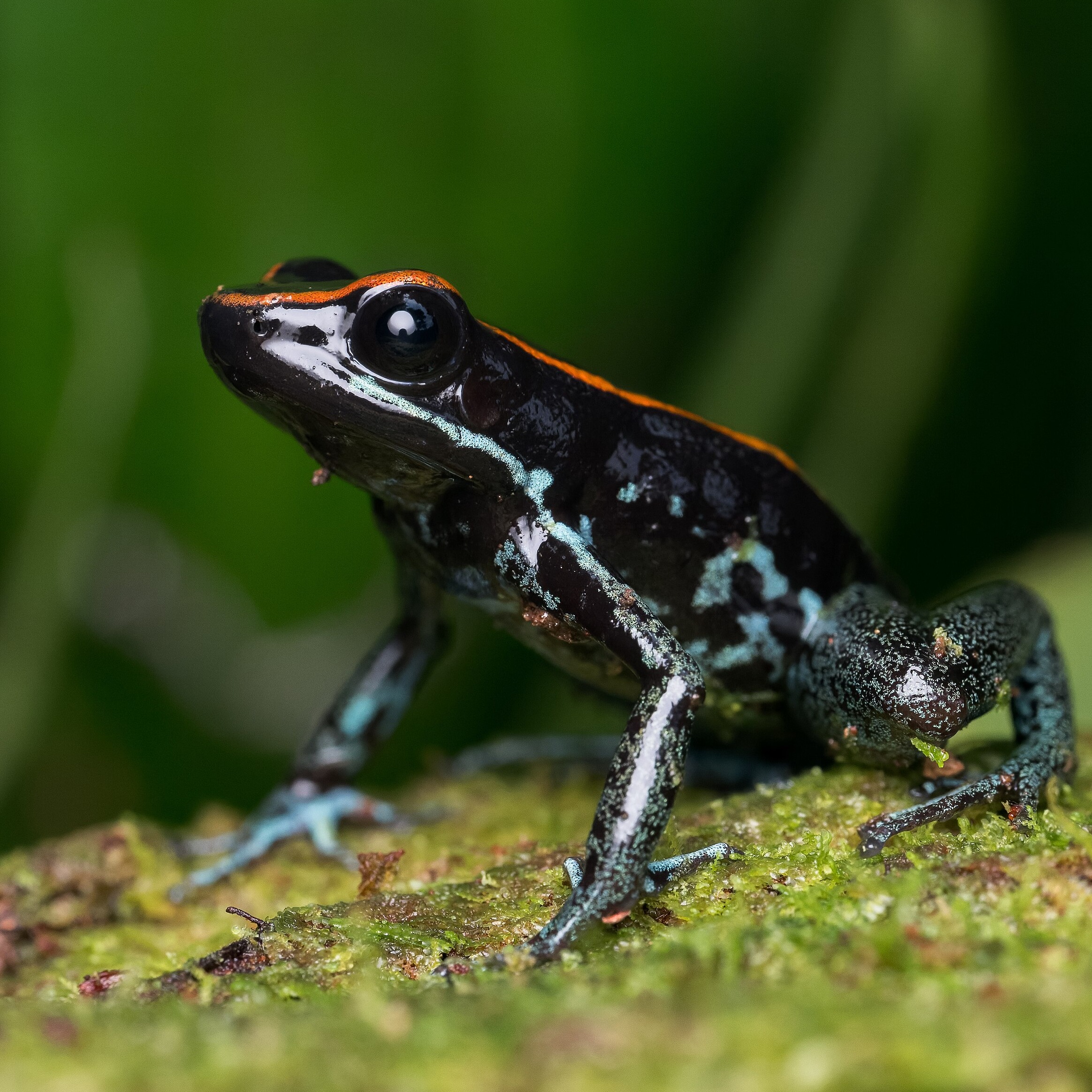
Phyllobates vittatus
Golfo Dulce Poison Frog
(Cope, 1893)
Added by
Anonymous Curator
Reviewed by
Under Review
Last modified by
Julia Trouin
TaxonomyBiological classification ranks placing this species within the tree of life, from Kingdom down to Genus.
Ecology & StatusHow this species lives: habitat preferences, diet, behavior, population status, and role in its ecosystem.
OriginWhether the species is native (evolved here), endemic (found only here), or introduced by human activity.
Native
Population TrendDirection of change in population size over time: increasing, stable, decreasing, or unknown.
Decreasing
Breeding SeasonTime of year when this species typically reproduces or flowers.
Year Round
Trophic RolePosition in the food chain: producer, herbivore, carnivore, omnivore, decomposer, or parasite.
Insectivore
Recent SightingsWhether this species has been observed in the wild in Costa Rica within recent years.
Yes
Habitat SummaryOverview of the specific ecosystems and environments where this species is found in Costa Rica. Multi-lang
The Golfo Dulce poison frog is endemic to an exceptionally narrow geographic strip in the south Pacific of Costa Rica, with a total distribution of less than 5,000 km² — one of the most restricted distributions of any amphibian on the American continent. It inhabits the interior and edges of lowland and premontane tropical moist and very moist forests, between sea level and 500 meters altitude, on the Osa Peninsula, the surroundings of the Golfo Dulce, the Esquinas River basin, and the forested foothills between Golfito and Palmar Norte. It requires continuous forests with high ambient humidity (above 80%), deep, moist leaf litter on the ground, slow or static water bodies — streams, pools, bromeliads with water — for larval development, and the presence of specific prey: ants of the tribe Solenopsidini (especially the genus Brachymyrmex) and melyrid beetles (Choresine) whose secretions are the source of the batrachotoxin precursors that the frog biosynthesize. It is practically absent from young secondary forests, grasslands, agricultural zones, and fragmented landscapes where its specific prey are scarce. It is concentrated mainly in the primary forests of Corcovado National Park, Isla del Caño Biological Reserve, and the private forest areas of the Osa.BehaviourDaily activity patterns, movement, territory use, foraging style, and seasonal behavioral changes. Multi-lang
The Golfo Dulce poison frog is diurnal and markedly terrestrial, spending most of its active time on the humid forest floor walking through leaf litter in search of prey. Unlike other tropical frogs, it does not use the ambush strategy from perches: it actively walks through ground vegetation, exploring crevices under fallen logs, rock edges, and the base of trees in an 'active hunting' foraging style characteristic of dendrobatids. Its aposematism makes it completely diurnal and entirely lacking in cryptic behavior: it moves in full daylight with deliberate and visible movements, without attempting to hide from potential predators. It is moderately territorial: males defend small calling territories of 1-5 m² during the breeding season through vocalizations and display behaviors, but rarely escalate to physical contact. Its vocalization is a short, repetitive trill audible at 5-15 meters, emitted from the ground or from low perches of 10-30 cm. Daily activity is concentrated between 7:00 and 15:00 hours; during extreme midday heat in summer it may temporarily retire to the leaf litter.Social ActivitySocial structure: whether the species is solitary, paired, or colonial; hierarchy and communication. Multi-lang
The Golfo Dulce poison frog is primarily solitary outside the breeding season, with individuals maintaining individual home ranges of 5 to 50 m² on the forest floor. The only regular social contacts are territorial encounters between males during the breeding season — which include warning vocalizations, postural displays with limb extension, and rarely physical fights with body pushing — and courtship between males and females. Chemical communication via cutaneous secretions is probable but has not been studied in depth in this species. Females initiate and control most of the courtship behavior actively, visiting the territories of singing males and selecting the male they will mate with based on territory quality, call intensity, and probably the male's physical characteristics. The male-offspring bond during larval transport is the longest documented social contact for the species.Feeding GuildWhat the species eats, how it forages or hunts, and its role as a consumer in the food web. Multi-lang
Terrestrial insectivore-myriapodivore specialized in high-density microground prey. Hunting is active: the frog walks slowly inspecting the leaf litter, detects prey visually and via lingual chemoreception, and captures with the extroflexible adhesive tongue in a movement of less than 50 milliseconds. It consumes exclusively terrestrial micro-invertebrates of 1-10 mm: wingless ants of the tribes Solenopsidini and Attini, melyrid beetles (Choresine), minute staphylinids, oribatid mites, springtails, and winged termites. Maximum prey size is limited by the oral aperture — approximately 8-10 mm prey length. It consumes between 15 and 40 individual prey per activity day. The documented preference for BTX precursor-bearing prey suggests active selection by specialized oral chemoreceptors. It does not store food.Trophic Chain DetailsSpecific interactions in local food webs: prey species, predators, competitors, and scavengers. Multi-lang
Specialized secondary consumer of micro-arthropods of the moist forest floor. The diet consists exclusively of small invertebrates captured on the ground: primarily ants of the tribes Solenopsidini and Attini (Brachymyrmex, Solenopsis, small Pheidole), melyrid beetles of the genus Choresine and other small beetles (Staphylinidae, Corylophidae), oribatid mites, springtails, winged termites, and other leaf litter arthropods 1-10 mm in length. It does not consume aquatic prey, vertebrates, or carrion. The selection of BTX precursor-rich prey — especially Choresine — appears to be non-random, suggesting the existence of specialized chemoreceptors in the oral mucosa that allow actively identifying and preferring these prey among all available on the ground. Its main predators are the snake Leimadophis epinephelus — the only Neotropical snake documented as relatively resistant to BTX — snakes of the genus Erythrolamprus, and ground-foraging insectivorous birds with little prior experience with dendrobatids. Immature subadult individuals are more vulnerable than full adults with maximum BTX load.Reproductive BehaviourMating strategies, courtship displays, nesting or spawning behavior, and parental care. Multi-lang
Reproduction in Phyllobates vittatus can occur year-round in the Golfo Dulce, with a notable increase in reproductive activity during the rainy season (May-November) when ambient humidity is at maximum and the availability of water bodies for larval development is greatest. The reproductive process begins with the male's call: it emits repetitive trills from low perches or from the ground to attract females. When a female approaches, the male performs tactile courtship — rubbing the female's back with the snout, gentle pushes — which can last hours. The female deposits 4 to 10 large (3-4 mm diameter), gelatinous, yellowish-white eggs on the moist forest floor leaf litter, generally under a fallen log, a large leaf, or a rock. The male fertilizes the eggs externally (external fertilization, characteristic of anurans) immediately after laying. The male exclusively guards the clutch during the 14-18 day incubation period, keeping it moist with urine and periodically turning it. Upon hatching, the tadpoles actively adhere to the male's back, who transports them individually or in batches to the nearest suitable phytotelma — preferably a pool of clean water in a bromeliad axil, a hollow in a log, or a temporary pool on rock. Complete metamorphosis takes 45-75 days. Metamorphosed juveniles are completely functional and self-sufficient.Physical Measures
Length (cm)
2.5 - 3.8 cm
Weight (Grams)
1 g - 3 g
Lifespan
Sexual MaturityAge at which the individual becomes capable of reproducing for the first time.
1 - 2 Years
Gestation / IncubationDuration from fertilization to birth (mammals) or to hatching (egg-laying species).
14 - 18