AnimaliaIUCN ENIn Progress Recent Sighting
Phyllobates vittatus
Golfo Dulce Poison Frog
(Cope, 1893)
Detailed Texts Multi-lang
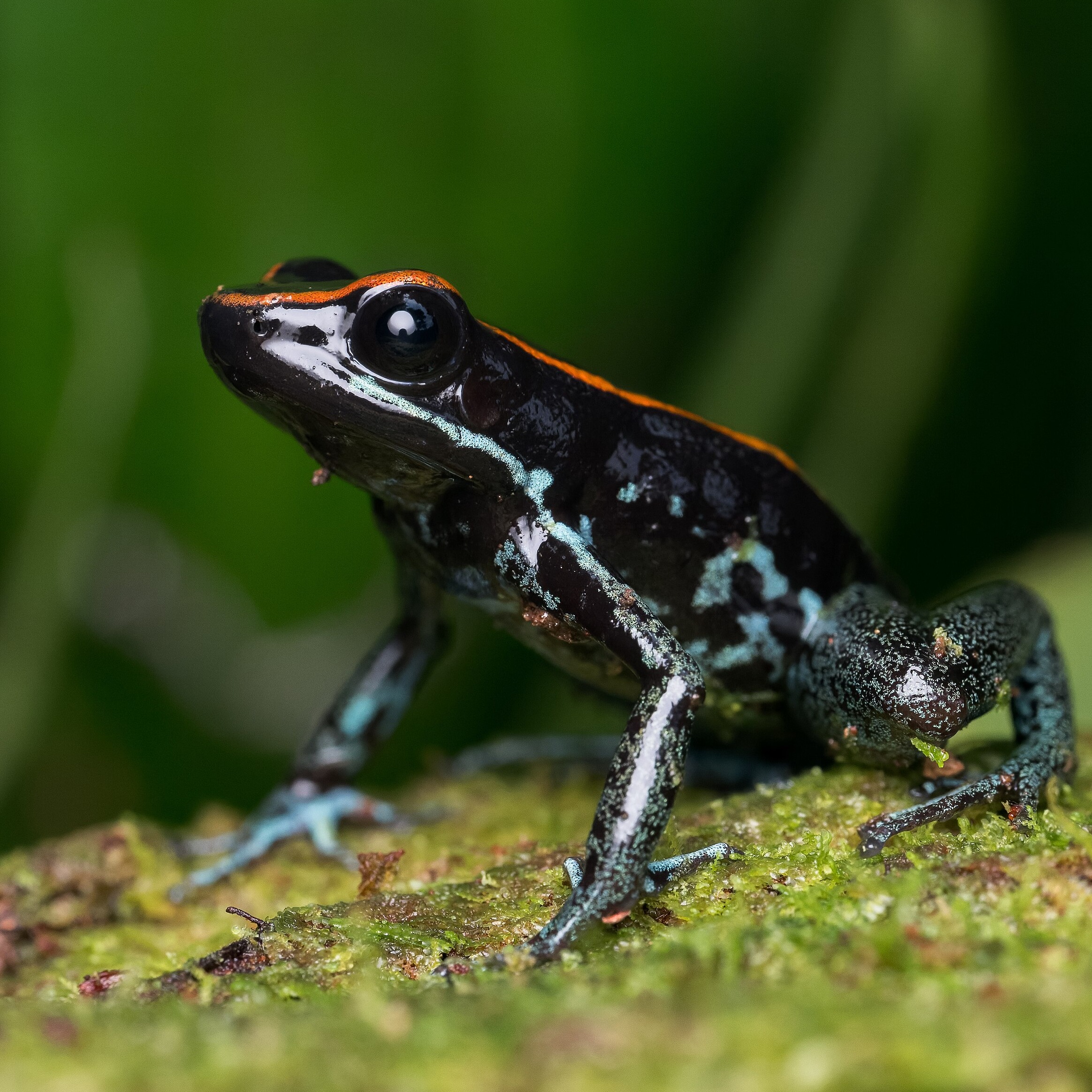
The Golfo Dulce poison frog (Phyllobates vittatus) is one of the most exclusive herpetological jewels of Costa Rica: an amphibian of the family Dendrobatidae endemic to an exceptionally restricted geographic strip in the extreme south of the Costa Rican Pacific. It is a small, robust frog — 2.5 to 3.8 cm snout-vent length — with smooth, bright, completely waterproof dorsal skin thanks to a layer of waxy mucus with bacteriostatic properties. The coloration pattern is of extraordinary vividness and contrast: the body is brilliant black with two longitudinal dorsal stripes of intense orange to golden-yellow running along the back from the tip of the snout to the end of the trunk, and a ventrolateral lateral stripe of paler or whitish tone. The limbs are black with small orange spots or mottling. The belly is bluish-black with irregular mottling. The eyes are large, prominent, and metallic black with a horizontal pupil. The fingers are elongated with small but functional adhesive discs at the tip. The scientific name vittatus — from Latin 'vittae', ribbon or stripe — refers directly to the characteristic longitudinal stripes that distinguish this species from the rest of the genus Phyllobates. Together with Phyllobates terribilis from Colombia and Phyllobates bicolor and aurotaenia from the Chocó, it is one of only four dendrobatids in the world capable of producing batrachotoxins (BTX), the most toxic steroidal alkaloids known in nature.
Added by
Anonymous Curator
Reviewed by
Under Review
Last modified by
Julia Trouin
Taxonomy
PhylumChordata
ClassAmphibia
OrderAnura
FamilyDendrobatidae
GenusPhyllobates
Taxonomic Authority(Cope, 1893)
Ecology & Status
Origin
Native
Population Trend
Decreasing
Breeding Season
Year Round
Trophic Role
Insectivore
Recent Sightings
Yes
Habitat Summary Multi-lang
The Golfo Dulce poison frog is endemic to an exceptionally narrow geographic strip in the south Pacific of Costa Rica, with a total distribution of less than 5,000 km² — one of the most restricted distributions of any amphibian on the American continent. It inhabits the interior and edges of lowland and premontane tropical moist and very moist forests, between sea level and 500 meters altitude, on the Osa Peninsula, the surroundings of the Golfo Dulce, the Esquinas River basin, and the forested foothills between Golfito and Palmar Norte. It requires continuous forests with high ambient humidity (above 80%), deep, moist leaf litter on the ground, slow or static water bodies — streams, pools, bromeliads with water — for larval development, and the presence of specific prey: ants of the tribe Solenopsidini (especially the genus Brachymyrmex) and melyrid beetles (Choresine) whose secretions are the source of the batrachotoxin precursors that the frog biosynthesize. It is practically absent from young secondary forests, grasslands, agricultural zones, and fragmented landscapes where its specific prey are scarce. It is concentrated mainly in the primary forests of Corcovado National Park, Isla del Caño Biological Reserve, and the private forest areas of the Osa.Behaviour Multi-lang
The Golfo Dulce poison frog is diurnal and markedly terrestrial, spending most of its active time on the humid forest floor walking through leaf litter in search of prey. Unlike other tropical frogs, it does not use the ambush strategy from perches: it actively walks through ground vegetation, exploring crevices under fallen logs, rock edges, and the base of trees in an 'active hunting' foraging style characteristic of dendrobatids. Its aposematism makes it completely diurnal and entirely lacking in cryptic behavior: it moves in full daylight with deliberate and visible movements, without attempting to hide from potential predators. It is moderately territorial: males defend small calling territories of 1-5 m² during the breeding season through vocalizations and display behaviors, but rarely escalate to physical contact. Its vocalization is a short, repetitive trill audible at 5-15 meters, emitted from the ground or from low perches of 10-30 cm. Daily activity is concentrated between 7:00 and 15:00 hours; during extreme midday heat in summer it may temporarily retire to the leaf litter.Social Activity Multi-lang
The Golfo Dulce poison frog is primarily solitary outside the breeding season, with individuals maintaining individual home ranges of 5 to 50 m² on the forest floor. The only regular social contacts are territorial encounters between males during the breeding season — which include warning vocalizations, postural displays with limb extension, and rarely physical fights with body pushing — and courtship between males and females. Chemical communication via cutaneous secretions is probable but has not been studied in depth in this species. Females initiate and control most of the courtship behavior actively, visiting the territories of singing males and selecting the male they will mate with based on territory quality, call intensity, and probably the male's physical characteristics. The male-offspring bond during larval transport is the longest documented social contact for the species.Feeding Guild Multi-lang
Terrestrial insectivore-myriapodivore specialized in high-density microground prey. Hunting is active: the frog walks slowly inspecting the leaf litter, detects prey visually and via lingual chemoreception, and captures with the extroflexible adhesive tongue in a movement of less than 50 milliseconds. It consumes exclusively terrestrial micro-invertebrates of 1-10 mm: wingless ants of the tribes Solenopsidini and Attini, melyrid beetles (Choresine), minute staphylinids, oribatid mites, springtails, and winged termites. Maximum prey size is limited by the oral aperture — approximately 8-10 mm prey length. It consumes between 15 and 40 individual prey per activity day. The documented preference for BTX precursor-bearing prey suggests active selection by specialized oral chemoreceptors. It does not store food.Trophic Chain Details Multi-lang
Specialized secondary consumer of micro-arthropods of the moist forest floor. The diet consists exclusively of small invertebrates captured on the ground: primarily ants of the tribes Solenopsidini and Attini (Brachymyrmex, Solenopsis, small Pheidole), melyrid beetles of the genus Choresine and other small beetles (Staphylinidae, Corylophidae), oribatid mites, springtails, winged termites, and other leaf litter arthropods 1-10 mm in length. It does not consume aquatic prey, vertebrates, or carrion. The selection of BTX precursor-rich prey — especially Choresine — appears to be non-random, suggesting the existence of specialized chemoreceptors in the oral mucosa that allow actively identifying and preferring these prey among all available on the ground. Its main predators are the snake Leimadophis epinephelus — the only Neotropical snake documented as relatively resistant to BTX — snakes of the genus Erythrolamprus, and ground-foraging insectivorous birds with little prior experience with dendrobatids. Immature subadult individuals are more vulnerable than full adults with maximum BTX load.Reproductive Behaviour Multi-lang
Reproduction in Phyllobates vittatus can occur year-round in the Golfo Dulce, with a notable increase in reproductive activity during the rainy season (May-November) when ambient humidity is at maximum and the availability of water bodies for larval development is greatest. The reproductive process begins with the male's call: it emits repetitive trills from low perches or from the ground to attract females. When a female approaches, the male performs tactile courtship — rubbing the female's back with the snout, gentle pushes — which can last hours. The female deposits 4 to 10 large (3-4 mm diameter), gelatinous, yellowish-white eggs on the moist forest floor leaf litter, generally under a fallen log, a large leaf, or a rock. The male fertilizes the eggs externally (external fertilization, characteristic of anurans) immediately after laying. The male exclusively guards the clutch during the 14-18 day incubation period, keeping it moist with urine and periodically turning it. Upon hatching, the tadpoles actively adhere to the male's back, who transports them individually or in batches to the nearest suitable phytotelma — preferably a pool of clean water in a bromeliad axil, a hollow in a log, or a temporary pool on rock. Complete metamorphosis takes 45-75 days. Metamorphosed juveniles are completely functional and self-sufficient.Physical Measures
Length (cm)
2.5 - 3.8 cm
Weight (Grams)
1 g - 3 g
Offspring per cycle4 - 10
Sexual DimorphismYes
Lifespan
Sexual Maturity
1 - 2 Years
Gestation / Incubation
14 - 18
Lifespan Estimated
Males5 - 10 Years
Females5 - 10 Years
Sexual Dimorphism
Males Multi-lang
The adult male of Phyllobates vittatus is slightly smaller than the female on average — a 3-8% difference in snout-vent length — though individual overlap is considerable. The male possesses internal vocal sacs that produce the territorial and courtship trill, absent in the female; during active vocalization, the male's throat shows a visible rhythmic pulsation. During the breeding season, the male develops nuptial pads of thickened keratin on the fingers of the front feet — especially the first and second finger — that facilitate gripping the female during axillary amplexus. Coloration is identical to the female's. Sex in the field can only be reliably determined by behavior (vocalization) or biometrics with capture.
Females Multi-lang
The adult female is slightly larger than the male on average — a 3-8% difference in snout-vent length — and has a notably more rounded abdomen during the breeding season when the ovaries are loaded. It lacks vocal sacs (unable to produce the male calling trill) and nuptial pads on the fingers. Active courtship initiator: the female seeks and visits males in calling, not vice versa. During the breeding season, the posterior ventral region may appear distended and larger in volume due to the presence of mature eggs in the ovaries. Outside the breeding season it is morphologically indistinguishable from the male to the naked eye without biometrics.
Evolutionary Adaptations Multi-lang
Production of batrachotoxins (BTX) through dietary alkaloid sequestration and biotransformation: the Golfo Dulce poison frog is one of only four amphibians on the planet capable of producing batrachotoxins in its skin, the most toxic steroidal alkaloids known in nature — with an LD50 in mice of 2 µg/kg, approximately 15 times more toxic than the tetrodotoxin of puffer fish. Crucially, the frog does not synthesize these toxins de novo: it sequesters them from the defense glands of melyrid beetles of the genus Choresine and from ants of the genus Brachymyrmex consumed in its diet, and biotransforms them into BTX via a specialized enzymatic system in its liver. Captive-raised frogs without access to these prey are completely non-toxic, demonstrating that toxicity is a function of diet, not genotype.
High-honesty aposematism: the black chromatic pattern with brilliant orange-yellow stripes is an aposematic signal — visual warning of toxicity — that has been shaped by millions of years of coevolution with visual predators (birds, snakes, mammals) that have learned to associate this color combination with highly aversive consequences. The honesty of the signal — which corresponds to real and lethal toxins, not an imitation — means that predators surviving a first contact immediately learn to avoid individuals with this pattern, protecting both the toxic individual and all individuals of the same pattern in the same area. This aversive learning by predators is culturally transmitted across generations of birds and snakes.
Biparental parental care with active larval transport: the male guards eggs deposited on the forest floor leaf litter during 14-18 days of incubation, keeping them moist with urine and turning them regularly to prevent fungal growth. Upon hatching, the tadpoles actively climb onto the male's back — adhering with their mouths to the moist skin — and are transported to a suitable water body for their development. The female actively participates in nest site selection and can feed tadpoles with unfertilized eggs (trophic eggs) in water bodies with limited resources, ensuring the protein contribution necessary for their metamorphosis.
Permeable skin with active hydration control via 'pelvic patch': like all amphibians, the Golfo Dulce poison frog lacks the cutaneous impermeability of reptiles and loses water by diffusion through the skin. To compensate for this loss, it possesses an extremely vascularized skin zone in the ventral pelvic region — the 'pelvic patch' — that can absorb water directly from moist soil or wet leaf litter through osmotic contact, without the need to drink. This capacity for cutaneous water reabsorption allows it to recover 30-40% of its body mass in water in less than 30 minutes when dehydrated, simply by placing the abdomen on a moist surface.
Main Threats Multi-lang
Loss and fragmentation of primary moist forest of the Osa Peninsula: historical deforestation for livestock, agriculture, timber exploitation, and tourist-real estate development has reduced the primary forest cover that existed in the Osa 50 years ago to less than 40%. The Golfo Dulce poison frog requires mature forests with deep leaf litter, high humidity, and dense populations of its specific prey — Choresine beetles and Brachymyrmex ants — which are practically nonexistent in young secondary forests and agricultural landscapes. Habitat fragmentation divides populations into isolated subpopulations with reduced gene flow, accelerating genetic erosion.
Chytridiomycosis (Batrachochytrium dendrobatidis, Bd): the chytrid fungus Batrachochytrium dendrobatidis is the most devastating pathogen for amphibians documented in history — responsible for the extinction of at least 90 amphibian species and the population collapse of more than 500 species in the last four decades. Bd infection interferes with the osmoregulatory function of amphibian skin, causing a cardiac electrolyte collapse that leads to death within 1-4 weeks. Phyllobates vittatus is potentially susceptible to the fungus, although available field studies suggest that the batrachotoxins in its skin may offer some degree of protection against fungal colonization. The fungus is present on the Osa Peninsula and represents a constant threat especially during periods of high humidity.
Illegal collection for the exotic terrarium market: poison frogs of the genus Phyllobates are highly sought after in the international terrarium amphibian market for their spectacular coloration and scientific-popular interest. Illegal extraction of wild individuals for sale in Europe, North America, and Asia represents a direct threat to the already fragmented and small populations of P. vittatus in the Osa. Unlike other dendrobatid species that are widely captive-bred, P. vittatus is difficult to breed in terrariums and captive individuals rarely achieve the toxicity of wild specimens, so demand for wild individuals persists.
Interesting Facts Multi-lang
The batrachotoxin (BTX) produced by Phyllobates vittatus is one of the most potent non-protein poisons known in nature, approximately 15 times more toxic than the tetrodotoxin of puffer fish and 4 times more toxic than curare. The LD50 in mice is 2 µg/kg body weight, meaning that an amount equivalent to the weight of a grain of salt could kill a 70 kg human being if it reached the bloodstream directly. BTX acts by permanently opening voltage-dependent sodium channels in nerve and muscle cells — preventing their closure — which produces continuous tetanic muscle contraction, fatal cardiac arrhythmia, and death by respiratory arrest. The indigenous Emberá of Colombia historically used the BTXs of the related species P. terribilis to poison the tips of their hunting blowgun darts, which is the origin of the name 'poison dart frog'.
The discovery of the dietary source of batrachotoxins in frogs of the genus Phyllobates was a scientific revolution in herpetology and natural chemistry: until 1992 it was assumed that BTXs were synthesized de novo by the frogs. Herpetologist John Daly of the National Institute of Health demonstrated that captive-raised frogs on diets free of melyrid beetles and Solenopsidine ants completely lacked BTX in their skin, while wild individuals accumulated them. Subsequent tracking identified beetles of the genus Choresine (Coleoptera: Melyridae) as the primary source of BTX precursors — beetles that in turn obtain them from symbiotic bacteria — in one of the most documented examples of 'dietary pharmacology' in vertebrates.
Phyllobates vittatus is endemic to one of the areas of greatest biodiversity and endemic species concentration in the entire Western Hemisphere: the Osa Peninsula and the Golfo Dulce form part of the so-called 'Osa Biological Corridor', recognized by the National Geographic Society as one of the most important nature destinations in the world. The historical isolation of the Osa — a peninsula separated from the main mountain ranges by the Golfo Dulce and the Sierpe River depression — allowed the differentiation of numerous endemic species, with P. vittatus being one of the most emblematic. The species has become a charismatic indicator of the conservation status of Osa forests: its presence or absence in a forest fragment is a standard metric in biodiversity monitoring programs of Costa Rica's SINAC and CITES.
The batrachotoxins of P. vittatus have inspired decades of pharmacological research due to their highly specific mechanism of action on voltage-dependent sodium channels, molecular structures involved in diseases such as epilepsy, cardiac arrhythmias, chronic neuropathic pain, and some forms of muscular paralysis. Lower-toxicity BTX synthetic analogues are currently standard laboratory tools in molecular neuroscience for studying sodium channel function. Natural BTX from Phyllobates remains under investigation for the development of next-generation analgesics, as its ability to block nociceptive pain transmission at sublethal doses makes it a candidate of interest for chronic pain pharmacology.